Lee, Takaichi: “Strategic Communication Between Korea and Japan Is Important” Ahead of U.S.-China-Russia Talks [ASEAN+3 Summit]
- Input
- 2026-11-17 22:00:00
- Updated
- 2026-11-17 22:00:00
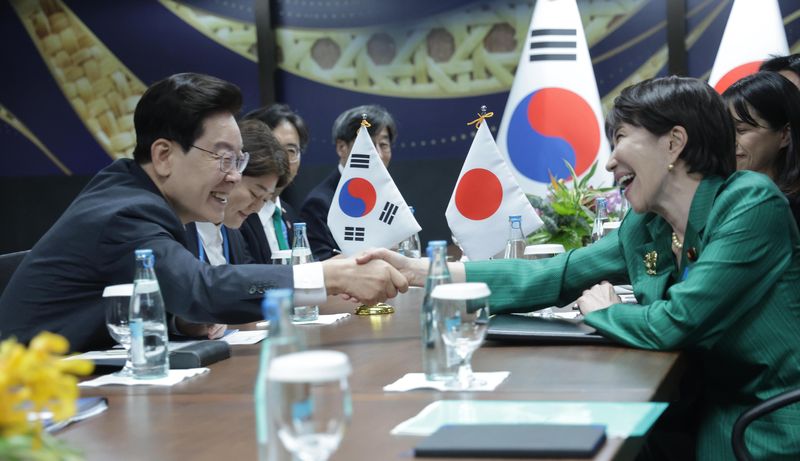
In his opening remarks at the summit with Prime Minister TAKAICHI, President Lee said, “People-to-people exchanges between our countries continue to expand, economic cooperation continues to grow, and we are also getting a lot of help on security issues.” He added, “You invited me for January next year, and I am truly grateful that you invited me to such a wonderful place,” and said, “I will gladly go and meet our prime minister.”
Earlier, Prime Minister TAKAICHI said, “I believe the importance of Japan-Korea relations is growing as the international situation becomes increasingly difficult,” adding, “I hope we can continue our shuttle diplomacy and further develop relations between our two countries.”
President Lee and Prime Minister TAKAICHI met on the 17th, about six months after their shuttle diplomacy, during which they traveled to each other’s hometowns—Nara Prefecture, Japan, in January and Andong, North Gyeongsang Province, in May. It was the seventh Korea-Japan summit since Lee took office and his fourth summit with TAKAICHI.
The meeting drew attention because U.S. President Donald Trump, Chinese President Xi Jinping and Russian President Vladimir Putin are to meet on the 19th in Shenzhen, China, on the sidelines of the Asia-Pacific Economic Cooperation (APEC) summit. This will be the first time the U.S., Chinese and Russian leaders have held a separate trilateral summit. In South Korea, concerns have been raised that North Korea’s nuclear program and Korean Peninsula security could be discussed at a meeting in which South Korea does not participate. This is why the talks have been dubbed a “Second Yalta,” after the 1945 Yalta Conference, where U.S., British and Soviet Union leaders discussed the postwar order.
In response to a question about how the government would respond to the U.S.-China-Russia summit, the Cheong Wa Dae spokesperson’s office said, “The government is closely monitoring related developments and continuing close communication and consultations with the countries concerned, in line with its consistent position that South Korea’s position and interests must be fully reflected in matters directly related to its national interests, including issues concerning the Korean Peninsula.”
The situation on the Korean Peninsula is also on the agenda for the China-Russia bilateral meeting scheduled for the 18th, ahead of the trilateral summit. The Russian Kremlin said President Xi and President Putin plan to discuss Ukraine and the situation on the Korean Peninsula. At the White House on the 16th (local time), President Trump said he might meet North Korean leader Kim during his visit to China, adding that whether Kim visits China is up to President Xi. It remains unclear whether the North Korean and U.S. leaders will meet or whether the Korean Peninsula issue will also be discussed at the U.S.-China-Russia trilateral summit.
According to some foreign media reports, the Kremlin said President Putin would meet President Lee Jae-myung during the APEC summit. It added that, if both sides deem it necessary, they may look for a place to have a brief conversation.
President Trump arrived in Manila that day and attended an ASEAN-U.S. special summit and dinner hosted by Philippine President Ferdinand “Bongbong” Marcos Jr. and his spouse. President Lee also attended the same dinner that day.
On economic issues between South Korea and Japan, the two countries agreed that they are important partners in supply chains and energy security amid an energy crisis triggered by developments in the Middle East, and decided to further strengthen related cooperation. To address energy supply uncertainty stemming from the situation in the Middle East at the time, the two leaders agreed to expand cooperation on liquefied natural gas (LNG) and strengthen information sharing on crude oil supply and stockpiling. They also agreed to broaden the scope of cooperation based on the Korea-Japan Supply Chain Partnership signed in March.
Earlier that morning, President Lee emphasized Korea-China-Japan cooperation at the ASEAN+3 (Korea-China-Japan) summit. Referring to the resolve of former South Korean President Kim Dae-jung, former Chinese Premier Zhu Rongji and former Japanese Prime Minister Keizo Obuchi, who took the first steps toward Korea-China-Japan cooperation in Manila in 1999, Lee called it “a model we should learn from in an era of multiple crises.”
That afternoon, just before the Korea-Japan summit, President Lee attended the 21st East Asia Summit (EAS) for the first time since taking office. The meeting adopted the “EAS Declaration on Stability and Resumption” and the “EAS Leaders’ Statement on Strengthening Cooperation to Combat Online Scams.”
On the 18th, President Lee will deliver a speech at the APEC CEO Summit in Shenzhen and attend a welcome dinner hosted by President Xi and his spouse. At the APEC summit plenary session on the 19th, he is expected to propose jointly responding to energy supply-chain shocks stemming from the Middle East and cooperating to restore the multilateral trading system.
[email protected] Seong Seok-woo Reporter