“My Eyes Kept Itching and Getting Blurry”... 11 ‘Live Worms’ Removed From Both Eyes of 71-Year-Old Man [Unusual Symptoms]
- Input
- 2026-11-17 19:00:00
- Updated
- 2026-11-17 19:04:43
[Financial News] His eyes kept bothering him. They felt gritty, as if grains of sand were rolling around, and were bloodshot. Even his vision became blurry.
He thought it was common presbyopia, dry eye, or perhaps conjunctivitis. But after enduring it for two months, the 71-year-old man went to an ophthalmologist and, following a microscopic examination, had to face an unbelievable diagnosis.
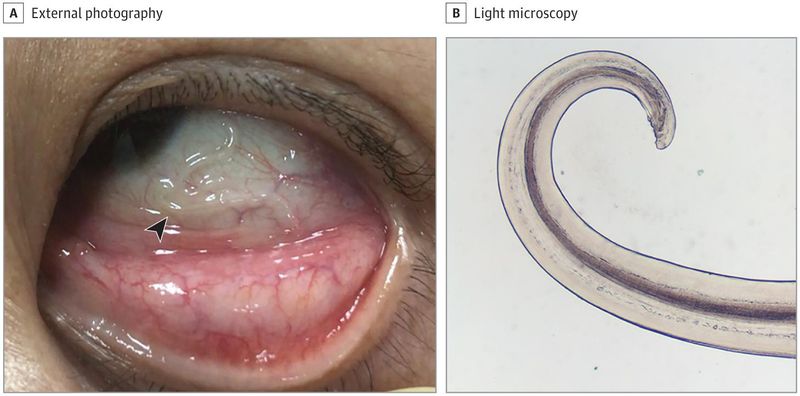
Live, white, threadlike worms were writhing inside his eyelids, in the conjunctival sacs.
Ophthalmologists at Kangwon National University Hospital recently reported to the world, through The New England Journal of Medicine (NEJM), one of the world’s most prestigious medical journals, a shocking case of a rare ocular parasitic infection that occurred in South Korea.
After administering anesthetic eye drops, the medical team set out to hunt down the parasites with fine forceps. They turned the eyelids inside out and carefully extracted the worms one by one, for a total of 11 from both eyes. The longest was 2 cm long.
The identity of these horrifying intruders was Thelazia callipaeda. This nematode mainly parasitizes the eyes of dogs and cats, but it can be transmitted to human eyes by flies such as blowflies and fruit flies, which perch near the eyes and feed on tears.
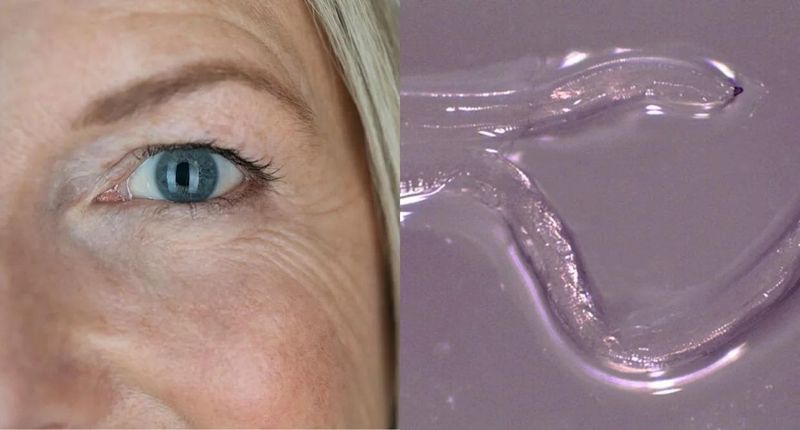
Even more alarming was the condition of the removed worms. Microscopic examination showed that the bodies of the female parasites were packed with eggs and early-stage larvae. Larvae were even seen emerging from them. The parasites had not simply remained in the patient’s eyes: nourished by tears, all 11 had formed a colony and were reproducing.
When Thelazia callipaeda burrows in, it causes severe foreign-body sensation, itching and redness. If left untreated, it can erode the cornea, causing ulcers and visual impairment. Fortunately, all 11 worms were successfully removed from the 71-year-old agricultural worker, whose corneal epithelium had sustained only partial damage. The foreign-body sensation that had bothered him for two months vanished completely, and his vision recovered without incident.
Specialists advise people to take care to keep flies and fruit flies away from their eyes during outdoor activities or farm work in summer and fall. They also urge anyone whose foreign-body sensation and redness do not improve with medication for conjunctivitis or dry eye, and whose discomfort persists, to see an ophthalmologist and get checked for a parasitic infection. It is a horrifying and vivid medical warning: leaving a single fly that feeds on tears unchecked can turn both eyes into a breeding ground for parasites.
[email protected] Jeon Sang-il Reporter