Lee: “We Help Each Other on Security”; Japan’s Takaichi: “Japan-South Korea Ties Are More Important Amid Difficult Times”
- Input
- 2026-11-17 18:49:14
- Updated
- 2026-11-17 18:49:14
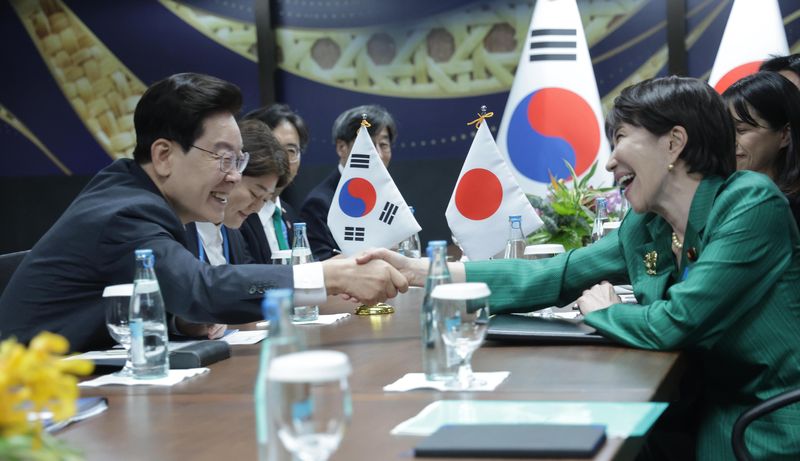
【Financial News, Manila (Philippines) = Reporter Seong Seok-woo】President Lee Jae-myung, who is visiting the Philippines for meetings related to the Association of Southeast Asian Nations (ASEAN), held a summit with Japanese Prime Minister Sanae Takaichi on the 17th (local time).
That day, following shuttle diplomacy in which the two leaders visited each other’s hometowns—in January in Nara Prefecture, Japan, and in May in Andong, Gyeongsangbuk-do—President Lee met Prime Minister Takaichi again for the first time in about six months. It was the seventh South Korea-Japan summit since Lee took office and his fourth summit with Takaichi.
At the start of the summit, President Lee said, “Thank you for making time to meet despite your busy schedule,” adding, “Thanks to our prime minister’s efforts, South Korea-Japan relations are brighter than ever.”
He went on to stress, “As you may have been briefed, favorability between the people of South Korea and Japan has improved considerably, and I think it is almost at an all-time high. People-to-people exchanges continue to expand, economic cooperation continues to grow, and we are also helping each other a great deal on security issues.”
He added, “You invited me for next January, and I am truly grateful that you invited me to such a wonderful place. I will gladly come and meet our prime minister. Thank you.”
Before President Lee’s opening remarks, Prime Minister Takaichi said, “It’s a pleasure to have met you in May in your hometown of Andong and to meet you again here,” adding, “Showing me the scenery of Andong became my best memory.”
She said, “I think the importance of Japan-South Korea relations is growing as the international situation becomes increasingly difficult,” adding, “I hope we can continue to develop relations between our two countries through shuttle diplomacy.”
The Manila meeting drew attention in particular because the South Korean and Japanese leaders met in person ahead of the US-China-Russia summit to be held in Shenzhen. This will be the first time the US, Chinese and Russian leaders have held a separate trilateral summit, and in South Korea, the possibility has been raised that North Korea’s nuclear program and security on the Korean Peninsula could be discussed at a meeting in which South Korea is not participating. This is the backdrop to references to a “Second Yalta,” likening it to the 1945 Yalta Conference, where the leaders of the United States, Britain and the Soviet Union discussed the postwar order.
[email protected] Seong Seok-woo Reporter