Korea-U.S. '800-Trillion-Won AI Alliance' to Hold for Now; Long-Term Roadmap Uncertain [Jensen Huang Risk Hits AI Ecosystem]
- Input
- 2026-11-17 18:35:34
- Updated
- 2026-11-17 18:35:34
■ Close watch on implementation of the '800-trillion-won AI alliance'
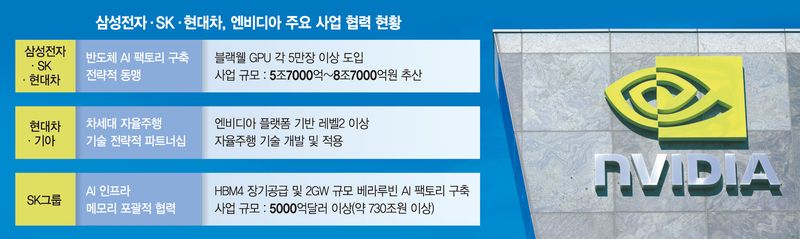
According to business circles on the 17th, the value of major memorandums of understanding (MOUs) and long-term supply partnerships that NVIDIA has signed with Samsung Electronics, SK Group and Hyundai Motor Group since 2024 is estimated at a total of 780 trillion to 800 trillion won.
SK Group has the largest-scale partnership. Last July, it signed a letter of intent (LOI) with NVIDIA for comprehensive cooperation worth $500 billion (about 730 trillion to 740 trillion won), encompassing everything from building AI factories to long-term supplies of next-generation AI memory. The figure reflects projected revenue from long-term supplies of sixth-generation high-bandwidth memory (HBM4) and the value of building out the data-center ecosystem.
Last October, Samsung Electronics formed an alliance with NVIDIA to build semiconductor AI factories using at least 50,000 graphics processing units (GPUs) at its facilities in South Korea and Taylor, Texas. It has since continued to expand cooperation on HBM3E (fifth-generation HBM), HBM4 and foundry services. The specific contract value has not been disclosed, but industry estimates put it at tens of trillions of won. Hyundai Motor Group also agreed last October to secure 50,000 Blackwell GPUs and jointly invest $3 billion (about 4.3 trillion won) in South Korea's physical AI sector. For now, experts expect the short-term impact of a CEO change alone to be limited. Kim Yong-seok, a distinguished professor at Gachon University's College of Semiconductor, said, “Even if a CEO steps down suddenly, formal commitments between companies will be upheld on the basis of trust,” adding, “Cooperation with SK is also necessary for NVIDIA itself, so the likelihood of it falling apart is low.”
■ Mid- to long-term road map and follow-on investment pace are key variables
The key variables are the mid- to long-term product road map and the pace of follow-on investment. NVIDIA typically launches new AI accelerators every year and has steadily advanced HBM specifications and performance. If Colette Kress's tenure as interim CEO is prolonged, or leadership confusion disrupts the launch schedule for next-generation architectures, the possibility that volumes or specifications under mid- to long-term LTAs will be revised cannot be ruled out. Against this backdrop, analysts say Samsung Electronics has considerable scope to spread risk by diversifying its HBM4 and foundry customer base to include non-NVIDIA big tech companies such as AMD and Broadcom. By contrast, SK hynix, whose largest customer is NVIDIA, is watching the new management's investment priorities and moves to reorganize the supply chain even more closely.
Professor Kim Yong-seok said, “In two to three years, the new CEO's capabilities could become a factor,” adding, “Even if NVIDIA's market share declines somewhat as big tech companies expand their in-house chips, demand for HBM itself will remain solid, and the domestic memory industry's advantage will continue.”
Hyundai Motor Group, which is accelerating its transition to future vehicles, is also keeping a close eye on the situation. Last March, Hyundai Motor announced a road map to adopt NVIDIA's DRIVE Hyperion platform, apply Level 2+ autonomous-driving technology to production vehicles in 2028 and pursue the commercialization of robotaxis. Kim Pil-su, a professor in the Department of Automotive Engineering at Daelim University College, said, “If work that used to move ahead swiftly through direct reporting and decision-making under Jensen Huang's leadership has to go through multiple levels of reporting and approval from now on, decision-making could become more difficult.”
A business-circle source said, “Domestic companies and NVIDIA are already closely intertwined through supply contracts worth tens of trillions of won and road maps for core technologies, so former CEO Huang's departure will not immediately lead to the alliance's collapse.” The source added, “Some change is inevitable in the existing top-down approach, which drove large-scale cooperation forward at speed through direct communication between corporate chiefs.”
[email protected] Park Ji-yeon, Park So-hyeon Reporter