“Unemployment Rises and Stock Prices Plunge” — Even Warsh Warns... Has the AI Bubble Already Burst?
- Input
- 2026-11-17 18:30:21
- Updated
- 2026-11-17 18:30:21
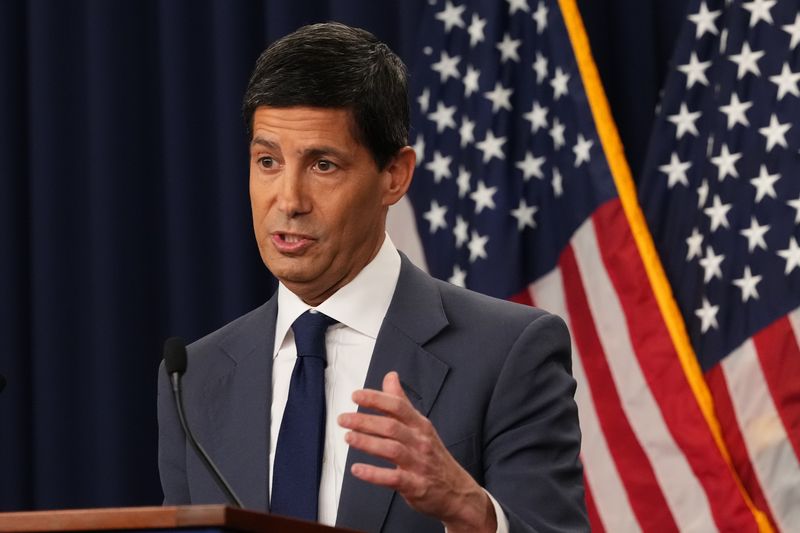
■ “AI Is Already a Bubble”... Warning of Recession
According to CNN on the 16th (local time), Gary Gensler, former chair of the U.S. Securities and Exchange Commission (SEC), said in an interview that day, “AI is already in a bubble,” adding, “I think a repricing of asset prices and an economic slowdown will occur before November 2028.” Gensler led the SEC from 2021 to 2025, during the Joe Biden administration, overseeing U.S. capital markets. He is currently a professor at the Massachusetts Institute of Technology (MIT).
Gensler identified the enormous scale of investment in AI infrastructure as the biggest risk. Some estimates put annual spending on AI infrastructure, including data centers and advanced semiconductors, at $800 billion. “Big tech companies are spending five times as much in 2026 as they did just three years ago,” he said. “History shows that massive investments in new technologies eventually stall and contract.”
He singled out the fact that investment funds are flowing in much faster than companies are generating returns. Circular financing among companies and complex funding arrangements in which debt does not appear directly on corporate balance sheets make it difficult to gauge how much financial risk is actually building up. “History will show that lenders lent too much money too quickly,” Gensler warned. “That is the essence of a boom that ends in a bubble.”
In its financial stability report released on the 13th, the Fed estimated that large U.S. banks have nearly $1 trillion in financial exposure to technology companies, data center developers and other companies and lenders involved in the AI infrastructure boom.
Neocloud companies that rent high-performance computing resources to AI developers were identified as the most likely to be hit first if a bubble burst. The impact of an AI bubble bursting could be as severe as that of the dot-com bubble's collapse in the early 2000s, but is expected to be less severe than the 2008 global financial crisis.
The IMF also warned that the global economy is becoming overly dependent on AI investment. IMF Managing Director Kristalina Georgieva said in an interview with CNBC that day, “The global economy is standing on one leg, and that leg is AI. If that leg starts to wobble, it could create problems for financial stability.” She specifically identified circular financing among AI companies as a risk. According to Georgieva, the scale of circular financing between AI companies is slightly more than $1 trillion, about two-thirds of which was funded with debt.
■ AI Optimist Warsh Also Cautions About Risks
Fed Chair Kevin Warsh, who has long emphasized that AI will boost productivity in the U.S. economy, also expressed concern about the side effects of the AI investment boom. At a conference hosted that day by the Federal Reserve Bank of San Francisco, Warsh presented three scenarios for AI's economic impact. In particular, he outlined how, if expected returns fail to materialize despite massive investment, the result could be a sharp stock market plunge, an economic slowdown and rising unemployment.
Warsh first said that AI could boost productivity and raise the U.S. economy's long-term growth rate. “What sets AI apart from other technologies is its ability to dramatically accelerate the creation of new ideas,” he said. “It is changing not only how innovation happens, but also how quickly.”
However, he cautioned that this productivity revolution had not yet fully emerged in the real economy. “Productivity growth has been fairly robust over the past few quarters, but it has not yet turned into a clear, structural uptrend,” he explained.
The first scenario the Fed is considering is one in which AI boosts productivity and the benefits are broadly shared by workers and businesses. In that case, economic growth could exceed its long-term average while unemployment remains stable. The second scenario is one in which AI stimulates economic growth while also replacing existing jobs. The economy could grow as productivity improves, but unemployment could rise as automation spreads. The most pessimistic third scenario is one in which the returns and productivity gains expected from massive AI investment fail to materialize. In that case, stocks of AI-related companies could plunge, consumption and the real economy could contract, and the result could be recession and rising unemployment. “Our job is to prepare for whatever may lie ahead,” Warsh stressed. “When the world is changing this quickly, preparing for contingencies becomes even more important.”
[email protected] Reporter