US Blocks China's Remote Access to AI Data Centers... China Vows Response to 'Unjust Suppression'
- Input
- 2026-11-17 18:29:38
- Updated
- 2026-11-17 18:30:41
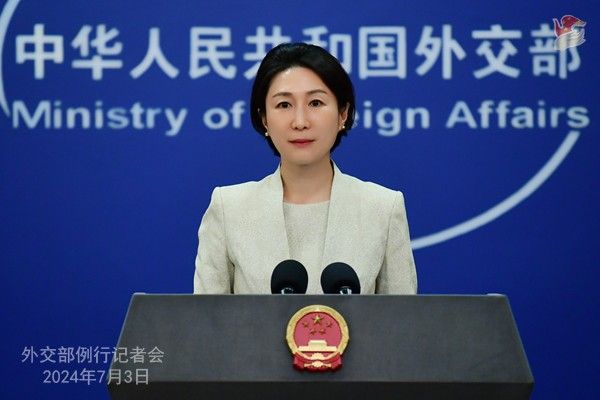
[Financial News] In response to the U.S. government's decision to control the provision of U.S. computing capacity through third countries, the Chinese government immediately protested and announced it would take countermeasures.
China's Foreign Ministry spokesperson Guo Jiakun said at a regular briefing on the 17th, “The United States constantly expands its concept of national security and abuses export controls. It even absurdly interferes with normal trade and scientific and technological cooperation between China and other countries, unfairly suppressing the development of China's high-tech industries.”
Guo added, “This is a typical act of economic coercion and extraterritorial jurisdiction (extending the scope of a law's application beyond a country's borders), violates agreements reached by the two countries, undermines the legitimate rights and interests of Chinese companies, and disrupts the stability of global industrial and supply chains. China will take necessary measures to resolutely safeguard its legitimate rights and interests.”
Earlier that day, the U.S. government decided to restrict China's remote access to advanced AI semiconductors, including NVIDIA chips.
In effect, the move blocks data centers in third countries from providing computing power to Chinese companies and others without U.S. approval.
Data centers that have previously provided such services must also obtain approval from the U.S. government within 90 days. Failure to comply will subject them to export restrictions in the future.
The U.S. government also required prior authorization for exports of advanced chips to Southeast Asian countries such as Singapore, Malaysia, Thailand and Indonesia, as well as Brazil.
This is based on the assessment that data centers in these five countries pose a greater risk of diversion, such as leasing computing power to China and elsewhere. The secretary of commerce may also add countries to the list in consultation with the secretary of state or the president's national security adviser.
The Bureau of Industry and Security (BIS), under the U.S. Department of Commerce, said on the 16th (local time) that it would implement these measures at the direction of the U.S. Treasury Department and the National Security Council (NSC).
The Commerce Department said the new rules were intended “to ensure that restrictions on access to sensitive U.S. technology cannot be circumvented through remote computing at data centers in third countries.”
Allegations have repeatedly surfaced that major Chinese AI companies such as Alibaba, DeepSeek and Moonshot AI have mainly leased data centers in Southeast Asia to access computing resources such as NVIDIA graphics processing units (GPUs), seeking to evade U.S. restrictions on exports of advanced semiconductors.
The Commerce Department's announcement today is a follow-up measure related to the scandal involving Jensen Huang, former CEO of NVIDIA.
[email protected] Lee Seok-woo, international affairs correspondent Reporter