"I'll Expose It With the #ExamCheating Hashtag" ... Bizarre Advance Warning Post by a Seoul National University Student Two Days Before the CSAT
- Input
- 2026-11-18 05:00:00
- Updated
- 2026-11-18 16:15:18
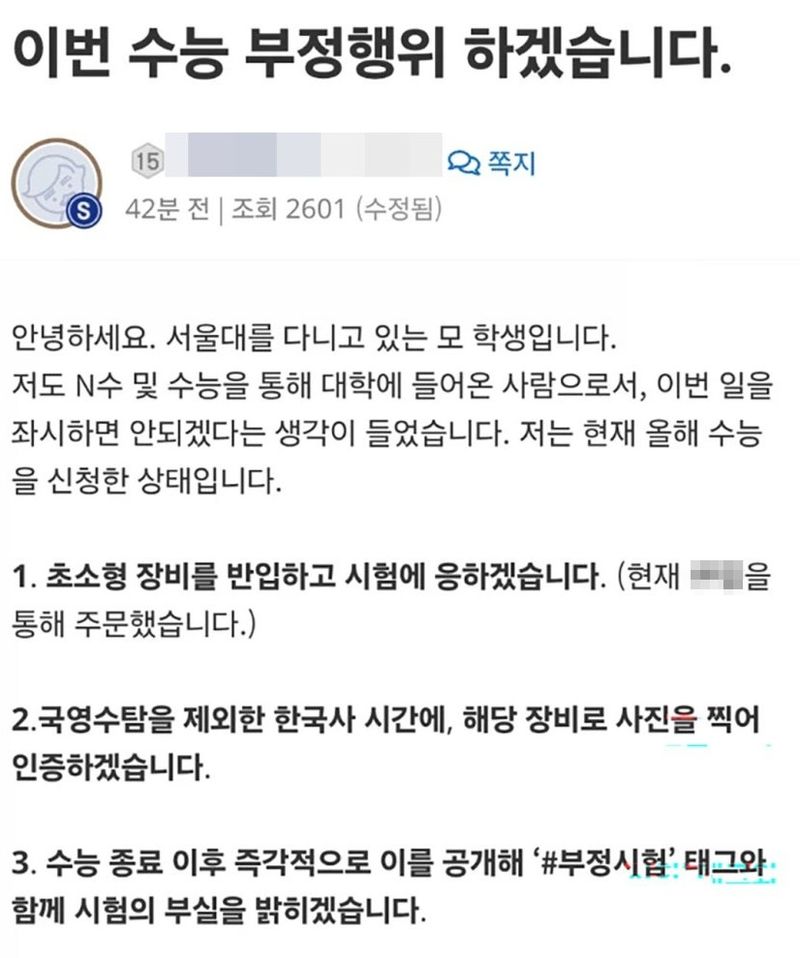
[Financial News] With the 2027 College Scholastic Ability Test (CSAT) just two days away, a so-called “pre-announced cheating” post has spread online, stirring controversy. The post says its author plans to bring a miniature electronic device into an exam site and expose security loopholes.
According to online communities and other sources on the 17th, a post titled “I Will Cheat on This Year’s CSAT” was published on a community forum the previous day. The writer, who identified themself as a current Seoul National University student, said, “As someone who got into university through repeated entrance-exam attempts and the CSAT, I felt I couldn’t stand by and watch the recent situation,” and claimed to have applied to take this year’s CSAT.
A said they had ordered a miniature device through an online shopping mall and described a detailed plan for carrying it out. The plan was to use the device to photograph the exam paper during the Korean history test—which, unlike the Korean, mathematics, English, and inquiry sections, is graded on an absolute scale—and post the image as proof. Immediately after the CSAT ends, they would publish it on social media (SNS) and elsewhere with the hashtag “#ExamCheating” to demonstrate flaws in the current proctoring system.
They framed the plan as an “experiment” to expose security vulnerabilities, rather than an attempt to improve their admissions score. However, it has not been confirmed whether they actually purchased the device or intend to carry out the plan on exam day.
As the post spread, it drew sharply divided reactions online. Some users defended the plan, saying, “Photographing and revealing it during the Korean history test, which is graded on an absolute scale, is a public-interest effort to expose loopholes in the exam.” Most, however, voiced serious concerns, calling it “clearly subject to criminal punishment, including for obstruction of official duties by deceptive means, whatever the intent,” and “a dangerous act that, if discovered, could lead to being barred from taking the CSAT as well as disciplinary action or expulsion from the university they attend.”
Anxiety about the fairness of national-level exams as a whole has grown after the top-ranked candidate in the 63rd tax accountant exam admitted to cheating with the help of artificial intelligence (AI) and miniature electronic devices, and allegations of cheating also emerged in the Law School Admission Test (LEET).
Amid these concerns, the government also announced tough measures to prevent smart devices from being brought into exam sites and to stop cheating on the CSAT. Prime Minister Han Seong-sook said in opening remarks at a meeting of the State Council of South Korea, held that day at Government Complex Seoul, “I am well aware that examinees and their parents are deeply concerned about cheating involving the misuse of AI in recent national qualification exams.” Han added, “We will classify this cheating as a social evil and deploy a pan-government emergency response team to root it out.”
Han went on to stress, “During the exam, all smart devices, including smartphones, will be switched off and collected together. We will inspect all glasses and watches worn by examinees and carefully check collars, sleeves, buttons, and other items. We will also strengthen Wi-Fi management around exam sites and periodically check whether devices in examinees’ bags stored outside exam rooms, such as in corridors, are operating, so as to prevent deliberate failure to turn in devices and to stop cheating at the source.”
[email protected] Moon Young-jin Reporter