'Urgent Disaster Alerts' to Detect Phones Hidden at CSAT Test Sites
- Input
- 2026-11-17 16:15:14
- Updated
- 2026-11-17 16:15:14
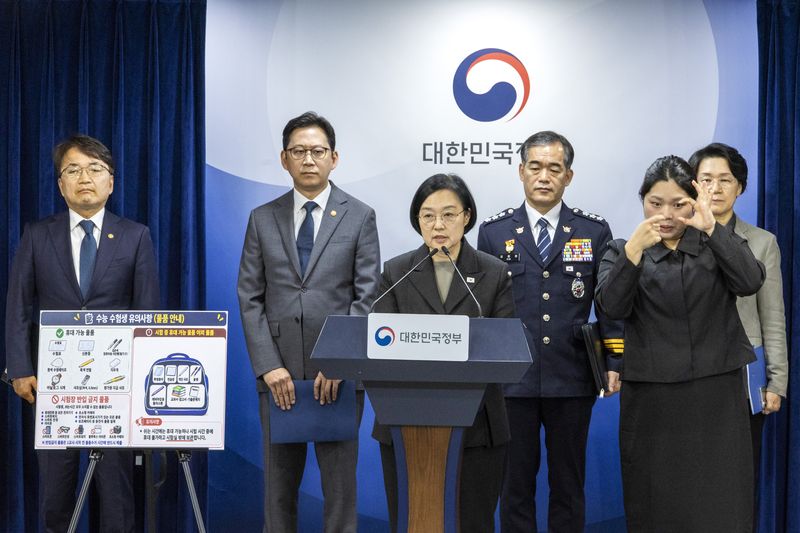
The government announced its “Public Address on the Government’s Response to Cheating on the CSAT” on the afternoon of the 17th, with Prime Minister Han Seong-suk, Deputy Prime Minister and Minister of Science and ICT Bae Kyung-hoon, Vice Minister of Education Choi Eun-ok, Kim Kwang-yong, head of the Disaster and Safety Management Office at the Ministry of the Interior and Safety (MOIS), and acting Commissioner General of the Korean National Police Agency Kim Jong-chul in attendance.
Prime Minister Han Seong-suk said at the event, “Public concern is growing as cheating involving advanced electronic devices such as smart glasses and miniature cameras has come to light in other national exams, including the recent tax accountant exam,” adding, “We will hold those responsible to account to the end under a zero-tolerance policy.”
■ Bags stored in hallways, button stickers and disaster alerts... on-site inspections tightened across the board
First, on-site inspections will be significantly tightened to catch prohibited items brought into test centers. Before the first period begins, the government will collect all electronic devices and store candidates’ bags separately in the hallway outside the classrooms to prevent them from hiding phones in their bags. It will then send a disaster alert between 8:25 and 8:30 a.m., before the exam begins, to detect phones that have not been turned in. A total of around 8,400 additional personnel will be deployed, including about 6,600 hallway proctors and 1,800 staff dedicated to smart devices, to carry out the checks.
Kim Kwang-yong, head of MOIS’s Disaster and Safety Management Office, explained, “Unlike emergency and safety disaster alerts, an ‘urgent disaster alert’ cannot be opted out of, so if a phone is switched on, it will inevitably sound an alarm.” Prime Minister Han added, “There was considerable internal debate because everyone in the country will receive the alert at the same time, but we judged that this was an important matter requiring that level of intensity to find hidden phones.”
Measures to prevent the use of miniature cameras and smart glasses will also be introduced. Stickers will be placed on every button attached to candidates’ clothing to prevent cameras from being concealed in the first place. When checking personal belongings, proctors will have candidates roll up both sleeves and inspect their collars and buttons. Smart glasses will be comprehensively inspected before the first period while placed on desks, then checked again during each period while being worn; metal detectors will be used if anything appears suspicious.
Vice Minister of Education Choi Eun-ok stressed, “There is ample time to complete all checks, including placing stickers on buttons, in the 30 minutes between the official 8:10 a.m. deadline for entering the test room and the 8:40 a.m. start of the exam,” adding, “Some may criticize these measures as excessive, but if the fairness of the CSAT is compromised, the resulting social disruption would be greater than that of a disaster. This is a situation that calls for an excessive response.”
■ Test bans retroactively extended to ‘10 years’ and criminal penalties... AI and communications records tracked after the exam to the end
Penalties will also be raised to the highest level ever. The government plans to extend the period during which cheaters are barred from taking the exam from one year to 10 years and immediately consult with the National Assembly on applying the change retroactively, starting with those who cheat on this year’s CSAT. In particular, serious cheating such as the use of smart devices will not merely result in the exam being invalidated; the government plans to file criminal complaints and request investigations on suspicion of obstruction of official duties by deceptive means under the Criminal Act, punishable by up to five years in prison. It will also work with the Korean Council for University Education to revoke the admission of students admitted through cheating, expel repeat test-takers from university while they are enrolled, and bar them from university admission for 10 years.
Post-exam tracking and online monitoring will also be carried out. Deputy Prime Minister Bae Kyung-hoon said, “For this CSAT only, we have arranged to receive active cooperation from global tech giants headquartered overseas regarding image-capture records, AI service usage records and cloud analysis processes,” adding, “We plan to track and act on usage records from Wi-Fi and telecommunications providers all the way through, including both real-time responses and post-exam log analysis.”
Acting Commissioner General of the Korean National Police Agency Kim Jong-chul said, “We will run cyber investigation units across the country at full capacity, 24 hours a day, to proactively monitor online posts confessing to or announcing planned cheating, and will take strict investigative action alongside measures to delete or block them.”
Prime Minister Han also pledged, “The government will assume full responsibility so that teachers who diligently perform their proctoring duties do not have to bear responsibility for unfair complaints or lawsuits,” and urged candidates, “Please bear in mind that cheating will not simply mean doing badly on this exam and then being done with it; it could change the course of your life.”
[email protected] Man-gi Kim Reporter