“So What If the Wait Is 80 Minutes? You Save Money by Going Only to ‘Proven Restaurants’”... Waiting With Confidence [Koreans Who Queue 2]
- Input
- 2026-11-21 06:00:00
- Updated
- 2026-11-21 06:00:05
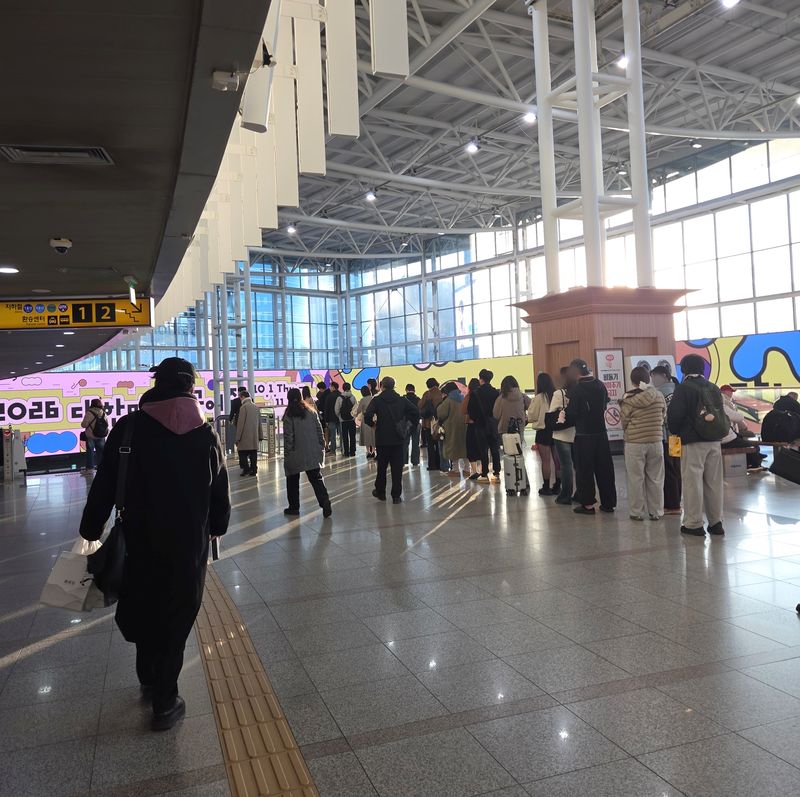
[Financial News] #1. “I don’t think I’d wait in a line like this just to eat it myself, but I’m buying it as a gift for friends who have never tried it.”Kim Jae-gyeong, 29, who lives in Daegu, joined the end of the long pickup line for “Hanjeongseon” inside Seoul Station to buy a housewarming gift for a friend. Kim joined the line through CATCHTABLE, a reservation and waitlist platform, and it took about 40 minutes to pick up the product. Kim said that using the reservation platform made the wait shorter than the regular line.
Kim said, “I don’t really understand lining up to eat something, but it looked like a good gift, so I bought it,” adding, “It’s satisfying that so many people will be trying it for the first time, and I don’t think waiting this long to give it as a gift is too much.”#2. “I do wonder whether it’s worth waiting this long to eat. But once you try it, you think, ‘There’s a reason it’s so popular.’ You feel glad you waited.”That’s what Moon Da-mi, 38, says about making an “opening rush” visit to a well-known bracken hangover soup restaurant near the airport whenever she travels to Jeju. Moon, who lives in Seoul, said that on her most recent visit, she registered her number at the reservation kiosk in the restaurant’s annex and was able to get in after waiting about 30 minutes.
Moon marveled that the crowds waiting in line seemed to grow larger year after year rather than shrink, but added, “These days, instead of waiting around without knowing when you’ll get in, you register at a kiosk and get an alert when your turn is near, so waiting is much easier.”
“Remote queuing”—joining a waitlist through an app or kiosk and waiting for a notification when your turn is coming up—has become an essential part of waiting culture, as it has for Kim and Moon. As lines outside restaurants have extended into smartphones, the number of users of reservation and waitlist apps has nearly tripled in three years. Some analysts say a consumer mindset has taken root in which waiting is seen not as a cost but as “participation.”
Waitlist apps reach 2.91 million monthly users, up 185% in three years
According to data analytics company Wiseapp, the number of monthly users of restaurant reservation and waitlist apps reached a record 2.91 million as of August last year, up 185% from three years earlier. Of those, 2.5 million used CATCHTABLE, the top-ranked app.
As of last September, CATCHTABLE had more than 15 million cumulative registered users and over 30,000 participating restaurants. Ward, the operator of CATCHTABLE, said the number of real-time waitlist uses had grown about 2.1-fold in two years compared with the service’s first year.
In particular, 97.2% of waitlist use was at restaurants where the average spend per customer was 50,000 won or less. This suggests that queuing has become part of everyday life at neighborhood Korean restaurants and barbecue joints, rather than upscale restaurants.
The sharp rise in lunchtime waits is also notable. According to CATCHTABLE’s analysis of lunchtime waitlist trends, the number of waits from 11 a.m. to 2 p.m. between January and August this year rose 45.3% from the same period a year earlier. That was more than 10 percentage points higher than the 35.1% increase in waits during dinner hours, from 5 p.m. to 8 p.m., over the same period. Lunchtime waits also accounted for a larger share of all waits, at 41.4%, than dinner waits, at 34.7%. The longest average lunchtime wait was in Mangwon-dong, Mapo-gu, Seoul, at over 80 minutes.
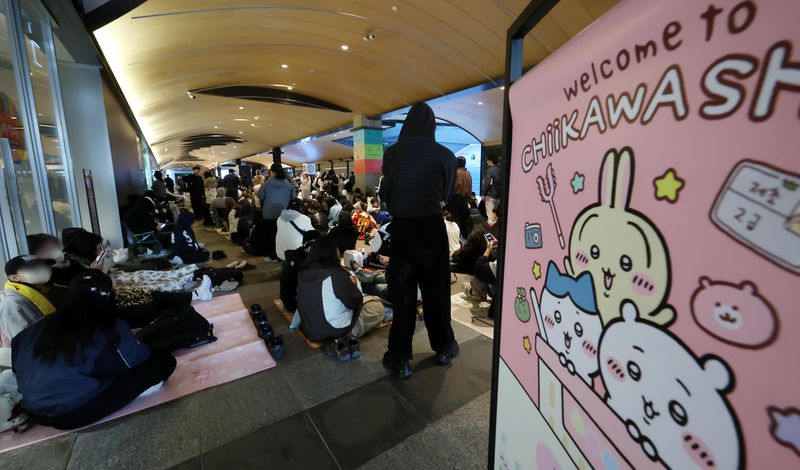
“Waiting is a cost, too”—but there are social-psychological benefits to “taking part”
Time spent waiting is a clear cost. In economics, it is called opportunity cost—the value of an alternative given up because of a choice.
Most consumers, in fact, are willing to wait only around 30 minutes. In a survey of 402 adults conducted last October by Honsin Culinary Research Institute and public relations firm Dongseo Nambuk, 78% said their limit for waiting was 30 minutes or less. Even so, quite a few consumers are willing to wait when it is a restaurant people line up for.
Kim Siwol, a professor in the Department of Consumer Studies at Konkuk University, said, “If you look at time in economic terms, it is an opportunity cost, but consumption also brings social-psychological benefits. We live in an era when conformity—the idea that these people are taking part, so I’ll join in too—and a sense of shared identity, or feeling that I belong to that consumer culture, are at work.” The explanation is that consumers have shifted toward enjoying the culture of waiting together rather than focusing on the taste itself.
A long line can itself provide information. For consumers whose wallets have been squeezed by high prices, it can be a way to “spend time instead of money to reduce the chance of disappointment.” Moon also said, “A lot of people waiting means the food must be that good,” adding, “I might not normally do this, but when I’m traveling, I feel like going to a ‘proven restaurant’ that people line up for, even if it takes a while, is a safer bet.”
Professor Kim cited the weakening of traditional evaluation criteria as one reason for this trend. Until now, people have evaluated restaurants relatively objectively through comments and ratings. But as AI and other tools are increasingly being used for that, factors such as “lots of people are waiting,” “people are flocking there,” and “good value for money” are gaining weight as new criteria in place of simple star ratings, Kim said.
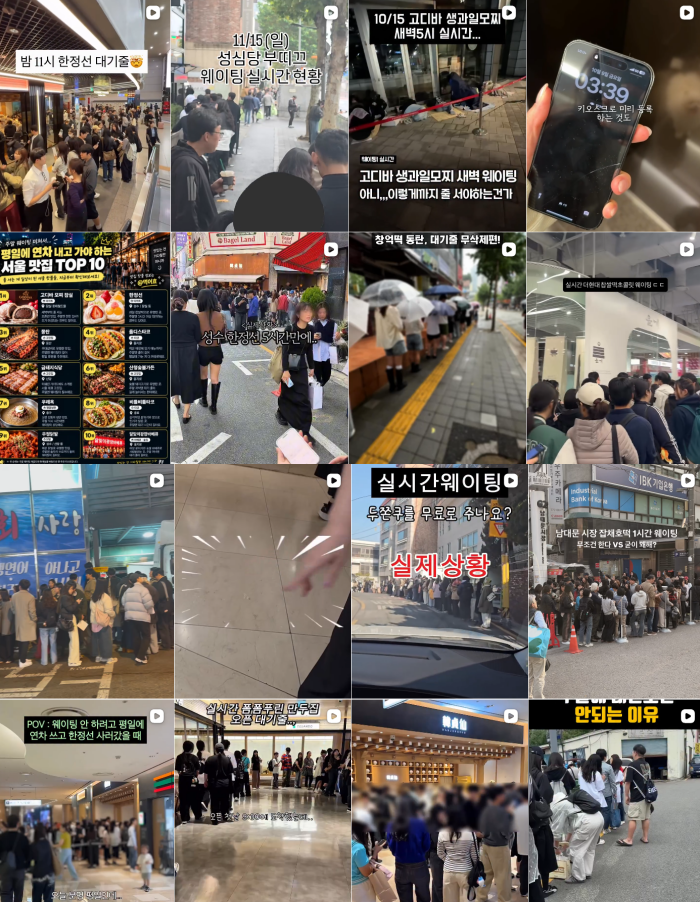
Social networking services (SNS) are at the heart of this trend. Posting about “succeeding” at getting in line—with screenshots of the waitlist screen and proof photos—creates a cycle that draws in the next customers. Kim explained, “There are now so many platforms for telling others about what you’ve bought and confirming that ‘I took part.’”
“If there’s a line, there must be something there”... The longer the wait, the better it tastes
Keumjoo Kwak, a professor of psychology at Seoul National University, pointed to herd mentality as a reason people queue. “If lots of people are going there, you conclude that the food is good and the place is worth visiting,” she said, explaining that “people are influenced more by what others do than by their own judgment.”
SNS amplifies this psychology. Repeated exposure to information such as “100 groups waiting” or “a two-hour wait” can actually make people want to visit the place.
Waiting can even change how food tastes. Professor Kwak said, “Because I’ve waited this long, it tastes good, and because other people say it’s good, that becomes the taste I perceive,” adding, “It’s the same reason food can seem inexplicably bad when there’s no one there.” In other words, taste is shaped less by the food’s objective flavor than by how and what we perceive, and by our surroundings.
Korea’s distinctive collectivist culture also plays a role. Professor Kwak said that in a society where saving face and being mindful of others matter, other people’s behavior can easily become the standard for one’s own, and people feel considerable anxiety about becoming an “outsider” if they are the only ones who don’t know what everyone else is doing.
From pop-ups to amusement parks... Queuing moves beyond restaurants
It is also worth noting that queueing culture is becoming more varied by the day and is no longer limited to restaurants. An online big-data analysis by the KPR Insight Research Institute found that “travel,” “shopping,” and “pop-up” appeared alongside “popular restaurants” among terms associated with “waiting.”
Indeed, app-based queue management is spreading wherever crowds gather: mobile waitlists for MUSINSA offline stores and pop-ups; Everland’s “Smart Queue”; “Weverse queueing” for waiting at concert venue booths; and the hospital registration app ddocdoc. The ways people use their waiting time are also changing, with people joining a waitlist and browsing nearby stores, for example.
As this queueing culture has spread, a market has emerged in which waiting can make money. Job listings for part-time workers to stand in line for department store opening rushes, paying 14,000 won an hour, have even appeared, prompting concerns that queueing is getting out of hand. Safety is another concern. On May 1, 160,000 people flocked to a Pokémon pop-up store in Seongsu-dong, Seoul, and the event was suspended over safety concerns.
[email protected] Kim Hee-sun Kim Su-yeon Reporter