GIST Announces 'Vision 2035' on 33rd Anniversary...A Qualitative Leap Beyond Quantitative Growth
- Input
- 2026-11-17 16:19:29
- Updated
- 2026-11-17 16:19:29
'GIST Vision 2035' is a medium-term vision developed by the GIST Future Vision Committee after eight months of discussions beginning in April. Its goal is to become 'A Leading University for Future Technology.' Building on achievements in expanding its education and research organizations and infrastructure over the past 33 years, it outlines development directions for assessing GIST's current competitiveness and improving research quality and technology commercialization results, among other things.
Based on the long-term vision 'Vision 2053,' announced in 2023 to mark the 30th anniversary of its founding, GIST has fleshed out the tasks to be carried out over the next 10 years into four major areas—education (talent), research (knowledge), value creation (technology) and ESG (foundation)—with 16 goals and 65 action items.
In education, GIST plans to make basic AI literacy education mandatory and introduce an integrated bachelor's-master's-doctoral fast track. In research, it will expand ambitious research in specialized fields such as semiconductors, quantum technology and lasers, as well as international collaborative research. In value creation, it will promote technology commercialization and startup formation in laboratories. In ESG, it will expand the autonomy of departments and research institutes and pursue improvements to administrative work using AI.
GIST aims to implement these initiatives in phases and enter the global Top 100 of research-focused universities by 2035.
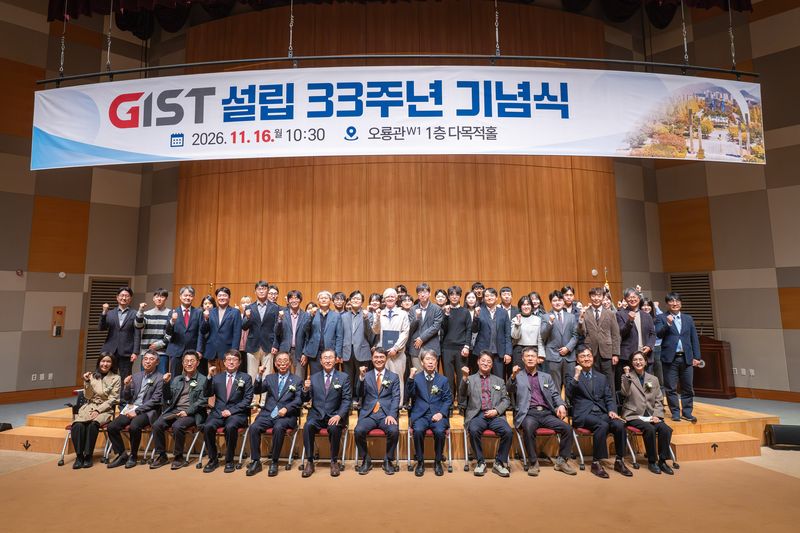
In this regard, at the 33rd anniversary ceremony held in the multipurpose hall on the first floor of GIST's Oryong Hall on the 16th, GIST President Ki-Cheol Lim said, "A factory opening does not automatically turn a city into a semiconductor city. We need people." He identified three key action priorities for GIST going forward: establishing a talent-development system spanning from an AI gifted school to training for employees; establishing the AI Semiconductor Research Institute 'GIANTS,' which will cover every stage from semiconductor design through packaging, testing and validation; and leading an innovative economy in partnership with the region.
President Lim stressed, "GIST must take the lead in nurturing local talent and supplying companies with the technologies they need." He also said, "Over the next five years, GIST-Arm School will train 1,400 semiconductor design specialists, including 400 master's and doctoral students." He added, "Only when patents from laboratories lead to startups, and those startups in turn create good jobs in this region, will the semiconductor cluster truly belong to our region."
GIST was established in 1993 and opened in 1995 as an institution focused on graduate education. It broadened its educational offerings by welcoming its first undergraduate students in 2010. More recently, it has strengthened the foundations for education, research and industry-academia collaboration by opening the Graduate School of Technology Management, establishing the Advanced AI Semiconductor Fab Center and launching the Startup Innovation Promotion Institute.
[email protected] Yeon Ji-an Reporter