“Sighed After Seeing the Minister’s Answer”... Lee Jun-seok Develops and Releases a “CSAT Cheating Detection App” Himself
- Input
- 2026-11-17 16:01:43
- Updated
- 2026-11-17 16:01:43
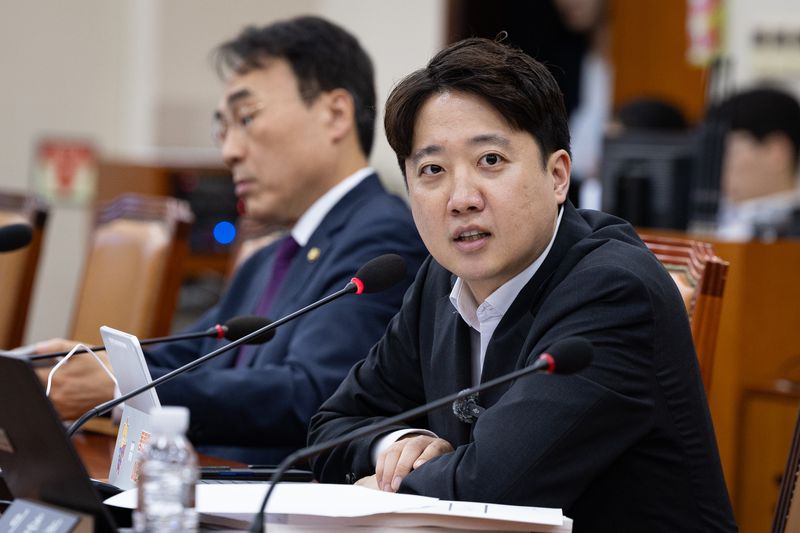
[Financial News] With the 2027 College Scholastic Ability Test (CSAT) just two days away, a dispute between political circles and education authorities is intensifying over recent allegations of cheating involving the misuse of artificial intelligence (AI) and ultra-small devices. Reform Party lawmaker Lee Jun-seok has urged the government to take more active measures, unveiling a radio-signal detection app he coded himself aboard a plane during a business trip to the UK.
In a post on his social media account on the morning of the 17th, Lee said, “I sighed after seeing the education minister’s response on the plane to the UK for a business trip,” and unveiled a prototype of “KoriyoSCAN,” a radio-signal detection app he developed aboard the plane using Starlink satellite internet. “Koriyo” comes from the name of the mascot of Hwaseong, Gyeonggi Province, which is Lee’s constituency.
The previous day, Education Minister Choi Kyo-jin had ruled out postponing the CSAT, saying it could cause even greater confusion, and said it would be difficult to completely prevent new forms of AI-enabled cheating at a plenary meeting of the National Assembly’s Education Committee.
Lee said, “If the credibility of the CSAT is shaken, distrust of the government will grow uncontrollably,” adding, “The government has ruled out postponing the exam, and even if it were postponed, a week might not be enough to put fundamental measures in place. In that case, the government should mobilize every measure available in the time remaining and show both its resolve to impose strict penalties and its ability to catch cheaters on the ground.”
The “KoriyoSCAN” app proposed by Lee was designed to make use of exam proctors’ mobile phones, given the difficulty of immediately supplying specialized detection equipment to test rooms nationwide. It first records Bluetooth and Wi-Fi signals in empty classrooms before candidates enter, then alerts proctors to newly detected signals after they enter, helping identify devices suspected of being used to cheat, such as ultra-small wireless earbuds or private wireless networks.
Lee said the app was designed to be installed on proctors’ mobile phones and take measurements with the phones in airplane mode and set to silent. He asked the Education Ministry to quickly consider a temporary exception to the rules restricting the entry and use of mobile phones at test sites for the purpose of detecting radio signals. Saying there was no time to wait for the app store registration process, he released the Android installation file (APK) and source code and appealed to other developers to help fix bugs and verify performance during the time remaining.
Lee also proposed checking wireless internet hotspots around test sites and temporarily restricting mobile network data for certain age groups during the exam. However, he said, “The government and telecom companies need to assess the legal basis and actual effectiveness, as well as issues involving emergency communications and inconvenience to residents. The opposition has no administrative authority.” He stressed, “The government, which holds the power, should consider and implement measures far more actively than this so that students who have prepared diligently can take the exam with peace of mind.”
Lee, who studied computer science and economics at Harvard University in the United States, has previously developed and released programs himself, including party-affairs automation software and a price-comparison program for Nara Jangteo.
[email protected] Moon Young-jin Reporter