[Exclusive] Multi-Legged Robots, AI Combat Vehicles and Other Advanced Systems to Go Straight onto Military Procurement List
- Input
- 2026-11-18 14:43:24
- Updated
- 2026-11-18 14:43:24
[Financial News] A fast track will be created for advanced military systems—including multi-legged walking robots, AI combat vehicles and multipurpose reconnaissance drones—that have completed military demonstrations but whose fielding has been delayed. The fast track will operate through the “certification list” under the Defense Advanced Capabilities Projects Act (Advanced Capabilities Act), jointly introduced by lawmakers from the ruling and opposition parties. The National Assembly's National Defense Committee proposed allowing advanced systems that have already undergone pilot projects to be added to the list.
Defense Committee proposes linking products already tested to the “certification list”
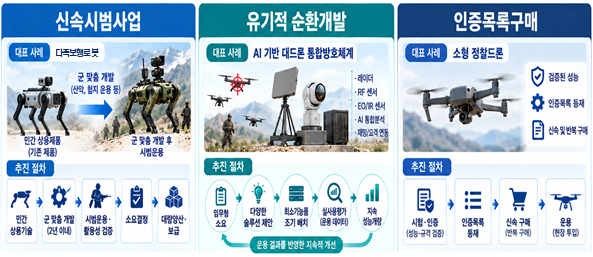
According to the National Defense Committee's review report on the Advanced Capabilities Act on the 18th, the committee noted that, because the Defense Advanced Capabilities Project at the heart of the bill and the existing rapid pilot project share some demonstration and performance-verification functions, “concrete procedures are needed to link the results of the rapid pilot project to purchases from the certification list or to ‘organic iterative development.’”The Advanced Capabilities Act aims to separately define advanced military systems such as artificial intelligence (AI) and drones and enable their faster introduction than under the existing process. The specific approaches include creating a certification list of products that have undergone advance verification for supply chain, security and performance so they can be purchased directly, or using organic iterative development, in which minimum viable products are deployed first and improved through use.
If the bill is amended as the National Defense Committee proposed, advanced military systems that have already completed demonstrations, including those in the rapid pilot project, could be added to the certification list, potentially accelerating their fielding. Alternatively, they could be linked to organic iterative development, allowing the military to use them while carrying out follow-on development.
The National Defense Committee said, “For products whose performance has already been demonstrated in the rapid pilot project, the verification results should be used in certification reviews to prevent duplicate testing. For systems requiring follow-on development, options for linking them to organic iterative development should be considered, taking into account existing R&D results and the record of project funding.”
Expectations for faster fielding of multi-legged robots, reconnaissance drones and manned-unmanned combat engineering vehicles
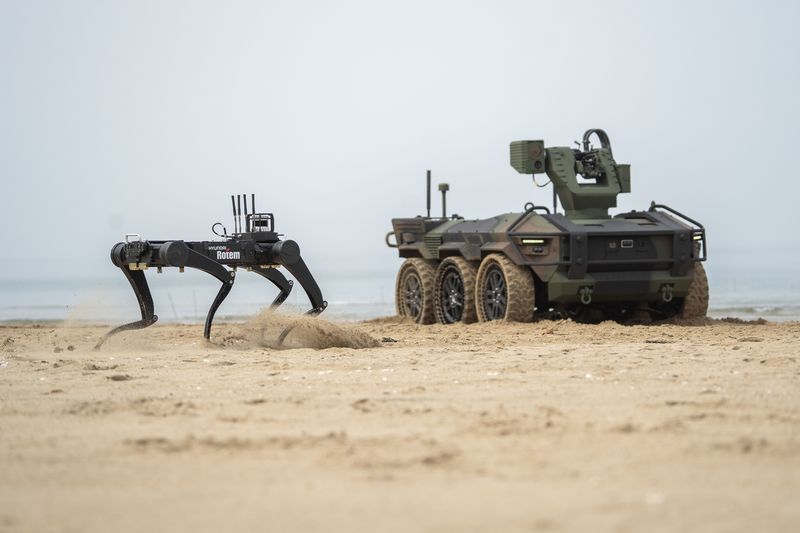
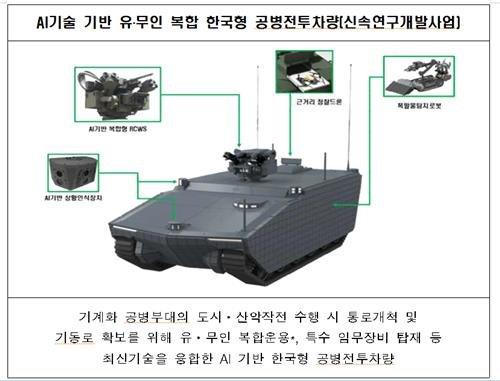
Multi-legged walking robots are a prime example of advanced military systems that have undergone rapid pilot projects and demonstrations. A multi-legged walking robot developed by Hyundai Rotem and Rainbow Robotics for counterterrorism operations went through a rapid pilot project and was deployed on a trial basis in 2024 to the Republic of Korea Army Special Warfare Command (ROK-SWC) and forward divisions, but no requirement decision has yet been made. Vision 60, a quadruped unmanned ground system made by Ghost Robotics, a subsidiary of LIG Defense & Aerospace (LIG D&A), took part in Army and Marine Corps combat experiments after a pilot demonstration project for defense service robots, but has yet to be adopted.The fielding of Hanwha Aerospace's AI-based manned-unmanned Korean combat engineering vehicle (K-CEV), now in development, and Hanwha Systems Co., Ltd.'s AI thermal-imaging sight for sniper rifles—which the military is reportedly preparing to request—also is expected to accelerate under the Advanced Capabilities Act. The outlook is especially bright for the K-CEV, which was pursued through a rapid research and development project to replace aging military trucks and armored vehicles.
A battalion-level multipurpose reconnaissance drone that PRENEU, a leading domestic drone manufacturer, submitted to the rapid pilot project could also get a new lease on life through the Advanced Capabilities Act. Under the military's policy of training 500,000 drone warriors, it plans to acquire more than 60,000 drones by 2029. If the act takes effect, military drones featuring the latest technology are expected to be introduced rapidly on a large scale.
[email protected] Kim Yun-ho Reporter