A Decade of Tourism and Youth Exchanges... Jeju and Hokkaido Explore Energy and AI Cooperation
- Input
- 2026-11-17 15:58:27
- Updated
- 2026-11-17 15:58:27
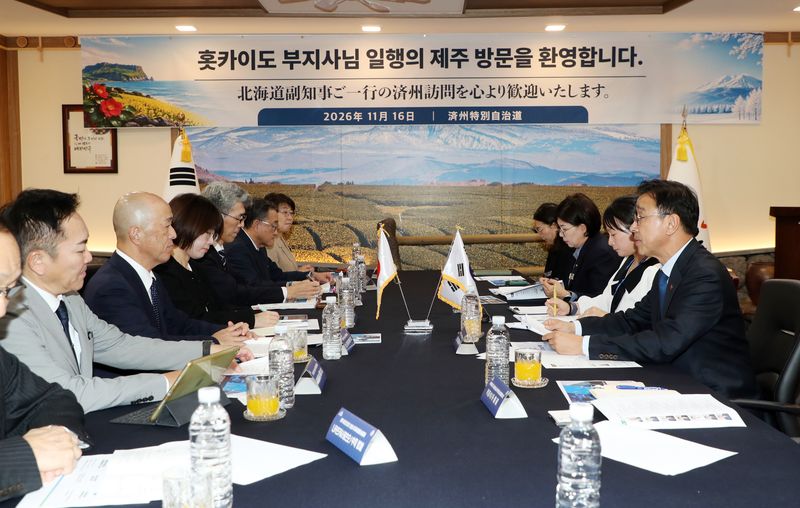
【Financial News, Jeju = Reporter Jeong Yong-bok】 Jeju and Japan's Hokkaido discussed expanding cooperation in future industries, including renewable energy, artificial intelligence (AI), and smart agriculture, as they marked the 10th anniversary of their friendship and cooperation. A key agenda item was how to extend exchanges centered on tourism and youth to industrial policy and business cooperation.
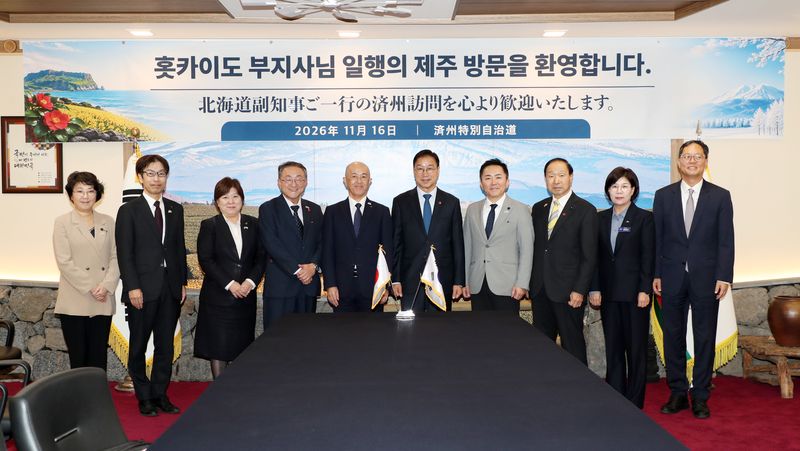
According to Jeju Special Self-Governing Province on the 17th, Jeju Governor Wi Seong-gon met a Japanese delegation the previous afternoon at Baengnok Hall at the provincial government office, including Hokkaido Vice Governor Kano Takayuki and Hokkaido Assembly Vice Chair Kajiya Taishi, to discuss cooperation in climate and energy and advanced industries.
The visit was arranged to mark 10 years since Jeju and Hokkaido signed a friendship and cooperation agreement in January 2016. The two regions have maintained cooperative ties centered on youth exchanges and participation in cultural events.
The Jeju International Youth Forum has also served as a key channel for exchanges. This year's forum is likewise being organized as an international exchange event bringing together young people from around the world.
Alongside existing people-to-people and cultural exchanges, the meeting addressed shared policy priorities: the energy transition and the development of future industries. Jeju and Hokkaido are regions where tourism and primary industries such as agriculture play important roles in the local economy. They also face common policy challenges in expanding renewable energy, responding to climate change, and developing advanced industries.
In particular, changes in the energy industries of both regions were identified as a key area for exploring opportunities to cooperate. Jeju is pursuing a project to establish a specialized distributed energy zone that links renewable energy generation, including solar and wind power, with electric vehicles and energy storage systems (ESS).
Unlike the long-distance transmission of electricity generated at large power plants, distributed energy is a system in which power is produced and consumed close to where it is needed. To address fluctuations in electricity supply and demand caused by changes in renewable energy generation, Jeju is testing AI-based power management technologies and distributed energy business models.
Hokkaido is also pursuing offshore wind and solar power projects, making use of its abundant renewable energy resources. In conjunction with the Japanese government's regional industry development policies, it is also working to establish industrial hubs in areas such as next-generation semiconductors, AI, and space.
In Chitose, Hokkaido, an advanced semiconductor manufacturing and research base is being built around Japanese semiconductor company Rapidus Corporation. The Japanese government is supporting related research and development and the construction of production facilities.
The South Korean government is also looking to Hokkaido as a partner in the semiconductor sector. On September 22, the Ministry of Trade, Industry and Energy held the “Korea-Japan (Hokkaido) Semiconductor Industry Cooperation Exchange” in Seoul, with participants from Hokkaido regional government agencies and business organizations. The event was intended to discuss opportunities for technology cooperation and business participation by companies from both countries.
The meeting between Jeju and Hokkaido did not finalize a joint semiconductor project. However, as Hokkaido is developing industrial hubs for semiconductors and AI and Jeju is pursuing regional industry development that combines energy and AI, the two could consider exchanging technical and policy experience in these areas in the future.
Smart agriculture and the agri-food industry were also proposed as areas for cooperation. Governor Wi proposed applying Jeju's AI technologies to the strengths of Hokkaido's agriculture and food industries.
Hokkaido is one of Japan's major agricultural production regions, with extensive farmland and a strong agri-food processing base. In Jeju, responding to climate change and improving agricultural productivity have emerged as important challenges, particularly in the production of specialty crops such as citrus and in facility-based farming. Taking these industrial characteristics into account, the two sides explored opportunities to cooperate on smart agriculture technologies and the agri-food industry.
Governor Wi Seong-gon said, “Cooperation in climate and energy and future industries will play an important role,” adding, “I hope we can also explore innovation in smart agriculture and the agri-food industry by combining Hokkaido's strengths in agriculture and food with Jeju's AI technologies.”
Hokkaido Vice Governor Kano Takayuki said, “The two regions have a lot in common, including developing tourism and primary industries as key sectors and actively promoting renewable energy,” adding, “I hope there will be active exchanges between the two regions in these areas.”
[email protected] Jeong Yong-bok Reporter