IMF Raises Korea's Growth Forecast to 3.9%; Also Expects Potential Growth of 2.5%
- Input
- 2026-11-17 15:25:32
- Updated
- 2026-11-17 15:25:32
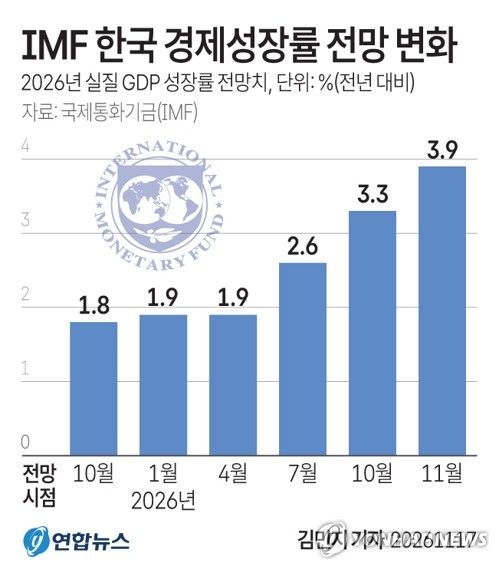
[Financial News] The International Monetary Fund (IMF) sharply raised its forecast for South Korea’s economic growth this year to 3.9%. It expects robust semiconductor exports, driven by increased global investment in artificial intelligence (AI), to fuel stronger growth than previously anticipated. It also assessed that South Korea’s potential growth rate could improve to around 2.5%.
However, the export structure’s heavy reliance on semiconductors and inflationary pressures were identified as obstacles to sustained growth. The IMF called for maintaining a tight monetary policy stance until inflation reaches the target level, and for diversifying export markets and products to reduce dependence on any one industry.
According to the Ministry of Economy and Finance on the 17th, the IMF released its “2026 IMF Annual Consultation Results,” which contains these findings. Annual consultations are meetings held each year by the IMF and its member countries, in accordance with the IMF Articles of Agreement, to review the economic situation in member countries.
■ Growth rate at 3.9% on AI boom ... potential growth also at 2.5%
The IMF forecast South Korea’s real gross domestic product (GDP) growth at 3.9% this year. That was 0.6 percentage points higher than its forecast of 3.3% released in October, a revision made in just over a month. It also raised its growth forecast for next year from 2.8% to 3.3%, an increase of 0.5 percentage points. After growth, which was just 1.1% last year, rebounds sharply this year, the IMF expects it to remain in the 3% range next year as well.
This forecast is higher than those of all major institutions. The Organisation for Economic Co-operation and Development (OECD) and Moody’s Corporation each projected 3.7%, while the Bank of Korea (BOK) forecast 3.3% and the Korea Development Institute (KDI) and Asian Development Bank (ADB) each projected 3.2%.
The IMF also assessed that South Korea’s potential growth rate could rise to around 2.5%. Potential growth is the rate of growth that can be sustained without fueling inflation, and is an indicator of an economy’s underlying strength.
The main factor behind the upward revision is strong semiconductor exports. The IMF said the AI boom is driving semiconductor exports to record levels and is also contributing to improved corporate earnings and increased government revenue. It expects a surge in exports from advanced technology industries, a rebound in investment and solid consumption to support growth this year, with growth continuing next year as investment in the AI transition gathers pace.
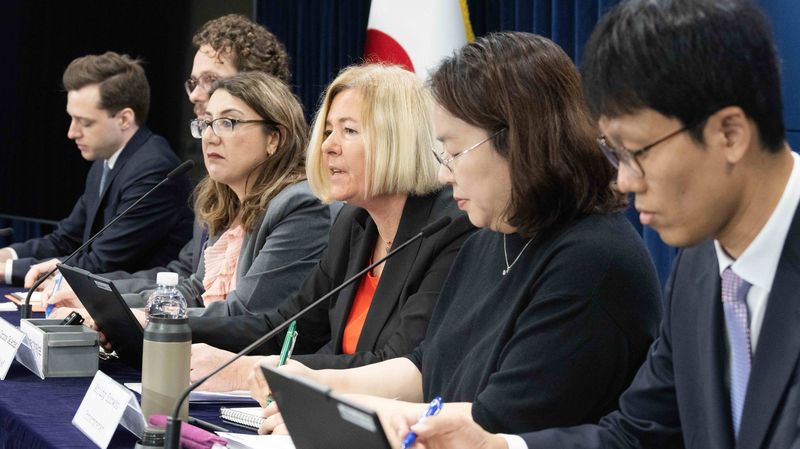
At a press briefing, Corinne Deléchat, head of the IMF mission to Korea, said, “Looking at the third-quarter results, they were better than we had expected, and taking into account all the recent export-related figures, we thought it was appropriate to issue an upward revision.” She added, “Other institutions are expected to revise their forecasts in the not-too-distant future.”
■ Guarding against overreliance on semiconductors ... calls for export diversification and tight monetary policy
However, the IMF assessed that it will take time for the benefits of the AI boom to spread throughout the economy. The gains from current growth are concentrated mainly in advanced technology industries, while structural problems—including an aging population, regional imbalances and productivity gaps between companies and workers—remain constraints on growth.
The IMF particularly identified the high dependence on semiconductor exports as a risk. If the semiconductor industry enters a downturn, the resulting shock to exports and overall growth could be greater. The IMF therefore recommended diversifying export markets and products and fostering service exports. It said South Korea has room to grow, given that its service exports are relatively weak compared with those of countries with similar-sized economies.
The IMF also warned of inflationary pressures. It forecast consumer price inflation of 2.7% this year and 2.3% next year. Both figures are above the Bank of Korea’s 2% inflation target. In particular, because core inflation is higher than overall inflation, the IMF recommended maintaining a tight monetary policy stance until inflation converges to the target level.
Deléchat stressed that “the two interest rate hikes implemented by the Bank of Korea this year were appropriate,” adding, “Ultimately, action should be taken to ensure that the price level converges to the target.”
[email protected] Kim Chan-mi Reporter