Check This Before the CSAT... One 'Thing' Could Void Your Exam
- Input
- 2026-11-17 15:45:23
- Updated
- 2026-11-17 15:45:23
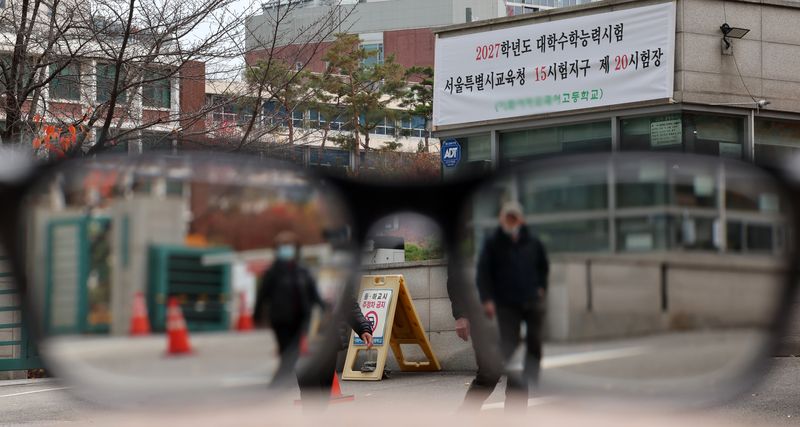
According to the education community on the 17th, test-takers should take care not to violate rules on possessing prohibited items at the test site, when they may write their answers, and the order in which they take their selected subjects in the 2027 CSAT.
The most common type of cheating detected in the CSAT over the past five years was writing answers after the end-of-test signal. According to data released by the office of Ko Min-jung of the Democratic Party of Korea (DPK), a total of 1,229 cases of cheating were detected from the 2022 academic year through the 2026 CSAT, held last November. Of these, 479 cases involved writing or changing answers after the signal, accounting for 39.0% of the total. They were followed by 348 cases of failing to turn in prohibited items and 286 cases of violating the rules for taking the fourth session.
The preliminary scoring sheet newly provided on the back of the admission ticket this year also requires care. Test-takers may use it to check their answers after the exam, but they must finish filling it out before the end-of-test signal for that session sounds. Transferring answers onto the scoring sheet after the signal sounds but before turning in the answer sheet may also be treated as cheating. When the signal sounds, test-takers must immediately put down their writing instruments and follow the proctor’s instructions.
AI smart glasses, which have recently drawn attention, are also prohibited items at the test site. The Ministry of Education has banned bringing all electronic devices into the test site, including smart glasses, mobile phones, smartwatches, tablet PCs, Bluetooth earphones and e-cigarettes. In particular, wearing smart glasses during the exam or using a smartwatch counts as cheating even if the device is not actually operated. If caught, a test-taker may have that exam invalidated and may also be barred from taking the CSAT the following year. Test-takers should also be careful to hand over any electronic device brought into the test site to a proctor before the first session begins; failing to do so may be treated as cheating even if the device is never actually used.
In the elective section during the fourth session, it is important to follow the order of the subjects selected. Test-takers must take the exam in the order of their selected subjects as listed on their admission ticket, and may place on their desk only the question booklet for the subject they are taking at that time. In particular, if a test-taker who selected two subjects writes or changes answers for the first subject, whose exam has already ended, during the time allotted for the second subject, this is considered cheating. Once the exam for a subject has ended, test-takers must not look at or touch their answers again.
Test-takers must enter their assigned exam room by 8:10 a.m. on test day. They must bring their admission ticket and a valid, unexpired photo ID; mobile IDs are not accepted. If they accidentally bring a prohibited item, such as a mobile phone, they must hand it over to a proctor before the first session begins. If they are caught possessing it without having turned it in, that exam will be invalidated.
The pre-exam orientation will take place on the 18th, the day before the test. Test-takers should receive their admission tickets at the orientation site and check the location of their test site and their selected subjects. They should also check their route and transportation in advance to avoid going to the wrong test site or missing the time for entering the exam room on test day. Only black computer-marking pens may be used on the answer sheet; personal mechanical pencils are not allowed. Test-takers should check which writing instruments are provided in the exam room and prepare in advance other items they will need that day, such as a packed lunch.
[email protected] Seo Ji-yun Reporter