'Productive Finance' Tailwind: Technology Credit Loans Rise by 22 Trillion Won in Nine Months, Already Surpassing Last Year's Total
- Input
- 2026-11-17 18:12:01
- Updated
- 2026-11-17 18:12:01

[Financial News] Technology credit loans to small and medium-sized enterprises have grown rapidly at banks so far this year. The outstanding balance, which increased by 16 trillion won over the whole of last year, has grown by more than 21 trillion won in just nine months this year. As financial authorities strongly urge banks to expand productive finance—moving away from real-estate-centered funding toward providing capital to innovative companies and advanced industries—banks, too, appear to be stepping up technology finance considerably.
Specialized banks up 13 trillion won; commercial banks up 7 trillion won
According to financial industry sources on the 17th, the outstanding balance of technology credit loans at 17 domestic banks stood at 340.4622 trillion won at the end of September, up 21.7324 trillion won from the end of last year. In just nine months, that was 5.7565 trillion won more than the full-year increase of 15.9759 trillion won last year.
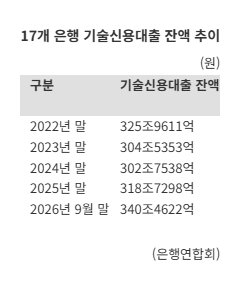
The outstanding balance of technology credit loans continued to expand, rising from 318.7298 trillion won at the end of last year to 326.0303 trillion won at the end of March this year, 335.0607 trillion won at the end of June, and 340.4622 trillion won at the end of September.
Technology credit loans are extended based on assessments of a company's technological capabilities and business prospects, as well as its financial condition and collateral. They are intended for small and medium-sized enterprises with technological capabilities. Unlike ordinary corporate loans, they incorporate the competitiveness and growth potential of a company's technology into credit assessments.
By bank type, the outstanding balance of technology credit loans at specialized banks (Korea Development Bank, Industrial Bank of Korea, Export-Import Bank of Korea, NongHyup Bank and Sh Suhyup Bank) rose by 13.6673 trillion won, from 154.0372 trillion won at the end of last year to 167.7045 trillion won at the end of September this year. Industrial Bank of Korea alone accounted for 12.3345 trillion won of the increase, or 56.8% of the total increase across the banking sector. By contrast, Korea Development Bank's balance fell by 95.5 billion won from a year earlier.
Over the same period, the balance at commercial banks (KB Kookmin, Shinhan, Woori, Hana, Citibank Korea Inc. and Standard Chartered Bank Korea Limited) increased by 7.742 trillion won, from 140.1494 trillion won to 147.8914 trillion won. Among commercial banks, Shinhan Bank recorded the largest balance and increase, with its balance reaching 45.7213 trillion won, up 2.8437 trillion won from the end of last year.
The balance at regional banks (BNK Busan Bank, BNK Kyongnam Bank, Gwangju Bank, Jeonbuk Bank, Jeju Bank and iM Bank) rose by 319.9 billion won, from 24.5465 trillion won to 24.8664 trillion won. Among regional banks, Busan Bank posted the largest increase, at 505.1 billion won. By contrast, iM Bank's balance fell by 247.8 billion won.
Rebound amid a push for productive finance
The outstanding balance of technology credit loans across the banking sector had been declining, standing at 325.9611 trillion won at the end of 2022, 304.5353 trillion won at the end of 2023, and 302.7538 trillion won at the end of 2024. The slowdown in growth at the time was reportedly affected by tighter standards for technology credit evaluation (TCB). When technology credit loans were first introduced in 2014, the range of companies eligible for technology credit evaluations was relatively broad, but the criteria for recognizing technology firms and the methods for calculating lending performance gradually became stricter.
A banking industry official explained, “A major factor behind the past decline in the outstanding balance of technology credit loans was the tightening of technology credit evaluation standards,” adding, “In some cases, even when existing loans were extended, they were excluded from technology credit lending totals under the stricter standards.”
The government's policy to expand productive finance is behind the recent increase in technology credit loans. Analysts say technology finance has once again come to the fore as financial authorities urge banks to expand funding for companies with technological capabilities and growth potential.
A banking industry official said, “Rising interest rates will increase the interest burden on small and medium-sized enterprises, but businesses will inevitably continue to need funding, including for working capital,” adding, “If the government's push to expand productive finance and banks' efforts to strengthen technology finance continue, technology credit lending could keep growing even in a high-interest-rate environment.”
[email protected] Seo Ji-yun Reporter