With Birth Rates Low, Even This Isn't Selling... Cereal, the Breakfast Staple, Loses Its Place
- Input
- 2026-11-18 08:24:14
- Updated
- 2026-11-18 08:24:14
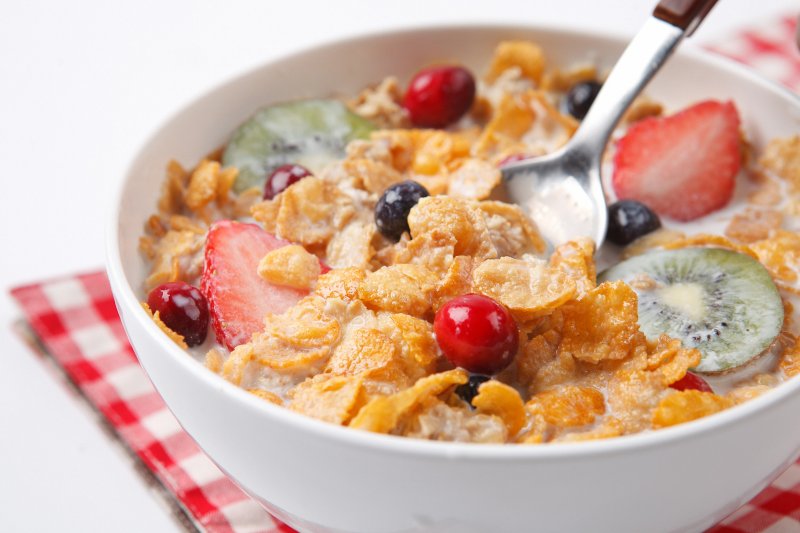
[Financial News] The cereal market, once beloved as a breakfast option by children and office workers alike, is steadily shrinking. Its position has weakened as the student population, a core consumer group, has fallen sharply amid low birth rates, while home meal replacements (HMR) and breakfast menus from cafes and burger chains have proliferated. With the market contracting by nearly 10% a year on average since the COVID-19 pandemic, cereal makers are seeking a rebound by lowering sugar content and promoting cereal bars that offer a convenient way to get protein.
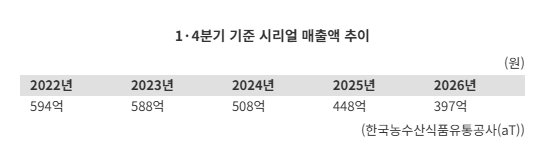
According to the Korea Agro-Fisheries & Food Trade Corporation (aT)’s Food Industry Statistics Information, domestic retail sales of cereal totaled 39.7 billion won in the first quarter of this year, down 5.1 billion won (11.4%) from 44.8 billion won in the same period a year earlier. Domestic cereal sales have been on a steady downward trend since the pandemic. First-quarter sales fell from 59.4 billion won in 2022 to 58.8 billion won in 2023, 50.8 billion won in 2024 and 44.8 billion won last year, before dropping into the 30-billion-won range this year—an average annual decline of nearly 10% over the past four years.
The biggest factor behind the cereal market’s contraction is considered to be the declining number of children and teenagers as a result of low birth rates. Students who grab a quick breakfast before school are the main consumers of cereal, but the steep drop in the school-age population has undermined its consumer base. According to the Ministry of Education, the number of elementary, middle and high school students nationwide has fallen steadily from 5.34 million in 2020, dropping below the 5 million mark this year.
The rapid growth of the HMR market and the food-service franchise sector’s stronger focus on breakfast menus are also replacing cereal. Advances in HMR technology have led to a wider range of convenient foods that can replace cereal eaten with milk—including frozen rice balls, bagels, porridge, protein shakes and Greek yogurt—giving consumers more options.
Food-service and cafe franchises have also had an impact by racing to offer affordable breakfast menus aimed at office workers on their way to work. At Starbucks Korea, sales of morning sets from January to July this year surged by at least 15% from the same period a year earlier. Paik’s Coffee has also made inroads into the morning market with “Paik Morning,” which pairs signature drinks such as Americano with bakery items such as salad bread at reasonable prices. The number of outlets offering it has grown fivefold from the end of last year, while related sales per outlet have at least doubled. Paris Baguette, McDonald’s, Burger King and convenience store chains have all joined the breakfast competition.
In response, cereal makers are launching granola with sharply reduced sugar content as well as cereal bars that provide protein anytime, anywhere without milk. They are seeking to attract customers across all age groups, including adults in their 20s and 30s who prioritize health and weight management, to make up for falling demand among children.
South Korea’s cereal bar market is estimated to have reached 100 billion won last year and is growing steadily by 5–10% annually. Orion Corporation, led by its Doctor You Bar series, currently leads the domestic cereal bar market with at least half of the market share, while Dong Suh Foods (Post) and Nongshim Kellogg have also rolled out a series of new products.
They are also making every effort to retain health-conscious consumers, including by expanding their low-sugar product lines.
An industry official explained, “The market has contracted directly because the alternatives to cereal for breakfast have become so varied—from HMR that can be heated up easily to coffee and sandwich sets and low-sugar, high-protein Greek yogurt.”
[email protected] Park Kyung-ho Reporter