Inadequate 'Safety Measures' for Malicious Comments on News Articles... Stalking Victims Left Defenseless
- Input
- 2026-11-17 15:13:17
- Updated
- 2026-11-18 20:38:49
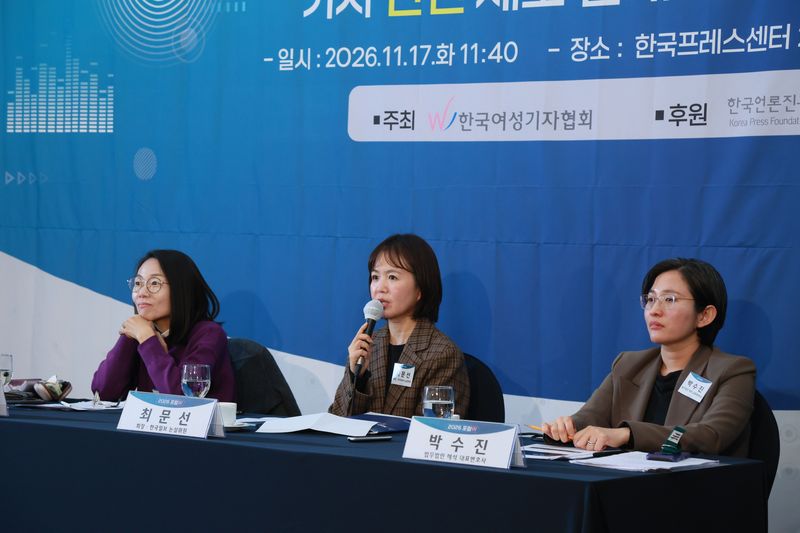
[Financial News] A survey has found that media companies' practical support systems are inadequate, despite continued cases of journalists being targeted with malicious comments and stalking. In particular, only 5 of the 35 media companies surveyed had measures or support systems in place to address stalking.
These survey results were released on the 17th at the 2026 Forum W for the second half of the year, held by the Korean Women Journalists Association at the Korea Press Center in Jung District, Seoul, under the theme 'Toward a Safer Workplace.' The association had previously conducted its first-ever comprehensive survey of all 35 member companies on the status of journalist safety policies and support systems, and held in-depth interviews with journalists who had actually experienced harm.
Kim Yu-gyeong, the labor attorney at Dolkkot Labor Law Firm who analyzed and presented the findings of the survey and in-depth interviews, noted, "While all 35 companies surveyed had rules for responding to workplace sexual harassment and sexual violence, only 15 had systems for responding to incidents involving people from outside the company."
Among those 15 companies (multiple responses allowed), 13 had a channel for reporting incidents or seeking counseling, 11 provided information about designated staff and departments, and 10 had temporary protective measures such as removing a journalist from reporting duties or changing their assigned work. However, only six companies each had protections for journalists' personal information and support for reporting incidents to police or filing complaints.
For stalking in particular, only five media companies had relevant systems. These were JTBC, TV Chosun, YTN, Chosun Ilbo and The Korea Times, which provided guidance on protective measures for victims and ways to secure evidence. The analysis found, however, that most support focused on the initial stage of victimization. New reporting formats such as YouTube were also found to be, in effect, a regulatory blind spot.
Kim, who has previously worked as a journalist, said, "A common point in the in-depth interviews with victims was that they suffered more because they were women, including being mocked for their gender." She proposed, "Major organizations such as media unions need to work together on a standard manual for responding to harm against journalists. In cases of harm within a company, improving the internal organizational culture among journalists will also be important."
A presentation followed on how to respond when attacks targeting journalists actually occur.
Attorney Park Su-jin of Hyesuk Law Firm outlined institutional and legal measures to protect journalists. "When harm occurs, it is very important to preserve evidence so that its ongoing and repeated nature can be demonstrated," she said. "When reporting an incident, it is best to use an official channel to prevent further harm." She explained that journalists can ask their companies to preserve malicious comments posted on media company websites and elsewhere as evidence, and that protective measures such as separating victims are also required by law.
On legal proceedings related to victimization, Park said, "It is important for the company to cover the legal costs while ensuring that the victim is the one receiving legal assistance." She added, "If someone does not have a lawyer, family members or acquaintances can accompany them when they attend legal proceedings. There are also special provisions for victims of sex crimes to receive legal support." The proposal called for continued legal support as perpetrators increasingly file complaints, including counter-complaints.
Korean Women Journalists Association Chair Choi Moon-seon said, "As outrage-baiting and polarization have intensified, attacks on journalists have become more frequent and more persistent, and women journalists are even more vulnerable." She emphasized, "Attacks on journalists are an attempt to silence the press, making institutional safeguards to protect journalists increasingly necessary."
[email protected] Yeon Ji-an Reporter