‘From the Twenty-Year-Olds of 60 Years Ago to Today’s Twenty-Year-Olds..’
- Input
- 2026-11-17 14:29:55
- Updated
- 2026-11-17 14:29:55
[Financial News] This year marks the 60th anniversary of the official dispatch of Korean nurses to Germany. The dispatch of nurses, which began in 1966, has reached its 60th anniversary, and 60 years had already passed by 2023 since the first miners arrived in Germany in December 1963.
Commemorative events, large and small, expressing gratitude for their efforts are also continuing in Korean society. Tributes such as inviting them back to their homeland or holding events to thank them are meaningful. But if they end with a single event, their stories can easily remain only as a fleeting emotional experience.
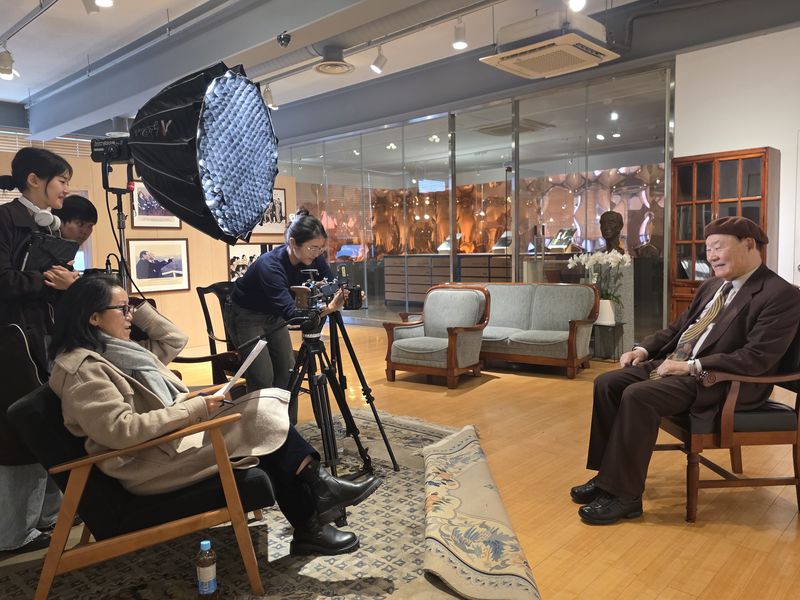
The incorporated Korean-German Cultural Exchange Association (LIDO-Korea), based in Busan and chaired by Jeong Mun-su, is an organization that researches and documents the history of Korean migration to Germany and promotes cultural exchange between Korea and Germany. Since last November, the association has been actively pursuing an oral history video project on first-generation Korean migrants to Germany and their descendants. It is a major project involving filming in Seoul, Busan and locations across Germany.
Thanks to support from the Seongju Foundation, the Hong Kong Yang Seong-won Foundation and association members, as well as the dedicated volunteer work of director Lee Min-a and Maken Film Asia, the project has so far captured the life stories of 59 people from the first to third generations of nurses and miners dispatched to Germany. The first generation is now in their late 70s and 80s. There was little time to spare.
This oral history video project was designed from the outset to bring the stories into contact with young people. The stories of the first generation have also been interwoven with the voices of the second and third generations to portray migration not as an event confined to one generation but as lives that continue across generations.
The association does more than express gratitude; it asks questions. It is asking together what the experiences of people who took their first steps in an unfamiliar place can offer young people today, and how young people are confronting their own uncertainties. The project was designed to ensure that this conversation can continue in a sustainable way.
An association official said, “Oral history videos are not exhibits that people watch once and then leave behind; they are materials that can be revisited and used in university classes. Talk concerts are occasions where young people do not just listen but speak for themselves,” adding, “As records accumulate and young people’s questions accumulate, this work will grow from an annual commemoration into a conversation that connects generations.”
The official went on to emphasize, “We are not saying that this work will resolve young people’s anxieties for them. The times and conditions are different. But I believe that recognizing, through people’s real faces and voices, that the anxiety felt in the face of great change is not mine alone, that others took that path before us, and how they took their first steps gives us a different kind of strength from vague encouragement.”
Next year will be when the records gathered so far are presented in the form of a documentary film and talk-concert conversations. The association plans to edit the oral history videos of the 59 people recorded to date into a documentary film titled “Unknown Diversity.” The film will bring together the first, second and third generations, capturing not only the first scenes of migration but also the lives that followed.
The edited video materials will first reach young people through their integration into general education courses at universities in Busan and Jeju. Students will watch the videos together and take part in talk concerts, where they add their own stories to the questions raised in the videos. The completed film will be screened at a suitable venue to be arranged, and the association plans to make these stories accessible to members of the public beyond the universities.
An association representative said, “‘The unknown’ is both fear and anticipation. The twenty-year-olds of around 60 years ago chose anticipation. We want to tell young people today what kind of lives that choice led to.”
This is why the association is so devoted to preserving these stories. It also published the Korean edition in 2024 of “Unknown Diversity (Unbekannte Vielfalt),” whose first German-language edition came out in 2014.
The word “unknown” in the book’s title carries both the meanings of “unfamiliar” and “unknowable.” People fear what is unfamiliar, yet because they do not know what lies ahead, they look forward to the possibilities the future may bring. The book sought to share the diverse stories hidden behind that fear.
But the written word alone cannot fully convey the full range of the voices or the messages hidden within them. That is why the association began its oral history video project last year.
■ The twenty-year-olds who first set out for an unfamiliar land
Most of the nurses and miners who left for Germany in the 1960s and 1970s were in their 20s. Escaping poverty and supporting their families back home were major reasons, but they were not the only ones. Each set out for an unfamiliar land, where they did not speak the language, carrying their own dreams.
The stories captured in the oral history videos show how they made their way through that uncertainty. One nurse volunteered for patient transport duties to learn German. She stuck notes with German words to beds and wheelchairs and memorized them as she went about her work. Two years after arriving in Germany, she met a bishop through the head nurse at a Catholic hospital. She boldly asked him to help her bring over the two children she had left in Korea, and secured his signature on an invitation letter. She later became the hospital’s personnel director. A business partner of a couple who had opened a grocery store in Düsseldorf drove a truck every Monday on a 1,200-kilometer round trip to Rungis Market in Paris to bring back fresh fish. There was nothing they could not endure.
There were tears and laughter, too. The filming team cried along with a miner who confessed that his homesickness was so intense that any young woman with black hair reminded him of his wife, whom he had left behind in Korea. Everyone burst out laughing at a nurse’s story about taking bubble baths with a colleague and dishwashing detergent in their dormitory bathroom when they could barely speak German, until the staff came rushing in. Their children grew up to become doctors, lawyers, professors, businesspeople, pilots and artists, becoming important members of German society and a bridge connecting Korea and Germany.
Their lives became a guide for later generations. In every interview with members of the second generation, it was clear that their mothers’ influence continued deeply and enduringly into the lives of the next generation. The first generation’s example of choosing their own paths rather than fearing the unfamiliar became a role model for their children and grandchildren.
[email protected] Byun Ok-hwan Reporter