Radio Signals Are Blocked at Presidential Events—Why Not at CSAT Test Sites?
- Input
- 2026-11-17 15:46:55
- Updated
- 2026-11-17 15:46:55
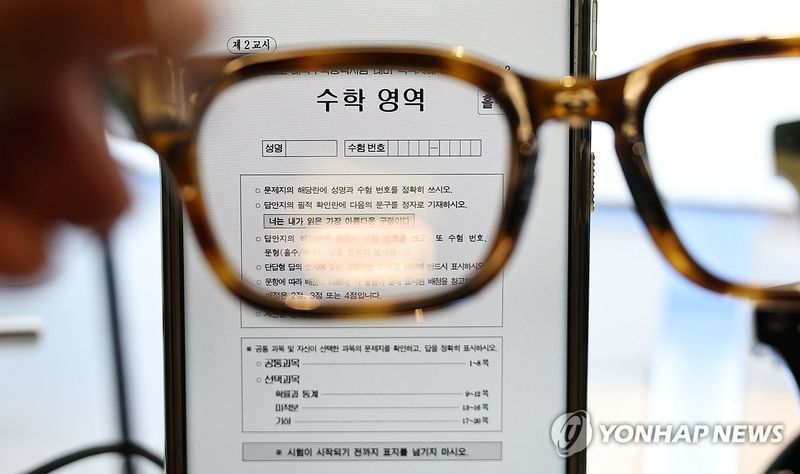
[Financial News] Ahead of the College Scholastic Ability Test (CSAT), the government is stepping up measures to prevent cheating using artificial intelligence (AI), but is running up against technological limitations. Radio-signal jamming technology used for presidential security is constrained by law, and LTE and 5G data communications remain available even if public Wi-Fi is shut off. It is also difficult to completely cut off communications around test sites. Although inspections for smart devices being brought into exam venues and supervision are being strengthened, it appears virtually impossible to completely prevent cheating using AI.
According to the government on the 17th, Prime Minister Han Seong-suk announced measures that day to strengthen inspections of smart devices brought into test sites and supervision there in order to prevent cheating on the CSAT. However, the measures did not include blocking communications to fundamentally prevent cheating using AI.
Above all, blocking communications themselves is difficult in practice. In the case of “jamming,” which blocks communications by transmitting interference signals on specific frequencies, it is used at presidential security events to cut off communications within a designated area around the venue, but it is difficult to apply it as-is at CSAT test sites.
Article 29 of the current Radio Waves Act generally prohibits acts that interfere with or block other people’s use of radio waves. Radio-wave jamming devices may be used as an exception when unavoidable for public safety, such as presidential security, counterterrorism or military activities, but preventing cheating on exams does not qualify for that exception. This means a separate legal basis would first have to be established before jamming could be introduced for the CSAT.
Telecommunications carriers also face significant practical constraints in blocking LTE and 5G mobile networks. Because mobile networks operate on a base-station basis, it is difficult to cut off communications only at selected test sites. Shutting down a base station could disrupt communications for mobile phones in nearby apartment buildings and shops, as well as on roads. There is also concern that applying this simultaneously at all 1,312 test sites nationwide could disrupt data communications and even emergency calls to 112 and 119 across a wide area.
Some have also floated limiting the AI services themselves. In China, during the Gaokao, the college entrance exam, last June, major AI companies including DeepSeek, Tencent Holdings Limited and Alibaba temporarily restricted image-analysis features. The measure was intended to prevent people from photographing exam questions and asking AI for the answers.
However, the situation in China differs from that in South Korea. China’s domestic AI companies lead the market, making cooperation with the government relatively easy, whereas global AI services such as ChatGPT, Gemini and Claude command an overwhelming share of the market in South Korea. Observers say that restricting global services in line with the exam schedule of a particular country is itself difficult.
A telecommunications industry official said, “A blanket shutdown of communications at test sites could affect surrounding areas, so we need to proceed cautiously,” adding, “Rather than relying solely on blocking communications, we should put in place a range of measures, including managing the entry of smart devices and conducting on-site inspections.”
[email protected] Yoon Hong-jip Reporter