Special Counsel Probe Into Fabricated Prosecutions Nears Launch... Appointments and Securing Records Among Key Tasks
- Input
- 2026-11-17 14:38:12
- Updated
- 2026-11-17 14:38:12
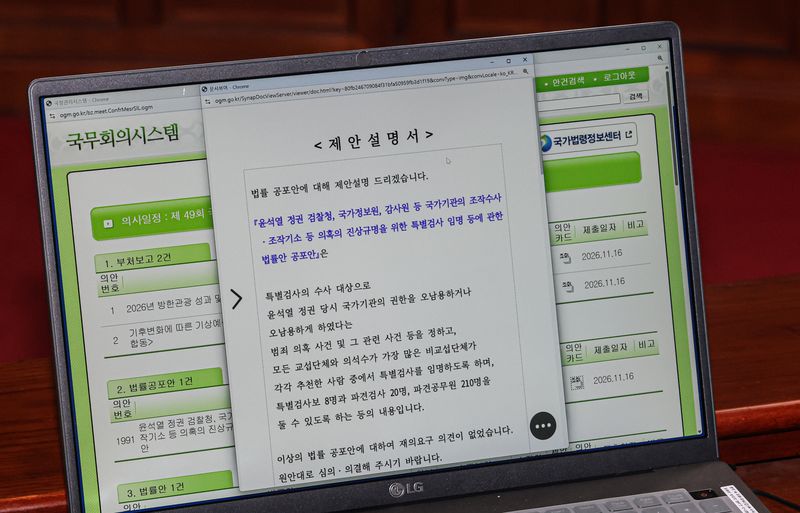
[Financial News] With the so-called “Special Counsel Act on Fabricated Prosecution” passing the State Council on the 17th, procedures to launch the special counsel investigation have moved into full swing. A special counsel is expected to be appointed as early as the end of this month, with securing existing investigation and trial records and the potential impact on ongoing trials emerging as key initial challenges.
According to legal circles, the Special Counsel Act on Fabricated Prosecution passed the State Council that day. The bill will be formally promulgated once President Lee Jae Myung gives his assent. The act stipulates that the speaker of the National Assembly must ask the president to appoint a special counsel within two days of its effective date. The president must request candidate recommendations within three days of receiving the request, and the ruling and opposition parties must recommend candidates within three days of receiving that request. The president must appoint a special counsel within three days of receiving the recommendations. The statutory deadlines add up to 11 days, making appointments possible by the end of this month if the process proceeds smoothly.
The special counsel will investigate for up to 180 days, excluding a 20-day preparation period. The main targets are allegations of unlawful acts, including fabricated investigations and the inducement of statements, raised during investigations and prosecutions of cases related to President Lee Jae Myung, including the Daejang-dong, Wirye New Town and Baekhyeon-dong development projects, violations of the Public Official Election Act, and the Ssangbangwool case involving alleged remittances to North Korea. The targets also include alleged statistical manipulation related to the Moon Jae-in administration and the case of a civil servant shot in the Yellow Sea. The special counsel can form an investigative team of up to 309 people, including one special counsel, eight deputy special counsels, 20 seconded prosecutors, 70 special investigators and 210 seconded public officials.
After the special counsel is appointed, reviewing records held by existing investigative agencies is expected to be a priority. Article 20 of the act allows the special counsel to request copies of investigation and prosecution-maintenance records from relevant agencies, including the Public Prosecution Office, the Serious Crimes Investigation Agency (SCIA), the Corruption Investigation Office for High-ranking Officials (CIO) and the four existing special counsel teams. In cases under trial, the special counsel may apply to the presiding judge to inspect and copy trial and evidence records, and the judge must grant the request unless there are special circumstances. The special counsel may also investigate during the 20-day preparation period to prevent the destruction of evidence.
Han Sang-hee, an emeritus professor at Konkuk University Law School, said, “In the early stages of the investigation, reviewing existing documents and records, as well as the trial proceedings, will be the starting point,” adding, “That is how potential charges can be identified.”
However, if investigations by the existing Prosecution Service Committee on Respect for Human Rights and the Future and the fact-finding team did not uncover clear signs of illegality, it may not be easy for the special counsel to prove the allegations. Professor Han said, “If there was a report that the internal investigation had found no particular illegality, the task facing the special counsel would become considerably more difficult,” adding, “That does not mean the investigation should be pursued excessively.”
The relationship with ongoing trials is also a point of contention. During revisions to the bill, a provision granting the special counsel the right to demand the transfer of cases that prosecutors are investigating, prosecuting or maintaining prosecutions in was deleted. However, legal disputes may arise over the effect on related trials if the special counsel’s investigation uncovers illegality in the original prosecution process.
Jung Tae-ho, a professor at Kyung Hee University School of Law, said, “The special counsel’s task is to determine whether the indictment itself was fabricated, not to interfere in the trial,” adding, “If fabrication is confirmed, the Public Prosecution Office should withdraw the indictment.” Professor Han, by contrast, stressed, “There may be procedural delays resulting from inspecting and copying trial records, but they must not affect the outcome of the trial.”
Controversy also remains over a supplementary provision recognizing the special counsel’s and seconded prosecutors’ powers to investigate and direct investigations under the former Criminal Procedure Act. Song Kyung-ho, former chief of the Seoul Central District Prosecutors’ Office, and Hong Seung-wook, Kim Yoo-cheol and Shin Bong-soo, former chiefs of the Suwon District Prosecutors’ Office, issued a joint statement that day, saying, “It even overturns the principle of separating investigation and prosecution and grants the privilege of applying exceptional criminal procedures only to the cases in question, thereby violating the right to equality and undermining the foundations of the criminal justice system.” They added, “It has included even cases that have already gone through investigation and prosecution and are currently pending before the courts in the special counsel’s scope of duties,” expressing concern that this would undermine judicial independence. They said they would take legal action to challenge the act’s constitutionality.
[email protected] Choi Eun-sol Reporter