Quadruped Robot Rides the Rails to Inspect a Tunnel ... First Deployment in Bundang Tunnel on the Bundang Line
- Input
- 2026-11-17 13:27:20
- Updated
- 2026-11-17 13:27:20
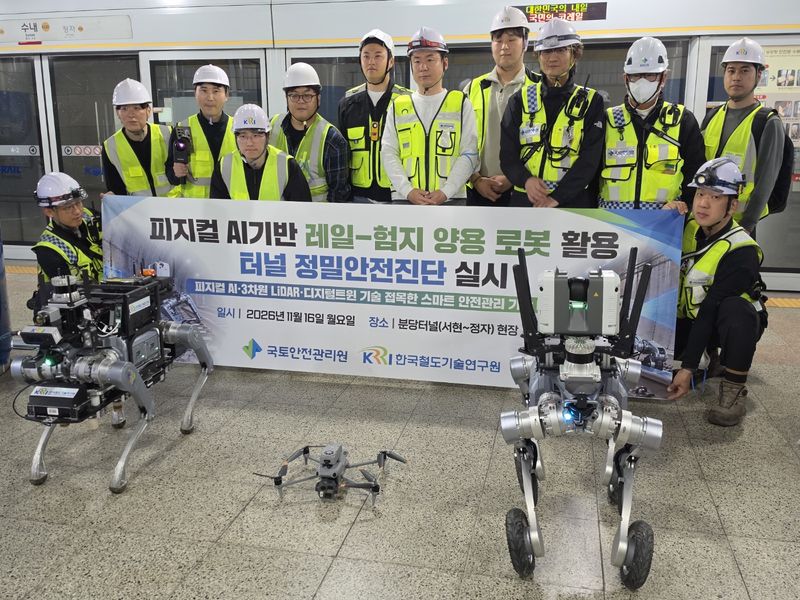
[Financial News] The Korea Authority of Land and Infrastructure Safety deployed a physical AI-powered “rail-and-rough-terrain dual-purpose robot” for a detailed safety diagnosis of Bundang Tunnel on the Bundang Line.
According to the Korea Authority of Land and Infrastructure Safety on the 17th, the authority inspected Bundang Tunnel the previous day using such advanced equipment in collaboration with the Korea Railroad Research Institute (KRRI). The effort aims to complement conventional tunnel inspections, in which inspectors walked through the tunnels to examine them. The goal is to protect inspectors and improve inspection efficiency by applying physical AI and 3D geospatial information technology in the field. This field deployment was carried out under a memorandum of understanding between the two institutions to introduce advanced technologies and enhance safety diagnostics.
The quadruped robot drew the most attention at the site. It traveled back and forth along the rails on its own, collecting data, and quickly and precisely measured areas that were difficult or dangerous for people to enter. The authority used the LiDAR mounted on the robot to capture the tunnel’s geometric shape and 3D spatial information. The 3D point cloud data, which represents the tunnel structure as countless points, is expected to significantly address the limitations of conventional inspections that relied on 2D drawings and visual surveys.
The point cloud data was linked to a digital twin, creating a basis for recreating the actual tunnel in a virtual space and viewing the condition of its facilities in three dimensions. Combining diagnostic results with spatial information makes it possible to systematically manage the locations of damage. The data can also be used to compare and analyze changes in facility conditions and to keep digital maintenance records.
The robot used in this demonstration is a railway-specific robot being developed by KRRI. In June this year, KRRI launched a project to develop core track inspection technologies based on railway-specific robots. The approach involves using drones, cameras and LiDAR to collect data on actual tracks and their surroundings and create a 3D virtual space, where the robots learn visual perception and movement control. The research will continue for three years, through 2028. An integrated inspection system is also under development: drones first scan wide sections, robots then go to anomalies for detailed inspection, and a control center records the results.
A detailed safety diagnosis is a statutory assessment that examines the condition of Class 1 facilities in the greatest depth. The required frequency depends on the safety rating: at least once every six years for Grade A, every five years for Grades B and C, and every four years for Grades D and E. The authority plans to make active use of robots and digital technologies in tunnels like this one, where many sections are difficult for people to access.
Park Chang-geun, head of the Korea Authority of Land and Infrastructure Safety, said, “This collaboration is highly significant because it brings together the authority’s expertise in detailed safety diagnostics and the Korea Railroad Research Institute’s research capabilities in robotics and advanced railway technologies.” He added, “We plan to actively use robots powered by physical AI to inspect hazardous areas, as well as digital safety management technologies based on 3D spatial information, in detailed safety diagnoses of infrastructure, including tunnels.”
[email protected] Jeong Gyeong-su Reporter