Korea Forest Service Conducts Special Safety Inspections at Autumn Logging Sites
- Input
- 2026-11-17 13:20:56
- Updated
- 2026-11-17 13:20:56
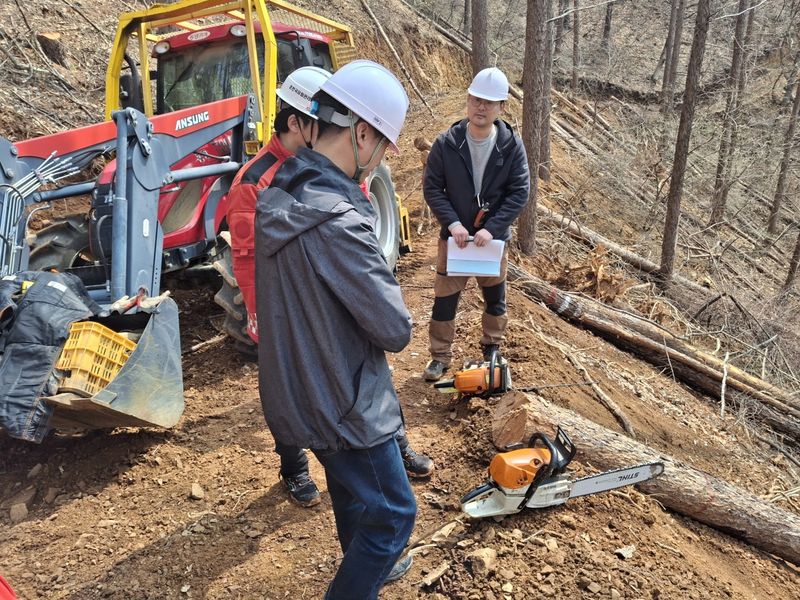
The Korea Forest Service said on the 17th that it had conducted special inspections of safety management practices at forest project sites from the 4th through the 17th, together with local governments. The inspections covered major forest projects involving tree-cutting work, such as forest tending and pest control, as well as areas authorized for logging. The agency also stepped up on-site management, including guidance on safety rules, at sites where standing timber had been sold and the buyers were to carry out the felling themselves.
Inspection teams focused on whether basic safety rules directly linked to preventing fatalities and injuries were being followed at the sites. Key items included maintaining a safe distance of at least twice the height of the tree being felled; designating escape routes and clearing nearby obstacles; following the directional-felling procedure, which determines the direction a tree will fall; ensuring that at least two people work together; and wearing personal protective equipment such as hard hats. Teams also carefully checked access controls around heavy equipment such as excavators, the assignment of signalers, pre-work safety meetings (TBM), and the availability of first-aid supplies.
The Ministry of Employment and Labor and the Korea Occupational Safety and Health Agency also took part in the joint inspections, helping make them more effective. The Korea Forest Service plans to go beyond on-site enforcement and, in consultation with relevant government agencies, include logging work in the scope of special safety and health training. It also intends to accelerate revisions to related regulations, including setting qualification standards under the Occupational Safety and Health Act so that only experienced workers with the required qualifications can carry out logging work.
Forestry is considered a high-risk industry, with a greater risk of serious accidents than other industries because the work involves steep slopes and uneven terrain, as well as handling heavy logs and sharp chainsaws. In particular, from autumn—when temperatures cool and tree growth stops, improving timber quality—through the following spring, logging work peaks nationwide. This is also when so-called “logging accidents,” such as workers being crushed by falling trees or struck by branches that fly off, occur most frequently.
Bang Jae-il, head of the Korea Forest Service’s Forest Safety, Health and Jobs Team, said, “Through this special inspection, we will carefully identify and address harmful and hazardous factors at forest project sites and swiftly pursue improvements to related systems,” adding, “We will create a safe working environment where forestry workers in the field can work with peace of mind.”
[email protected] Kim Won-jun Reporter