Supreme Court of Korea to Hold Deliberations and Issue Rulings on Same Day... Unprecedented Schedule Under Chief Justice Cho Hee-dae
- Input
- 2026-11-17 14:05:56
- Updated
- 2026-11-17 14:05:56
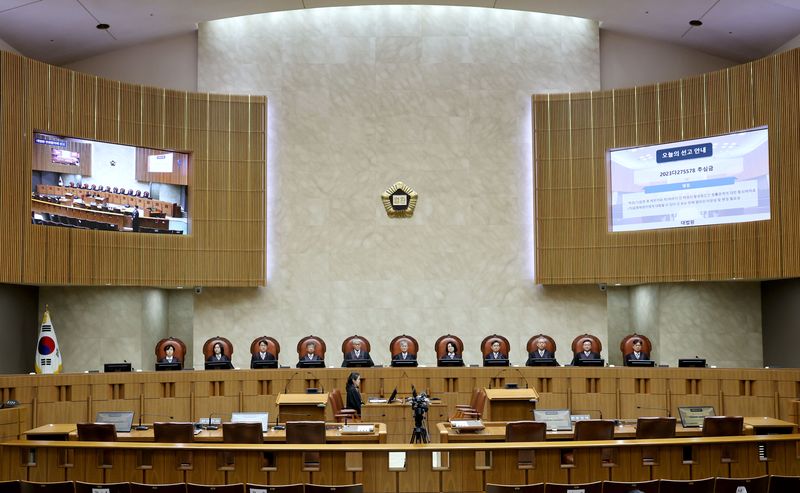
According to legal sources on the 17th, the Supreme Court of Korea on the 16th, set the 19th as the date for en banc rulings in three cases: Han’s insurrection case, Kim Keon Hee’s case involving alleged violations of the Capital Markets and Financial Investment Business Act, and a civil case seeking reimbursement of costs. Justice Oh Kyung-mi is the justice in charge of Han’s case, and Justice Park Young-jae is the justice in charge of Kim’s.
The 19th is also an en banc deliberation session for the Supreme Court of Korea. The court held its first deliberation session on September 29 and set the second for the 19th, but also scheduled a ruling session for that same day. In response to a query from this newspaper asking, “Will deliberations and a ruling in Han’s case, including the charges of aiding and abetting the leader of an insurrection, both take place on the 19th?” the National Court Administration replied, “That appears likely.”
None of the 31 en banc rulings handed down since Chief Justice Cho took office on December 11, 2023, was issued on the same day as deliberations. For this reason, many believed it would be practically impossible to issue a ruling on the 19th. The reasoning was that an en banc deliberation session gives all the justices an opportunity to examine the issues and exchange views, making it difficult to complete a written judgment that same day. With Han’s detention period set to expire at midnight on the 20th, there was speculation that he could be released without a ruling.
The Supreme Court says deliberations have already concluded. In a statement to the media, the National Court Administration said, “If discussions that continue up to an en banc deliberation session result in sufficient agreement to make a ruling possible, a ruling date may be set immediately,” and “in addition to regular en banc deliberation sessions, the justices involved exchange views, discuss matters and meet frequently in various ways.” It also explicitly stated that Han’s detention deadline had been taken into account. Explaining its decision to set a ruling date in Han’s insurrection case, it said, “Since the previous deliberation session on September 29, there has been ongoing review and discussion taking into account developments in related cases and any contradictions or conflicts with them, the expiration of the detention period, and the status of the examination and deliberations in each case. The ruling date was set after these circumstances were considered as a whole.”
Concerns have also been raised in legal circles. An official at the Serious Crimes Investigation Agency (SCIA), who previously served as a senior prosecutor, said, “Because the ruling is being issued on the day of deliberations, there could be controversy over whether a decision was reached to meet the detention deadline without sufficient review,” adding, “It could even lead to complaints being filed against the justices under the distortion-of-law offense.”
However, Article 123-2 of the Criminal Act, the distortion-of-law offense that took effect last March, makes the intentional misapplication of laws or the fabrication of evidence punishable, while the legislative process explicitly excluded discretionary judgments made within the bounds of reasonable interpretation.
The Special Prosecutor’s Office for Insurrection (Special Prosecutor Cho Eun-seok) submitted an opinion on the 5th requesting a swift ruling, and another on the 13th arguing that Han should be released, even on conditional bail. The National Court Administration said, “Many reports state that a Supreme Court ruling cannot be handed down before the detention period expires and that he will be released immediately. However, such categorical reporting could lead to misunderstandings, so we ask that it be avoided.”
Han is accused of recommending that a Cabinet meeting be held to make it appear that the December 3 emergency martial law declaration had been deliberated by Cabinet members, and of trying to obtain their signatures after martial law was declared. He was indicted without being detained in August last year, sentenced to 23 years in prison at his first trial on January 21 and detained in court, then had his sentence reduced to 15 years on appeal on May 7.
The issue is the scope of the offense of performing a key role in an insurrection. The question is how far responsibility can extend for arranging the procedures for declaring martial law or supporting its implementation, even if a person did not directly plan the emergency martial law or command the military and police. Both the first and second trials found that Han’s actions amounted to performing an important role in the insurrection.
The Supreme Court of Korea is ruling on an insurrection case for the first time in 29 years. The only precedent was the en banc court’s ruling in April 1997, when it upheld life imprisonment for former President Chun Doo-hwan and a 17-year prison sentence for former President Roh Tae-woo on appeal in the 12·12 Military Insurrection and 5·18 cases. The presiding justice was Justice Jeong Gwi-ho.
Kim’s case, involving the so-called “three major allegations” and set to be ruled on at the same time, has three prongs: violations of the Capital Markets Act and the Political Funds Act, and mediation bribery under the Act on the Aggravated Punishment of Specific Crimes. On April 28, Criminal Division 15-2 of the Seoul High Court (High Court Judges Shin Jong-o, Sung Eon-ju and Won Ik-seon) found Kim guilty of Deutsche Motors stock-price manipulation, which the first trial court had acquitted her of, and sentenced her to four years in prison and a fine of 50 million won.
[email protected] Kim Dong-gyu Reporter