Bank of Korea Says Korean Workers Spend 2.8 Trillion Won a Year on AI, Yet Productivity Stagnates
- Input
- 2026-11-17 12:00:00
- Updated
- 2026-11-17 12:00:13
[Financial News] South Korean workers’ use of generative artificial intelligence (AI) has surged to the highest level among major economies, but AI is still not being used extensively for “core tasks,” the essence of their jobs. A diagnosis of the situation found that while AI adoption has more than doubled the amount of work time saved year on year, this has not directly translated into actual gains in companies’ quantitative productivity.
According to a report released by the Bank of Korea on the 17th, titled “AI Diffusion and Productivity Effects: More Widely, More Efficiently, but Still Shallow,” the rate of AI use for work in South Korea rose sharply to 66.5% this year, up from 51.8% the previous year.
This figure is nearly twice the average for the United States and six European countries (33.7%), with the rate of diffusion the fastest among major economies. This rapid adoption was driven by the swift expansion of paid subscriptions, which came with individuals bearing the cost.
Among users of work-related AI, 28.4% had paid subscriptions that they covered themselves. Their average monthly spending was 49,000 won (median: 29,000 won). The top 10% spent an average of 87,000 won a month, the top 5% spent 140,000 won, and the top 1% spent 350,000 won. Paid AI use was also more common among younger people, less-senior workers, and those with higher levels of education and income.
Based on these figures, workers’ total annual spending on AI is estimated at about 2.8 trillion won. However, this is far lower than the potential value of the time saved through AI use, estimated by converting it into monetary terms at about 61.1 trillion won.
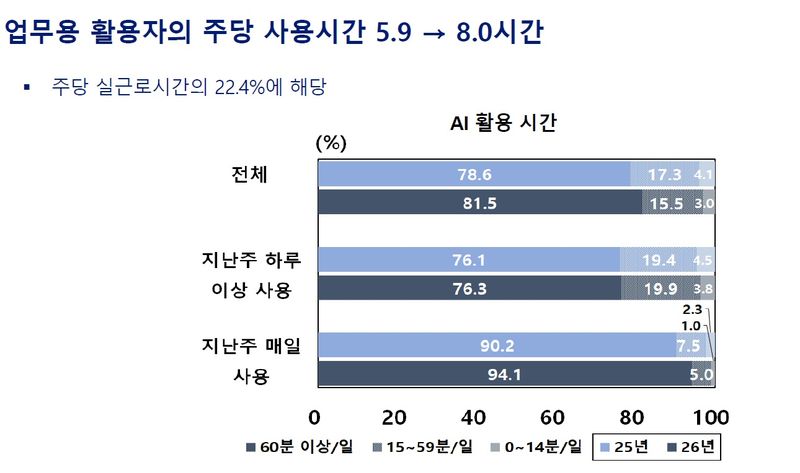
In a survey last August of more than 16,000 employed people aged 18 to 64, the BOK found that the average rate of weekly work-hour savings from AI use surged 2.4-fold, from 3.8% last year (1.5 hours based on a 40-hour workweek) to 9.2% this year (3.7 hours). The BOK projected that, if this upward trend continues, the figure will rise next year to nearly a full day’s working hours (eight hours).
The time-saving effect was more pronounced among workers with higher levels of education and among those with paid subscriptions or company support.
A particularly noteworthy point is the disconnect: time savings have little connection to actual results.
The time saved through AI is reportedly being reinvested mainly in focusing on core tasks (33.8%) and handling additional work (29.3%). Yet the correlation between the rate of time saved and the growth rate in actual work volume (quantitative output) remained very low at 0.08. Even if workers finish tasks faster, that does not directly increase output if a company’s total assigned workload or demand remains fixed.
Oh Sam-il, head of the BOK’s Employment Research Team, explained, “AI use and time savings increased rapidly over the past year, but we found that AI’s penetration into core tasks and growth in output remained limited.”
The BOK recommended that future AI policy and corporate management shift their focus away from simply increasing adoption rates and usage time.
The point is that, beyond simply using AI, companies need to support innovation in how work is done—including reorganizing workflows, redesigning organizational structures and redeploying staff—so that the time saved translates into real value.
[email protected] Jung Sang-gyun Reporter