Mercedes-Benz to Expand Hands-Free Driving Beyond Highways to City Streets... Launch in U.S. and Germany Next Year
- Input
- 2026-11-17 11:06:26
- Updated
- 2026-11-17 11:06:26
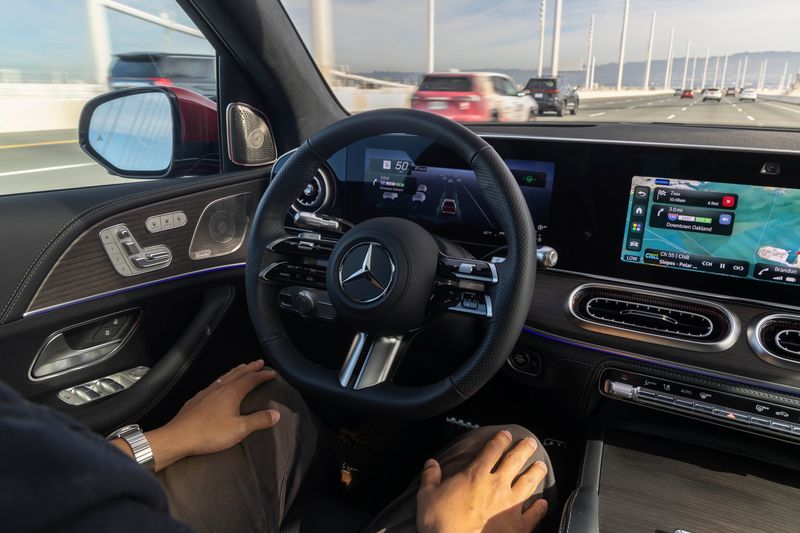
[Financial News] Mercedes-Benz will unveil advanced driving assistance technology that not only lets drivers travel on highways without touching the steering wheel but also helps them reach their destinations in complex urban areas. By combining artificial intelligence (AI), high-performance sensors and computing technology, the company is expanding its driving-assistance capabilities to reduce driver intervention and strengthen its competitiveness in software-defined vehicles (SDVs).
Mercedes-Benz said on the 17th that it would roll out new features of MB.DRIVE, an advanced driving assistance system that supports hands-free driving and travel from origin to destination, in stages in the German and U.S. markets.
Hands-Free Assist, which will first be introduced in Germany at the end of this year, allows drivers to take their hands off the steering wheel and drive on highways at speeds of up to 130 km/h, provided certain conditions are met. The technology reduces the burden of long-distance driving by having the vehicle perform routine driving tasks in response to traffic conditions.
Proactive Lane Change Assist, introduced alongside it, enables the vehicle to initiate and complete lane changes on its own, without a separate instruction or approval from the driver. It can be used to overtake a slower vehicle ahead or take a highway exit along the navigation route. Drivers must still monitor traffic conditions at all times and take control of the vehicle immediately if necessary. In the United States, Hands-Free Assist is set to be introduced nationwide next year.
In the first half of next year, Mercedes-Benz will launch MB.DRIVE ASSIST PRO in Germany and the United States, extending driving assistance to urban areas. After setting a destination in the navigation system, the driver presses a button on the steering wheel and the vehicle assists with driving along the route. The system also handles complex urban driving situations, including lane changes, turns at intersections, slowing down and stopping at traffic lights, and setting off again.
High-performance sensors and computing systems are at the heart of the technology. The vehicle is equipped with a total of 27 sensors, including 10 cameras, five radar sensors and 12 ultrasonic sensors. The collected data is analyzed by a high-performance computer capable of processing up to 254 trillion operations per second. The features are expected to be available across all powertrain types, including electric and internal combustion vehicles.
Starting in December, Mercedes-Benz will also run a preview program for select customers in Stuttgart and Munich, Germany, and California in the United States. The company plans to improve the system ahead of its official launch by gathering customer feedback in real-world road conditions. Existing vehicles equipped with the required hardware will be able to add the features through a future software update.
Mercedes-Benz is also stepping up its partnerships with global technology companies. It jointly developed an urban driving assistance system for Western markets with NVIDIA Corporation, and introduced related features in China in partnership with local company Momenta. More recently, it began working with U.K.-based AI autonomous driving technology company Wayve to develop next-generation driving assistance technology for both urban roads and highways.
Jörg Burzer, chief technology officer (CTO) of Mercedes-Benz Group, said, “By combining software, sensors and computing technology with hands-free functions and an advanced driving assistance system that supports travel from the starting point to the destination, we provide customers with a more convenient driving experience. With just the push of a button, the vehicle assists with the drive from the starting point to the destination, greatly reducing the burden on drivers and making everyday life more convenient.”
[email protected] Kim Dong-ho Reporter