“Shot Up in an Instant”... What a Power Bank Fire Test Revealed [Field Report]
- Input
- 2026-11-17 19:25:47
- Updated
- 2026-11-17 19:25:47
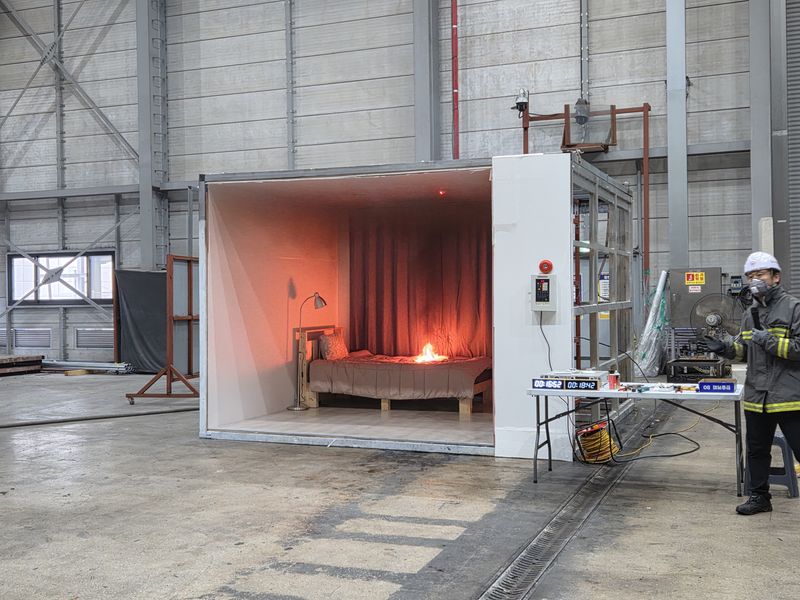
At that moment, an alarm sounded: “Fire, fire.” It came from the smoke detector mounted on the ceiling. It was just 16.52 seconds after smoke became visible. Flames then suddenly flared up and, just as quickly, reached the ceiling. The heat detector also sounded an alarm 1.90 seconds after the smoke detector went off.
Just 16 seconds after smoke appeared... early detection is key
The scene of a power bank fire-risk scenario reenactment and a comparison of smoke and heat detector responses, held at the Fire Protection Research Institute in Yeoju, Gyeonggi Province, on the 17th. The institute is a research organization affiliated with the Korea Fire Insurance Association, established to promote quality improvements in fire-protection products and contribute to advances in national fire-prevention technology. It opened as the Fire Prevention Testing Laboratory in 1986 and was upgraded to an institute in 2000.According to the Fire Protection Research Institute, although the two types of detectors in this test activated only about two seconds apart, smoke detectors generally detect a dangerous situation about two minutes earlier in larger spaces such as living rooms and kitchens. That is because smoke first rises toward the ceiling in the early stages of a fire, and the temperature in the fire area rises afterward.
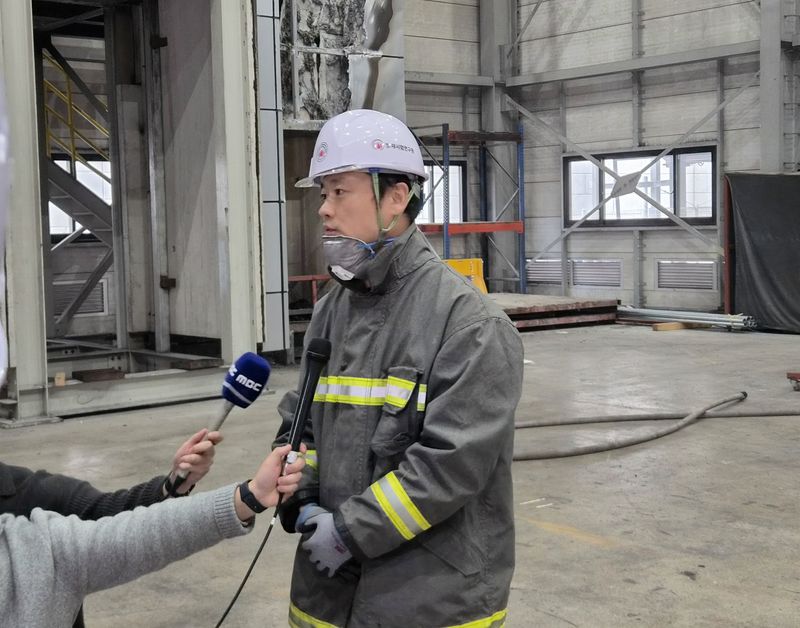
Power banks are among the common causes of household fires. They are widely used in everyday life, and people often leave them plugged in even after they are fully charged. Kim Seong-je, a senior researcher at the Korea Fire Insurance Association’s Fire Investigation Center, explained, “Power banks have safety devices to prevent overcharging, but they don’t last forever. Problems are influenced less by age alone than by usage habits, such as frequently dropping them or using them while exposing them to heat.”
For products that use lithium-ion batteries, such as power banks and cordless vacuum cleaners, it is recommended that users choose chargers specified and approved by the manufacturer. Avoid charging near bedding or sofas, or along evacuation routes such as entryways. If a battery shows signs of a problem, such as swelling or becoming hotter than usual, stop using and charging it.
Installing smoke and heat detectors is a legal requirement. Since February 2017, all types of housing, including detached houses, multi-family homes and villas, have been required to have fire extinguishers and alarm-type detectors installed. Researcher Kim noted, “These are generally installed as standard in multi-unit housing such as apartments, but some landlords and others may not even know about the requirement when it comes to detached houses.”
Fire insurance support for vulnerable groups... broader use of data
Since the program began, 55 insurance claims had been paid by August, totaling 1.08 billion won. An association official said, “Local governments subsidize the premiums, while non-life insurers take on the policies without screening applicants. The association provides technical support, including detectors and power strips.”
The Korea Fire Insurance Association has also established a system to centrally manage safety inspection records and public and disaster data for around 62,000 special buildings nationwide. The system is BRIDGE, a comprehensive risk management platform launched in 2023. Last year, it had 1,124 monthly active users (MAU), and the Korea Management Association (KMA) valued the economic and social benefits it generates at 65.5 billion won.
Using its accumulated data, BRIDGE supports underwriting (insurance risk assessment), geographic information systems (GIS) and accident statistics (RDS). Non-life insurers can use it for pre-contract risk assessment and underwriting, portfolio risk management, and post-incident loss analysis and feedback.
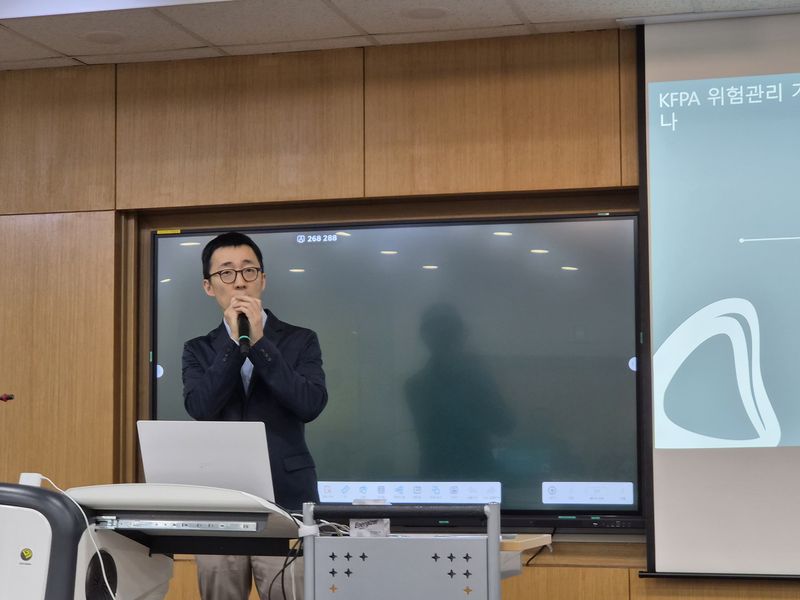
Ahn Seung-il, head of the Platform Team at the Korea Fire Insurance Association, said, “Non-life insurers can use accident cases and statistics to decide how to assess a fire risk the next time they consider underwriting one. The government and local authorities, as well as the general public, will also be able to use this data to assess fire risks and work toward greater stability in their lives.”
[email protected] Kim Tae-il Reporter