Shortening Master's Program Lengths and Exporting Curricula to Vietnam... Universities Are Changing
- Input
- 2026-11-17 12:00:00
- Updated
- 2026-11-17 12:00:02
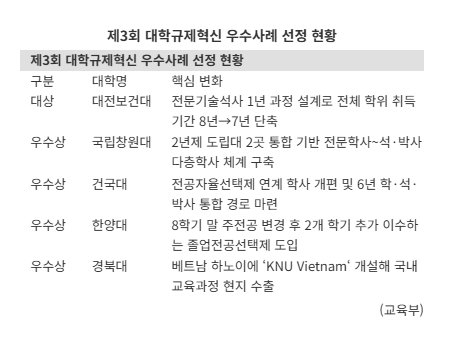
[Financial News] Five universities, including Daejeon Health Institute of Technology, which cut the time to earn a professional technical master's degree from eight years to seven, and Kyungpook National University, which exported an educational curriculum to Vietnam, were selected for this year's university regulatory innovation best practices. On the 17th, the Ministry of Education announced that it had selected one grand prize winner and four excellence award winners following the judging for the Third University Regulatory Innovation Best-Practice Contest.
Launched in 2024, the contest was established to identify and share innovative models based on amendments to laws and regulations and regulatory exemptions. This year, 25 entries were submitted and went through a document review and an online public evaluation.
After the Enforcement Decree of the Higher Education Act was revised on June 2 last year, Article 57-2 allowed the period of study for professional technical master's programs to be shortened by up to half. Using this change, grand prize winner Daejeon Health Institute of Technology revamped its “High-Skilled Meister Fast Track” program. Previously, the path took a total of eight years: three years for an associate degree, one year for a bachelor's degree, two years of work experience and two years for a master's degree. Under the Recognition of Prior Learning (RPL) system, up to half of the credits required for the master's degree can be recognized, and with early graduation, the university designed a one-year professional technical master's program, reducing the total period to seven years. The Ministry of Education expects this to ease tuition and academic burdens for employees in industry and improve the timeliness of workforce supply to industrial sites.
Excellence award winner Changwon National University merged with South Gyeongsang Provincial Geochang University and South Gyeongsang Provincial Namhae University to establish an open, multi-tier academic progression system spanning associate and bachelor's degrees through master's and doctoral degrees. It used the regulatory exemption for Higher Education Innovation Specialization Zones, designated under Ministry of Education Notice No. 2025-167 on April 21 last year, as the institutional foundation for innovation at the merged university. It also linked the specialized fields of its four campuses in Changwon, Sacheon, Geochang County and Namhae to regional strategic industries.
Konkuk University overhauled its academic system following the introduction of a major self-selection system, creating a pathway from exploring and choosing a major to expanding and designing it and linking it to a degree. It established a progression route combining a 3.5-year undergraduate program with a 2.5-year integrated master's and doctoral program, allowing students to earn bachelor's, master's and doctoral degrees within six years.
Hanyang University introduced “Hanyang Intercollege” and a “Graduation Major Selection System,” based on the provision for a major self-selection system in Article 19 of the Enforcement Decree of the Higher Education Act and the authorization in Article 29, Paragraph 3, for students in any year to change majors. Hanyang Intercollege is a program that supports multidisciplinary major experiences through a pre-admission boot camp and interdisciplinary foundational education. Under the Graduation Major Selection System, students who meet the requirements for multiple majors can apply to change their primary major at the end of their eighth semester. They then take 24 additional credits over two more semesters, completing 140 credits in total, and receive their degree in their new primary major.
Kyungpook National University (KNU) used the amendment to Article 13 of the Enforcement Decree of the Higher Education Act, which allows overseas educational programs to operate, to open “KNU Vietnam” in Hanoi, Vietnam, and began recruiting students and operating the program last September. KNU is responsible for developing and operating the curriculum, awarding degrees and quality control, while Vietnam's FPT University, its partner under an agreement, handles local operations, including educational facilities and administrative support. Eligibility is limited to cases in which both the student and the student's parents are foreign nationals. The university will initially offer business administration and computer science. It presented the initiative as the first franchise-model education export by a national university. The Ministry of Education expects it to boost international competitiveness and expand the country's reach into overseas education markets.
The Ministry of Education will hold an awards ceremony at 2 p.m. on the 18th at the Government Complex in Sejong City and present the winning universities with the Minister of Education Award and prize money. It will then hold a meeting to hear about difficulties encountered in pursuing regulatory innovation.
Minister of Education Choi Kyo-jin said, “Bold regulatory reform is needed to create a flexible educational environment in which universities can innovate on their own,” adding, “We will continue to identify demand for regulatory improvements in the field and act on it, so that universities can fully demonstrate their capacity for innovation.”
[email protected] Kim Man-gi Reporter