Special Foreign Language Education Centers to Be Established at Elementary, Middle and High Schools From the 20th
- Input
- 2026-11-17 11:35:53
- Updated
- 2026-11-17 11:35:53
[Financial News] From the 20th of this month, Special Foreign Language Education Centers will be established at elementary, middle and high schools and educational institutions nationwide to help students learn foreign languages and provide interpretation and translation services to nearly 210,000 multicultural (migrant-background) students. The Ministry of Education said that a partial amendment to the Enforcement Decree of the Act on the Promotion of Education in Special Foreign Languages, which contains these provisions, was approved at a Cabinet meeting held on the 17th. The measure sets out the necessary details for the Act on the Promotion of Education in Special Foreign Languages, revised last May, which takes effect on the 20th.
Special foreign languages are languages strategically needed for national development. The term refers to 53 languages prescribed by presidential decree, including Arabic, Hindi, Kazakh, Polish and Brazilian Portuguese.
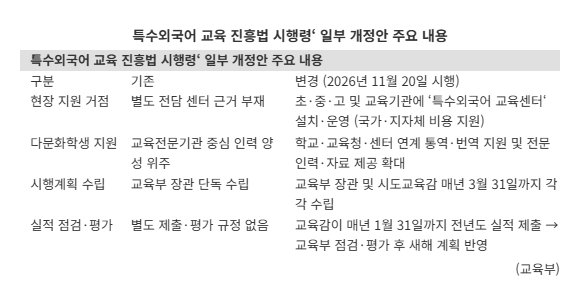
The most notable change under the amendment is the establishment of a new support system in schools. Special Foreign Language Education Centers, established and operated by the Minister of Education and provincial and metropolitan superintendents of education, will play a central role in supporting students’ study of special foreign languages and teachers’ related educational activities. The state and local governments may provide support for the costs of establishing and operating the centers, as well as the costs of deploying specialized personnel.
As demand for language support in schools grows—with the number of multicultural students in elementary, middle and high schools nationwide reaching 210,838 this year, according to the Ministry of Education’s 2026 Basic Education Statistics—support for students from migrant backgrounds will become more comprehensive. Specialized education institutions for special foreign languages, such as universities designated by the Ministry of Education, will partner with schools, provincial and metropolitan offices of education, and education centers, connecting them with specialized personnel to provide interpretation, translation and related materials needed in schools.
Provincial and metropolitan offices of education will also take on a greater role in providing education suited to local circumstances. Previously, only the Minister of Education drew up implementation plans for promoting education in special foreign languages. Going forward, each provincial and metropolitan superintendent of education must also draw up a plan for their region by March 31 each year, taking local conditions into account. Superintendents must also submit the previous year’s implementation results to the Minister of Education by January 31 each year for review and evaluation, and reflect the results in the new year’s plan.
Minister of Education Choi Kyo-jin said, “This revision to the enforcement decree will make it possible to pursue policies on education in special foreign languages that reflect local educational conditions and needs, and to strengthen support for students from migrant backgrounds.” He added, “We will work with provincial and metropolitan offices of education to provide professional and systematic support for education in special foreign languages.”
[email protected] Kim Man-gi Reporter