"Find Bugs and Review Code"... AWS Launches ‘Kiro Bots’ for Developers
- Input
- 2026-11-17 10:24:00
- Updated
- 2026-11-17 10:24:01
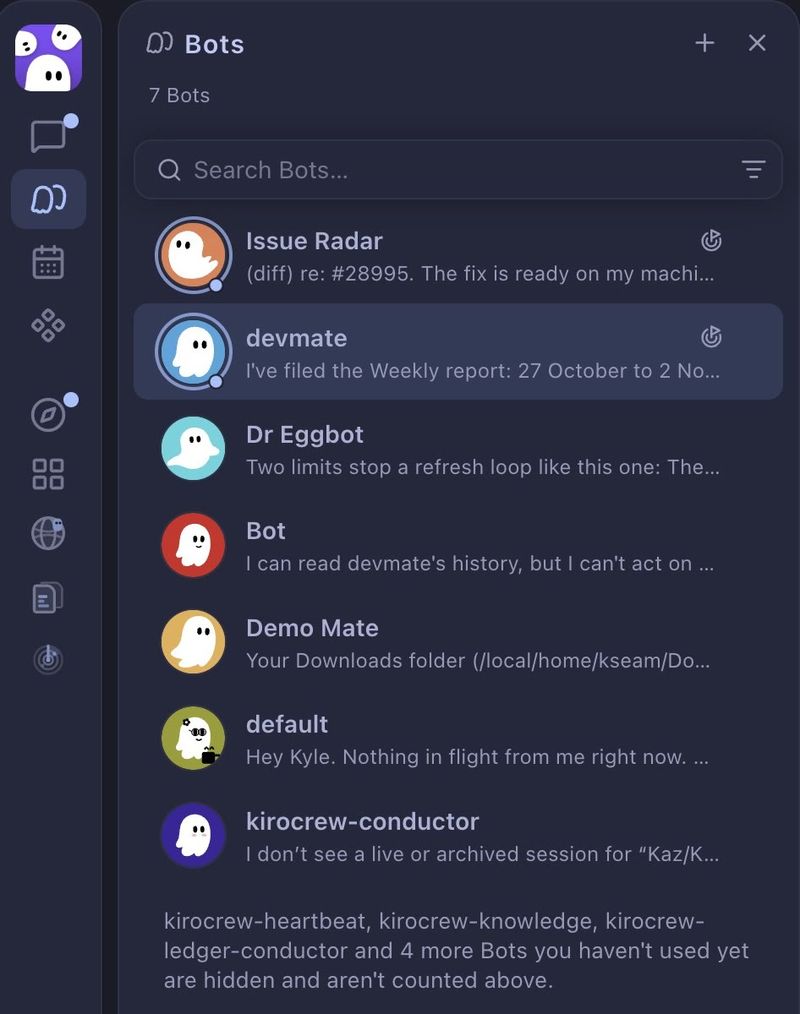
According to industry sources on the 17th, AWS officially launched Kiro bots in Kiro Crew, its AI agent-based development workspace.
Kiro bots are AI agents that continuously perform specific roles in the software development process. Developers divide work into multiple steps and assign each bot a task, while setting the direction of the work or reviewing the results.
Existing AI coding tools have mainly been used in a way that has developers request individual tasks and check the results. When several AI agents are assigned tasks at the same time, developers have had to track each task’s progress and review previous conversations, which has been inconvenient.
To address these issues, Kiro bots give individual AI agents ongoing task-management capabilities. Each bot is provided with its own name, chat window and workspace, and previous decisions and unresolved items are recorded separately.
In particular, Kiro bots can run multiple tasks in parallel and track their progress. If a task deviates from the plan, they adjust its direction, and when a developer’s judgment is needed, they ask only about the matter in question. Other tasks can continue without interruption. The service also supports scheduling repetitive tasks to run.
AWS outlined four roles for Kiro bots: issue intake, build status checks, code review and release preparation.
An issue intake bot reviews and categorizes newly filed bug reports and requests. It can identify and flag duplicate reports or write steps to reproduce an error.
A build status bot periodically checks continuous integration (CI) environments that build and test code. It distinguishes new errors from known transient ones and alerts developers only to issues that require their attention.
A code review bot reviews code changes submitted by developers. It checks whether they meet the team’s coding rules, security standards and other requirements, and suggests revisions.
A release preparation bot checks whether code changes have been tested and release notes have been written. Once preparations are complete, it asks the developer for final approval.
Permissions and memory are also separated for each AI agent. For example, a bot assigned to research can read files or search the web, but it is not granted permission to modify files. A deployment bot can be set up to run deployment scripts while requiring developer approval for changes.
Developers can directly manage the information a bot remembers, the rules it follows, and the tools and permissions it uses.
AI models can also be configured differently for different roles, taking cost and performance into account. For example, a high-performance model can be used for complex planning, while a faster, lower-cost model can handle routine checks.
Kiro bots run in environments where Kiro Crew is installed, such as a developer’s laptop, a Mac mini or an Amazon EC2 instance.
Kiro Crew is an open-source development workspace that retains project context and developers’ preferences. Released under the Apache License 2.0, it supports the Mac, Linux and Windows operating systems.
AWS plans to use Kiro bots to help developers delegate ongoing development work to AI instead of managing each AI task individually, allowing them to focus on important decisions and final reviews.
[email protected] Jang Min-kwon Reporter