Gwangju Special City to Provide Public Transit Access Within 10 Minutes, Connect Regional Hubs Within 30 Minutes, and Enable Interregional Travel Within 60 Minutes
- Input
- 2026-11-17 10:47:05
- Updated
- 2026-11-17 10:47:05
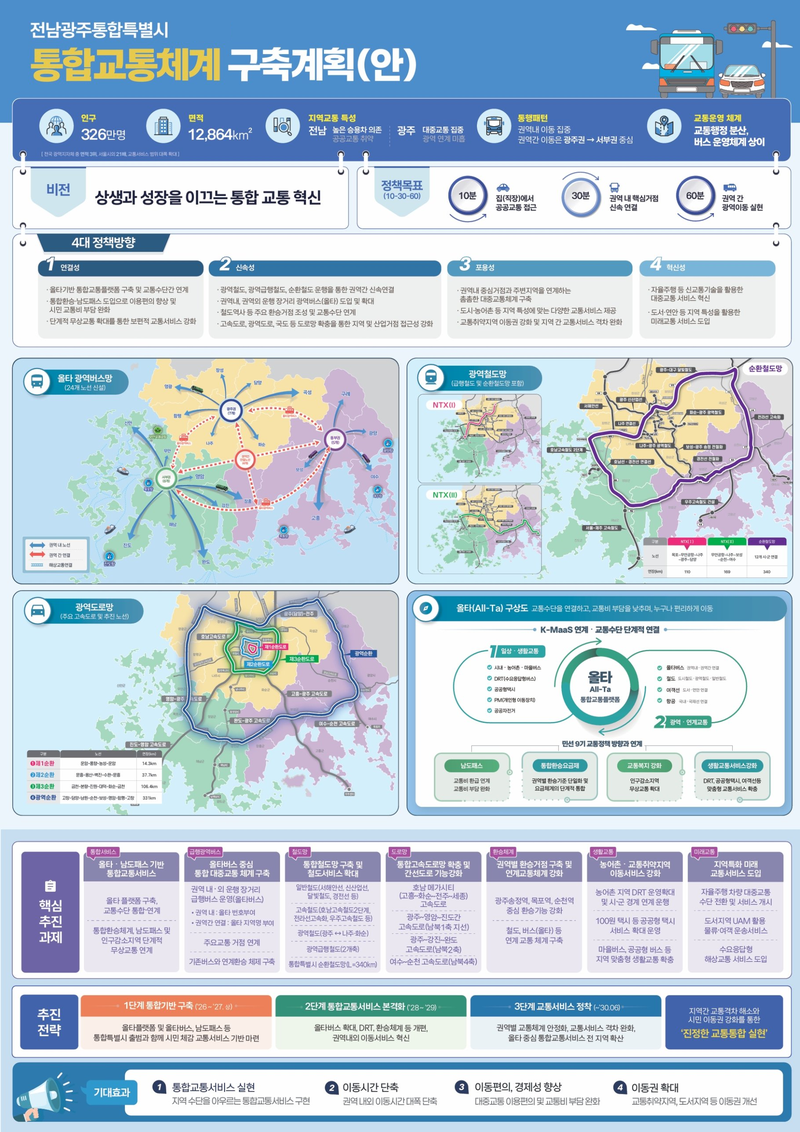
【Financial News, Jeonnam-Gwangju = Hwang Tae-jong, reporter】Jeonnam-Gwangju Integrated Special City (Gwangju Special City) is moving to provide public transit access within 10 minutes, connect regional hubs within 30 minutes, and enable interregional travel within 60 minutes.
Kim Young-seon, director of the Gwangju Special City Transportation Integration Bureau, announced the plan on the 17th in the briefing room at the Gwangju government complex to create the ‘Jeonnam-Gwangju Integrated Transportation System,’ connecting South Jeolla Province and Gwangju as a single transportation area.
The director explained the rationale, saying, “Citizens can feel the effects of administrative integration in their daily lives when areas and regions are connected by transportation.”
The Jeonnam-Gwangju Integrated Special City, formed by the integration of South Jeolla Province and Gwangju, has a population of about 3.26 million and covers 12,864 square kilometers. Because transportation conditions and travel demand differ between urban centers, rural areas and islands, it needs to expand its regional transportation network and integrate transportation services while also providing more tailored transport options in underserved areas.
Gwangju Special City plans first to expand its metropolitan express bus service, the ‘ALL-TA Bus,’ which connects major hubs such as railway stations, terminals and the integrated government complex, to 24 routes in total: 20 within regions—eight in the West Region, five in the East Region and seven in the Gwangju Region—and four connecting regions. ‘ALL-TA Bus’ is the inaugural Gwangju Special City’s flagship transport brand, with a name that conveys the idea of ‘everyone riding.’ It began operating on September 1 and currently runs six routes with a fleet of 35 buses.
The plan is to connect areas around Mokpo Station, including Muan County, Yeongam County and Haenam County, and key everyday-life hubs in the West Region; improve access to major cities and industrial hubs such as Yeosu and Gwangyang, centered on Suncheon Station, in the East Region; and strengthen connections with nearby areas such as Naju, Hwasun, Damyang County and Jangseong County, centered on Gwangju Songjeong Station, in the Gwangju Region.
Gwangju Special City will also build the ‘ALL-TA Integrated Transportation Platform,’ an app where users can search for routes and modes of transport to their destinations and access everything from reservations and payments to transfer information in one place. Services will begin in phases in the second half of 2027. The platform will first link local transportation options, including ALL-TA Bus, urban and rural buses, demand-responsive transport (DRT) and public taxis, and will later expand to include urban rail, conventional rail, ferries and air travel.
Gwangju Special City also plans to introduce the ‘Namdo Pass’ in July 2027, combining existing public transit fare support programs in Gwangju and South Jeolla to ease transportation costs for residents of the special city. It will expand the age limit for youth transit support from 34 to 39 and strengthen support for older adults and low-income groups to encourage public transit use and narrow disparities in transportation benefits between regions. The city will harmonize regional differences in transfer time limits and discount rules, and phase in an integrated transfer fare system so passengers can receive transfer benefits when traveling between regions.
Gwangju Special City plans in particular to connect local areas and major hubs by linking Gwangju Urban Railway with metropolitan, conventional and high-speed rail. It will first prepare for the safe opening of Line 2 of Gwangju Urban Railway, advance the administrative procedures for the Gwangcheon-Sangmu Line, Line 3, in stages, and strengthen connections with neighboring cities through metropolitan rail lines such as Naju-Gwangju and Hwasun-Gwangju.
For conventional rail, the city plans to advance projects including the West Coast Line, which will connect Gunsan and Mokpo along the west coast; the Daegu-Gwangju Moonlight Railway; and the New Industrial Line, which will pass through Jangseong County and the Gwangju industrial complex before connecting to the West Coast Line in Yeonggwang. These projects will improve travel between regions and expand connections between industrial and logistics hubs.
For high-speed rail, the city plans to connect major areas with high-speed services by ensuring the stable opening of Phase 2 of the Honam High-Speed Railway, upgrading the Jeolla Line for high-speed service, and advancing the Space Railway toward Gwangyang. Over the medium to long term, it will expand the rail network linking major cities and industrial hubs, including by building two corridors of the Honam region’s express rail network (NTX) and a circular railway network for the integrated special city.
The city will expand expressways across nine routes—four in the West Region, three in the Gwangju Region and two in the East Region—adding a total of 372.2 km to improve travel between regions and access to the southern coastal area. In the Gwangju Region, it will strengthen the outer ring expressway network; in the West Region, it will reinforce key links such as Jindo-Yeongam County-Gwangju and Wando-Gangjin-Gwangju; and in the East Region, it will expand connections between major cities and industrial hubs, including Yeosu-Suncheon. It also plans to link the Goheung County-Gwangju Expressway with Section 4 of the Third Ring Road and build the ‘Honam Megacity Expressway Network,’ extending via Damyang County and Jeonju to Sejong and the capital region.
The city will also continue to expand major arterial roads, including national highways and nationally supported local roads, taking regional transportation conditions and demand into account.
Because rural areas have low population density and widely dispersed villages, existing fixed-route buses alone cannot meet residents’ travel needs. Gwangju Special City therefore plans to expand locally tailored transport options, including demand-responsive transport (DRT), public taxis, 100-won taxis and village buses. It will continue to expand areas served by free buses and villages served by public taxis to reduce rural residents’ transportation costs and make travel more convenient.
In island and coastal areas, the city will strengthen connections between ferries and land transport and expand mobility assistance for people with limited mobility, including older adults and people with disabilities. It will also expand autonomous public transit services and build an artificial intelligence (AI)-based transportation management system. The city plans to improve access to transportation in each region by introducing new modes such as maritime demand-responsive transport (DRT) and island-based urban air mobility (UAM).
Kim Young-seon, director of the Transportation Integration Bureau, explained, “The Jeonnam-Gwangju Integrated Transportation System is scheduled to be implemented in three phases through June 2030. In Phase 1 (2026-2027), we plan to focus on initiatives that residents can see and experience, such as expanding ALL-TA Bus and introducing Namdo Pass and the ALL-TA Platform.”
The director added, “In Phase 2 (2028-2029), we will expand transportation services between regions and improve transfer systems at major hubs. In Phase 3 (through June 2030), we will focus on the stable operation of integrated transportation services and improving transportation services in each region.”
[email protected] Hwang Tae-jong Reporter