Gangwon Province Draws Up Youth Rural Settlement Strategy, Adds Four New Homegrown Initiatives Next Year
- Input
- 2026-11-17 10:30:00
- Updated
- 2026-11-17 11:02:45
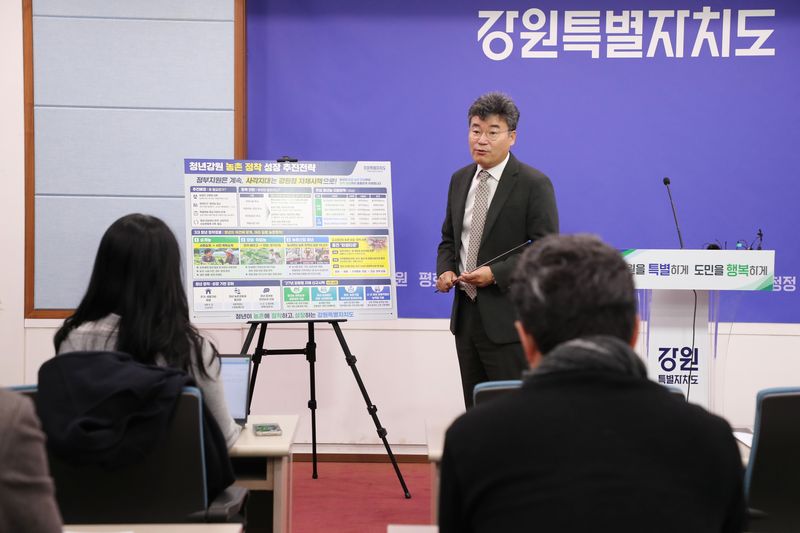
【Financial News, Chuncheon = Kim Gi-seop】Gangwon Province is shifting its policy focus from how many young farmers it has selected to whether young people have actually put down roots in rural areas.
According to Gangwon Province on the 17th, it has drawn up the Youth Gangwon Rural Settlement and Growth Strategy and will implement it in stages starting next year. The province will maintain the framework of government support for young farmers, while filling gaps in government programs with its own initiatives in planned farm succession, employment at agricultural corporations, rural industry jobs, and young people’s group activities.
To that end, next year the province will introduce four new initiatives: support for young farmers’ planned succession and joint management; employment and incubation at agricultural corporations for young people; job support to promote the shared growth of young people and rural businesses; and farm-work support by youth group work teams in cities and counties. The initiatives are scheduled to be implemented after procedures including consultation with the provincial council and the Ministry of Health and Welfare (MOHW) on establishing a social security program.
The province changed its policy direction because rural population aging has reached a critical point. Last year, 76.9% of farmers in the province were in their 60s or older, while only 2.3% were in their 40s or younger. Over the past three years, the population of young people aged 18 to 39 fell by 4.3%, while the number of young farmers in the same age group dropped by 7.2%, a steeper decline.
The new strategy establishes three settlement pathways based on young people’s circumstances: successor farmers, young people starting or taking jobs in agriculture, and young people working in rural industries. For successor farmers, the province will identify young people who will inherit their parents’ farms while their parents are still farming, help them manage the farms jointly and transfer management in stages, and connect them with support for transferring farmland and facilities as well as tax and legal advice. Young people who find it difficult to start farming independently right away will be supported in getting jobs at agricultural corporations to learn production techniques and gain practical experience in management and distribution, before moving on to start businesses, work long term, or take part in corporate management.
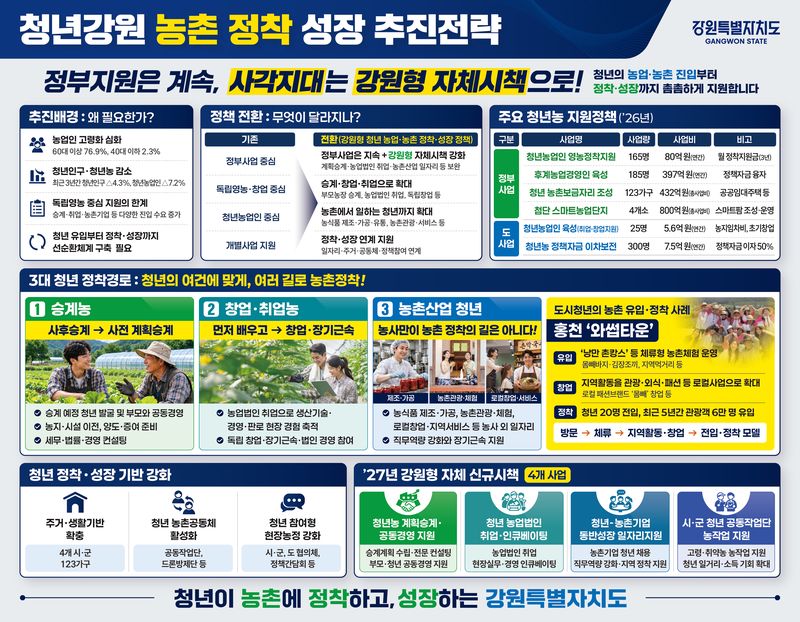
Young people who do not farm are also included in the policy’s target group. The plan is to link jobs in rural industries—including agri-food manufacturing, processing and distribution companies; rural tourism and experience-based services; and local startups—to settling in the area, broadening opportunities for young people from cities to move into rural areas. At Wassup Town, a youth village in Seoseok-myeon, Hongcheon County, examples are emerging of young people from cities who first experience the area through a residential rural experience—a romantic countryside staycation—and then settle there after starting local businesses. In Goseong, young people who have set up lodging businesses and restaurants and live alongside local residents have also been featured in an Airbnb campaign.
The province is also strengthening the foundations for housing and community life. It plans to create youth rural living complexes equipped with public rental housing and leisure, cultural and childcare facilities in four cities and counties—Samcheok, Jeongseon County, Inje County and Hwacheon—and develop youth group-work organizations for tasks such as drone pesticide spraying and joint seedling cultivation, harvesting and sorting. The province also plans to operate youth agriculture and rural affairs consultative bodies at the city and county and provincial levels, positioning young people not as recipients of support but as participants in agricultural policymaking, and to build a virtuous cycle linking the attraction of young people to jobs, housing and long-term settlement.
Jeon Jae-seop, director-general of Gangwon Province’s Agricultural Policy Bureau, said, "We will be evaluated not by how many young farmers we select or how much money we give them, but by whether young people who move to rural areas find jobs and homes and actually put down roots." He added, "Whether they inherit their parents’ farms, learn the trade at an agricultural corporation, or get jobs at rural businesses, we will fill gaps in government programs with the province’s own initiatives so young people can settle along the path they choose."
[email protected] Kim Gi-seop Reporter