'Beyond Quantitative Growth, a Qualitative Leap!'... GIST Announces 'Vision 2035' on Its 33rd Anniversary
- Input
- 2026-11-17 09:42:41
- Updated
- 2026-11-17 09:42:41
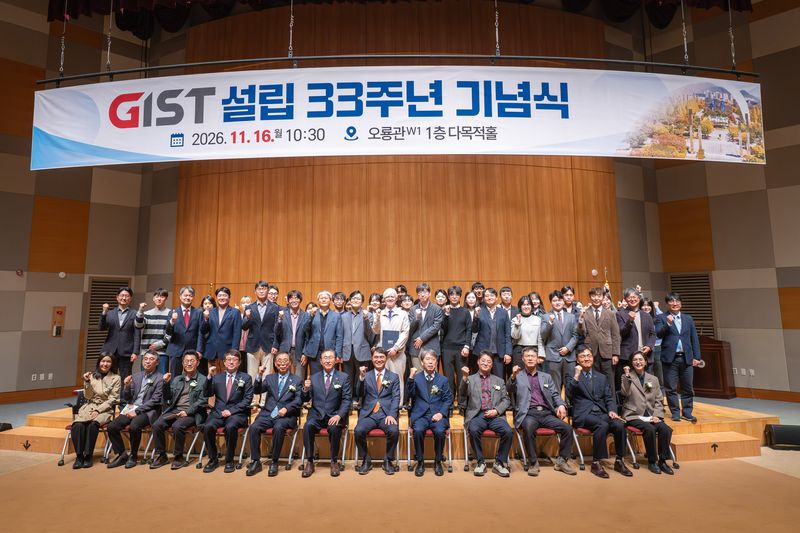
【Financial News Jeonnam-Gwangju = Hwang Tae-jong, reporter】Gwangju Institute of Science and Technology (GIST), which marks its 33rd anniversary this year, announced 'Vision 2035' and pledged to strengthen its competitiveness in education and research and improve its technology commercialization outcomes, with the aim of joining the 'global top 100 research universities' by 2035.
GIST said on the 17th that it had held a ceremony marking its 33rd anniversary at Oryong Hall on campus the previous day and announced 'GIST Vision 2035,' a medium-term vision outlining its direction for the next 10 years.
'GIST Vision 2035,' developed by the GIST Future Vision Committee through eight months of discussions since April, assesses the institute's current competitiveness based on its achievements in expanding its education and research organizations and infrastructure over the past 33 years, and sets out development directions to improve research quality and technology commercialization outcomes.
In particular, building on the long-term vision 'Vision 2053,' announced in 2023 for the institute's 30th anniversary, it detailed the initiatives to be pursued over the next 10 years in four key areas—education (talent), research (knowledge), value creation (technology), and ESG (foundation)—with 16 goals and 65 action plans.
Noh Do-young, chair of the GIST Future Vision Committee, explained, "In education, we plan to make foundational artificial intelligence (AI) literacy education mandatory and introduce an integrated bachelor's-master's-doctoral fast track; in research, we will expand ambitious research in specialized fields such as semiconductors, quantum technology and lasers, as well as international joint research; in value creation, we will promote technology commercialization and laboratory startups; and in ESG, we plan to expand autonomy at the department and research institute levels and improve administrative work using AI." He added, "Our goal is to join the global top 100 research universities by 2035."
In his earlier commemorative address, President Ki-Cheol Lim emphasized, "If the first semiconductor success story was written in the Seoul metropolitan area, the Republic of Korea's second AI semiconductor success story must be written here in Jeonnam-Gwangju by our own hands," adding, "GIST must take the lead in developing local talent and supplying companies with the technologies they need."
He also outlined three action priorities for GIST going forward: establishing a talent-development system spanning AI gifted schools through training for working professionals; establishing the AI Semiconductor Research Institute 'GIANTS,' which will cover the entire process from semiconductor design through packaging, testing and demonstration; and leading an innovative economy together with the region.
President Lim said in particular, "Over the next five years, the GIST-Arm School will train 1,400 semiconductor design professionals, including 400 master's and doctoral students," and added, "When patents from laboratories lead to startups, and those startups lead to good jobs in this region, the semiconductor cluster will finally belong to our region."
GIST was established in 1993 and opened in 1995 as a graduate-focused educational institution. It broadened its educational scope by welcoming its first undergraduate students in 2010.
In recent years, it has expanded its foundations in education, research and industry-academia collaboration by opening the Graduate School of Technology Management, establishing the Advanced AI Semiconductor Fab Center, and launching the Startup Innovation Promotion Institute.
To date, it has produced a total of 9,364 science and technology professionals, including 2,228 PhDs, 5,480 master's graduates and 1,656 bachelor's graduates. The cumulative number of startups founded by faculty members, researchers and students has reached 122.
[email protected] Hwang Tae-jong Reporter