Jeju April 3 Incident: Reading the Structures of State Violence and Memories of Loss and Mourning Together
- Input
- 2026-11-17 09:22:41
- Updated
- 2026-11-17 09:22:41
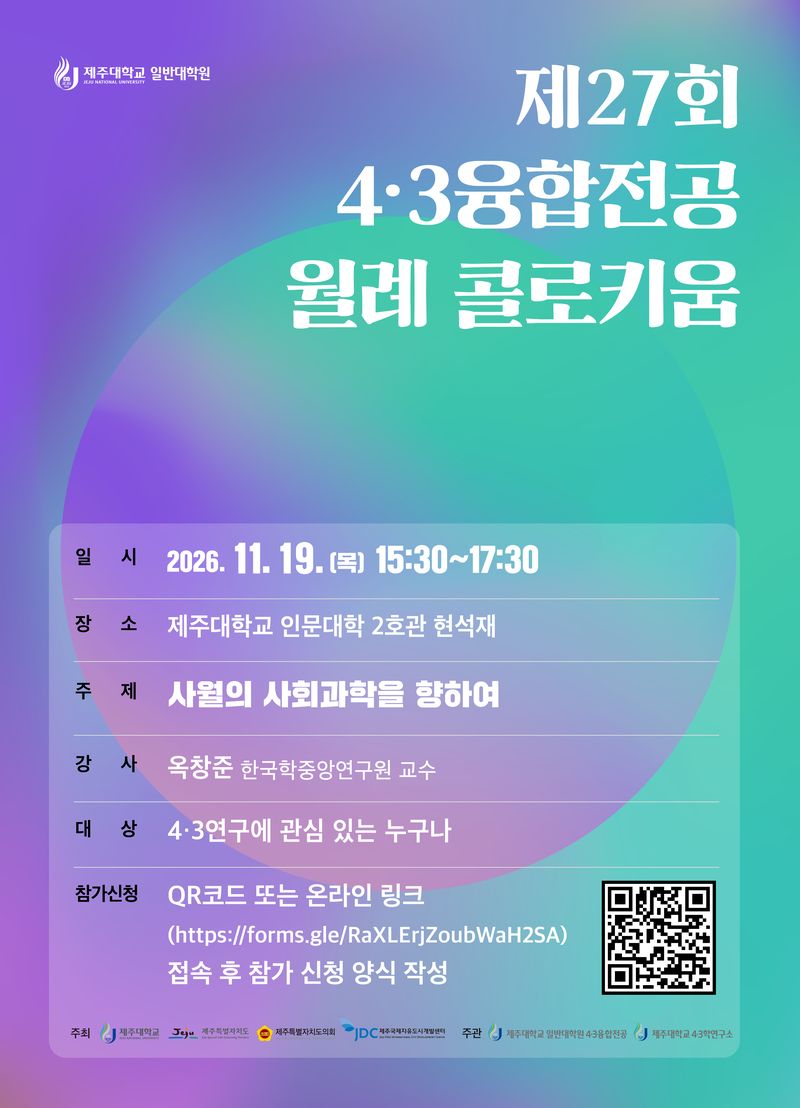
【Financial News, Jeju = Reporter Jeong Yong-bok】 An academic discussion examining the Jeju April 3 Incident not only in terms of the structures of state violence and political responsibility, but also through the loss and silence that follow the sacrifices and the question of mourning, will be held in Jeju. The event will seek new questions for interpreting the incident by bringing together the different research methods of literature, social sciences and Korean studies.
According to Jeju National University on the 17th, its Graduate School's 4·3 Interdisciplinary Major will hold the 27th monthly colloquium at 3:30 p.m. on the 19th at Hyeonseokjae in Humanities Building 2.
The lecture will be given by Academy of Korean Studies professor Ok Chang-jun on the topic “Toward a Social Science of April.” Gong Min-seok, a professor in Jeju National University's Department of Political Science and Diplomacy, will moderate.
The central question of the lecture is how the disciplines studying the Jeju April 3 Incident can bring together their different questions and analytical methods.
The Jeju April 3 Incident has been studied from various perspectives, including state formation and the Cold War system, the structures behind state violence and political responsibility, and fact-finding and the restoration of victims' honor. Literature has captured in works the individual pain and memories, and the lives that follow loss, which historical and institutional explanations alone can struggle to fully reveal.
Professor Ok is expected to argue that the social sciences, which analyze the structures of state violence, also need to take loss, silence and mourning as important research questions. In particular, he will examine both research that explains the April 3 Incident with a focus on state formation and political responsibility, and research that explores life after violence through memory, ritual and diaspora.
Diaspora refers to the experiences of people who leave their homeland or original place of residence and live dispersed across other regions and countries, as well as the experiences of their communities. In research on the Jeju April 3 Incident, the memories and identities held by people who left Jeju and their descendants can also be important subjects of study.
The lecture focuses on connecting political and social analyses of state violence with research into the memories of individuals and communities through their respective questions and methods, without subordinating one to the other.
Building on this approach, Professor Ok will explore the possibility of reading the Jeju April 3 Incident as an “infinite text.” The underlying idea is that a single event need not be confined to one academic explanation: history, literature, political science, sociology and Korean studies can interpret and examine it using their own sources and research methods.
Professor Ok has researched Cold War international politics and the formation of Korean studies, among other subjects. In 2021, he published “The Topology of Korean Studies,” an analysis of early international Korean studies conferences held in Korea, and also took part in collaborative research on neutrality, nonalignment and peace in Cold War Asia.
This colloquium is an interdisciplinary effort to examine the Jeju April 3 Incident in terms of state violence, memory, political responsibility and life after violence, rather than limiting it to a subject of local history research.
Jeju National University's Graduate School established the 4·3 Interdisciplinary Major in the second semester of the 2023 academic year. The master's and doctoral program brings together fields including literature, history, sociology and political science to train experts in 4·3 research and education and build a foundation for academic research.
The event is co-hosted by Jeju National University, Jeju Special Self-Governing Province, the Jeju Special Self-Governing Provincial Council and the Jeju Free International City Development Center. It is co-organized by Jeju National University's Graduate School 4·3 Interdisciplinary Major and its 4·3 Research Institute.
Anyone interested in research on the Jeju April 3 Incident may attend the colloquium. Participants can register through the QR code on the event poster, among other means.
[email protected] Jeong Yong-bok Reporter