“Just Increased the Weight for Squats”... Inguinal Hernias on the Rise Among Men in Their 30s and 40s Who Work Out [Health Talk]
- Input
- 2026-11-17 08:54:43
- Updated
- 2026-11-17 09:04:56
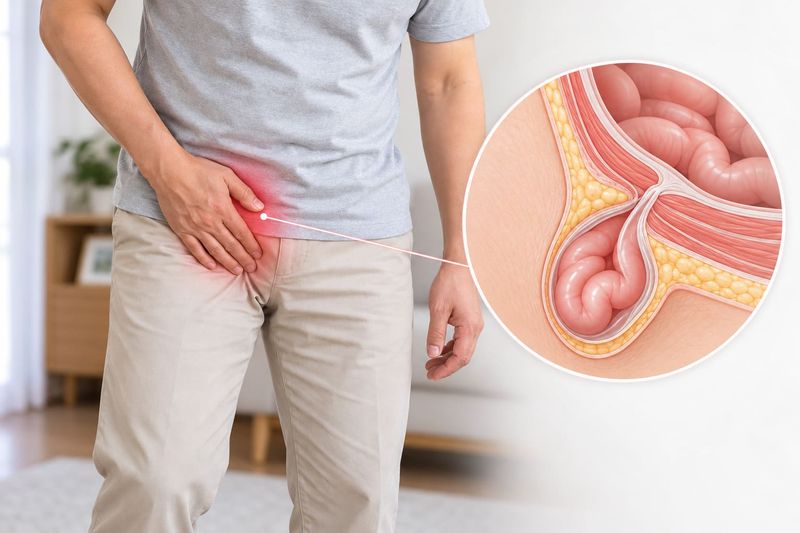
[Financial News] As more men in their 30s and 40s take up heavy weight training, warnings are emerging that they should also watch out for “groin hernias.” If a bulge repeatedly appears in the groin when lifting a heavy barbell and goes back in when lying down, it may be an inguinal hernia rather than simple muscle soreness.
Exercises involving heavy weights, such as squats and deadlifts, greatly increase pressure inside the abdomen as you brace your core. If there is a weak spot in the abdominal wall, tissue can push through it, causing a bulge or discomfort. In effect, a hidden hernia becomes visible when abdominal pressure spikes.
An inguinal hernia is a condition in which tissue such as fat or intestine from inside the abdominal cavity protrudes through a weak spot or opening in the abdominal wall in the groin. It can occur at any age, from childhood to old age, and is especially common in men. According to the Health Insurance Review and Assessment Service, of the 54,679 patients treated for inguinal hernias (groin hernias, K40) in 2025, 48,354 were men, accounting for 88.4%.
The condition is more common in men because of the structure of the inguinal canal. The canal is the path through which the testicles descended and also a passage for the vas deferens and blood vessels, making it relatively vulnerable to hernias. In children, a key cause is a congenital factor in which the peritoneal passage through which the testicles descended does not close; in adults, common causes include weakening of the abdominal wall with age.
Young adults are not necessarily in the clear. In people with a weak abdominal wall, lifting heavy weights or repeatedly straining due to constipation can raise abdominal pressure and bring on hernia symptoms. In fact, men in their 30s to 50s accounted for 22% of male inguinal hernia patients in 2025, and patient numbers tended to rise from the 30s onward. Compared with 2020, the number of male patients in their 30s rose by 12.9%, while the number in their 40s rose by 12.4%.
Risk of bowel necrosis if left untreated because “it goes back in when you lie down”
With an inguinal hernia, it is easy to think the problem has gone away because the bulge recedes and discomfort eases when you lie down. But even when symptoms subside, the weakened abdominal wall remains. If intestine or fat that has protruded becomes trapped at the hernia site and cannot return to its proper position—a condition called incarceration—it can lead to bowel obstruction and requires prompt medical attention. If it progresses to strangulation, which cuts off the blood supply, the bowel can become necrotic, requiring emergency surgery.
If a bulge that usually goes back in suddenly does not, or the pain worsens, go to an emergency room immediately. Vomiting, abdominal distension, inability to pass stool or gas, and a change in the skin color over the bulge are also warning signs.
Surgery through a 2.5-cm navel incision... both sides can also be repaired at once
Surgery is the definitive treatment for an inguinal hernia. It involves returning the herniated tissue to its proper position and reinforcing the weakened abdominal wall. In adults, surgery typically involves placing an artificial mesh over the area to keep tissue from protruding again. Surgical approaches include open, laparoscopic, and robotic surgery.
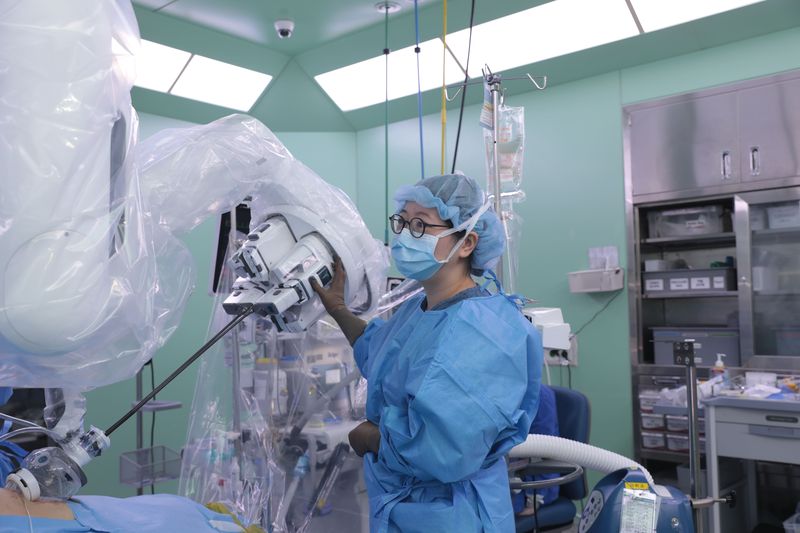
Recently, “single-port robotic surgery,” which uses just one incision at the navel, has been attracting attention. An incision about 2.5 cm long is made at the navel, and a camera and surgical instruments are inserted through it. After locating the hernia inside the abdominal cavity, the surgeon opens the peritoneum, places mesh between the abdominal wall and the peritoneum, and sutures it closed. The robotic arms, which have joints, allow precise dissection and suturing of tissue, and the burden of postoperative pain and scarring is also relatively low.
Because the procedure accesses the abdominal cavity, surgeons can examine the condition of the opposite inguinal area during surgery as well as the side with symptoms. If a hernia is found on the asymptomatic side, both sides can be repaired in a single operation without an additional incision. However, finding an abnormality on the opposite side does not mean surgery is always necessary; the decision depends on the patient’s condition and the results of prior consultation.
Professor Park So-eun of the Department of Surgery at Hallym University Dongtan Sacred Heart Hospital said, “People who frequently lift heavy objects or engage in high-intensity strength training, as well as those with chronic cough or constipation, should also be cautious. If you develop a bulge in the groin or pain, stop strenuous activity and seek medical care. In particular, if the bulge suddenly no longer goes back in and is accompanied by severe pain, you should go to a hospital immediately.”
She added, “Even if symptoms temporarily improve, an inguinal hernia does not heal on its own, so it is important to determine the right course of treatment. The appropriate surgical approach should be chosen for each patient after taking into account factors such as any previous abdominal surgery, the hernia’s location and size, and whether general anesthesia is an option.”
[email protected] Jung Myung-jin, medical specialist Reporter