Takeover Rules Curb M&A Competition ... Spain's Competitive Bid Share Falls From 25.3% to 9.1% [fn Market Watch]
- Input
- 2026-11-20 13:50:19
- Updated
- 2026-11-20 13:50:19
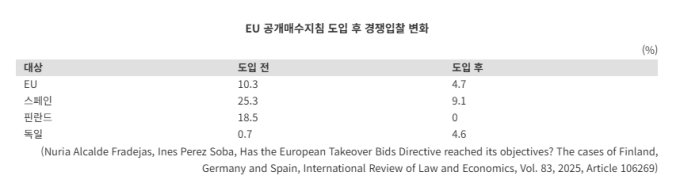
[Financial News] Deals in which multiple acquirers compete for the same company have declined noticeably since the European Union (EU) introduced takeover regulations. In Spain, the share of competitive bids plunged from 25.3% to 9.1%. While the system is intended to protect minority shareholders, analysts say it may in practice weaken both competition among acquirers and takeover premiums. There are calls for South Korea to consider both the scope of purchases and the incentives for completing deals when designing its mandatory tender offer system.
According to investment banking (IB) industry sources on the 20th, researchers at the University of Zaragoza in Spain and Complutense University of Madrid analyzed 679 takeover bids in Finland, Germany and Spain in a paper published last year in the International Review of Law and Economics. They found that the share of competitive bids fell from 10.3% to 4.7% after the EU Takeover Directive was introduced.
In Spain, the share fell from 25.3% to 9.1%, while in Finland it dropped from 18.5% to 0%. Germany, by contrast, saw an increase from 0.7% to 4.6%.
Minority shareholders did not benefit as much as expected, either. Descriptive statistics in the same paper show that the takeover premium for ordinary shareholders fell from 22.2% to 19.2% in Spain and from 32.4% to 28.9% in Finland. Germany also saw a decline in the simple average, from 27.8% to 24.3%, but regression analysis found no statistically significant change. The researchers concluded that “after the directive was implemented, takeover premiums in Spain and Finland were negatively affected, while there was no significant change in Germany.”
The key point is that introducing the system did not immediately lead to more cross-border acquisitions. The researchers separately analyzed the share of cross-border takeover bids within the EU for each country on a half-year basis, but found no evidence of a significant increase after the directive took effect. This means that harmonizing the rules alone did not create a single European market for corporate control.
The differences among the three countries were also clear. Spain and Finland became relatively more open as foreign EU acquirers made less use of local subsidiaries as intermediaries; in Germany, by contrast, the use of local acquisition vehicles increased. The researchers said that institutional barriers such as Germany’s system of co-determination and worker representation may still have been at work. In other words, harmonizing legislation alone is unlikely to remove the practical barriers in each country.
In 2004, the EU adopted the Takeover Directive, requiring member states to establish mandatory tender offer rules. An acquirer that secures control by exceeding a certain shareholding threshold must make a takeover offer to all remaining shareholders at a fair price. Each member state sets the threshold; Germany and Spain apply 30%. The UK also requires an offer to buy all remaining shares when an acquirer obtains 30% or more.
An evaluation report commissioned by the European Commission and published in 2012 by Marcus Partners and the Centre for European Policy Studies (CEPS) also found that M&A transaction volumes tended to decline where mandatory tender offer rules were in place. The analysis suggested that higher acquisition costs may deter some acquirers from bidding in the first place.
South Korea has had a similar experience. In 1997, it amended the Securities and Exchange Act to require acquirers purchasing 25% or more of a company’s shares to make a tender offer for up to 50% plus one share. However, after the foreign exchange crisis, the rule was abolished in 1998, just over a year later, amid criticism that it delayed corporate restructuring. The current amendment would revive the same 50%-plus-one-share framework after 28 years.
The implications are clearer when viewed alongside the domestic debate. The proposal under consideration in South Korea would require an acquirer who purchases at least 25% of a listed company and becomes its largest shareholder to make a tender offer for up to 50% plus one share. Some academics and members of the financial investment industry argue, however, that a 100% tender offer is needed to protect ordinary shareholders. In practice, others believe that a greater funding burden could reduce the number of transactions themselves.
An IB industry source said, “The key to designing the system is balancing fairness with the likelihood that a deal will be completed,” adding, “If, as in Europe, the rules are tightened in principle but takeover competition declines, the benefits of protecting minority shareholders could also be diminished.” The source added, “Domestic simulations should first be conducted for each scenario, including 50% plus one share versus a full 100% purchase, and pro rata allocation versus priority purchases by controlling shareholders.”
[email protected] Kang Gu-gwi Reporter