Full Checks of Test-Takers’ Glasses for the CSAT Under Discussion... Dedicated Staff at 16 Jeju Test Sites
- Input
- 2026-11-17 08:40:34
- Updated
- 2026-11-17 08:40:34
【Financial News, Jeju = Reporter Jeong Yong-bok】 Ahead of the CSAT, to be held on the 19th, the Ministry of Education discussed conducting comprehensive checks of test-takers’ glasses and inspecting their clothing to prevent cheating using artificial intelligence (AI) smart glasses. The Jeju education office will assign one dedicated staff member to each of the province’s 16 test sites to help proctors identify smart glasses.
According to the Ministry of Education and the Jeju Special Self-Governing Provincial Office of Education on the 17th, the ministry held a meeting the previous day of deputy superintendents from 16 metropolitan and provincial education offices nationwide, chaired by Vice Minister Choi Eun-ok, to discuss measures to address cheating involving advanced electronic devices in the 2027 CSAT.
The Ministry of Education’s nationwide measures focus on guidance on identifying advanced devices such as smart glasses, support for proctors, and stronger penalties for cheating.
The Ministry of Education provided metropolitan and provincial education offices with information on the physical characteristics of smart glasses, miniature cameras and earphones, as well as behavioral signs that could indicate device use. It also discussed procedures for individually checking all test-takers’ glasses on exam day and looking for devices hidden in collars, sleeves and buttons.
The Ministry of Education instructed that at least one dedicated staff member to identify smart glasses be assigned to each of the country’s 1,312 test sites. It also plans to establish a communication network linking test sites, metropolitan and provincial education offices, and the ministry’s situation room to respond to situations that are difficult to assess on site.
Test-takers who refuse a proctor’s request to check their smart glasses may, following a review, face penalties equivalent to those for serious cheating. The ministry will also pursue criminal measures, such as filing complaints or requesting investigations, in cases of planned and deliberate cheating.
The Jeju education office is overhauling its system for supporting proctors at the 16 test sites in line with these nationwide guidelines.
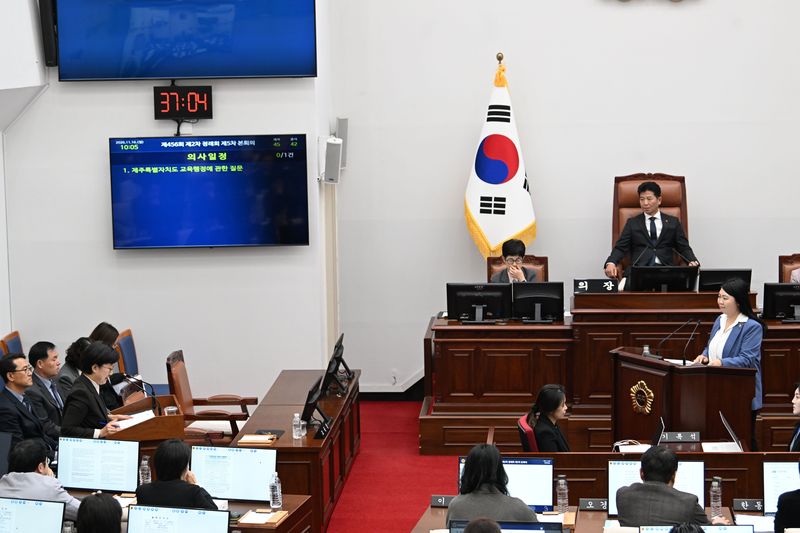
At an education administration question session during the second regular session of the 456th Jeju Special Self-Governing Provincial Council on the 16th, Jeju superintendent of education Go Ui-suk answered a question from councilor Jeong Da-un and explained the burden on test sites involved in identifying smart glasses and the plans for responding.
Superintendent Go said, “Ahead of the CSAT, I visited 30 high schools in the province and gathered their views. Although guidance was given on site that smart glasses were prohibited, concerns were raised that it would be difficult to distinguish them from regular glasses at actual test sites.”
She added, “We provided guidance on how to distinguish them by visual inspection through promotional videos and related materials,” and said, “However, the fact is that people have difficulty and concerns about whether they will be able to identify them even after receiving the guidance.”
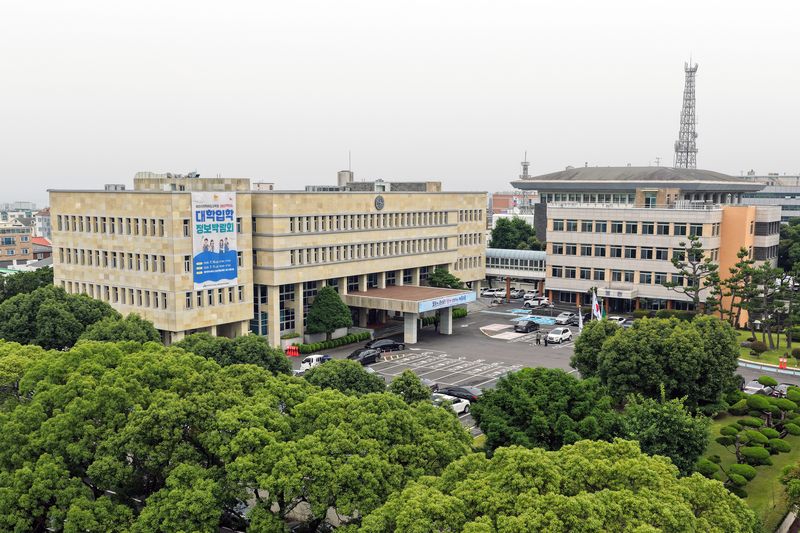
To prepare for situations in which a proctor may find it difficult to determine alone whether a device is involved, the provincial education office will designate and assign one dedicated staff member to each test site. One staff member will be assigned to each of Jeju’s 16 test sites, applying the Ministry of Education’s nationwide policy on dedicated staff to local test sites.
The office plans to provide proctors and test-site managers with renewed guidance on how to identify smart glasses and handle cheating cases, and to explain prohibited items and inspection procedures at the pre-exam briefing for test-takers.
Superintendent Go also said that the Korea Institute for Curriculum and Evaluation has liability insurance for proctors and other personnel working at test sites. This is not insurance separately arranged by the Jeju education office, but an existing safeguard for personnel involved in administering the CSAT.
The Jeju Federation of Teachers’ Associations had also called, on the 3rd, for clear criteria to distinguish smart glasses from regular glasses and measures to protect proctors. On site, a key challenge is to establish a support system that helps prevent cheating without placing excessive responsibility for making decisions on individual proctors.
The number of CSAT test-takers in Jeju this year is 7,414, down 99 from last year. Test sites will be set up at 16 schools in total: 12 in Jeju City and four in Seogwipo.
Test-takers must collect their admission tickets starting at 10 a.m. on the 18th and attend the pre-exam briefing held at each test site at 1 p.m. They will receive information on exam-room locations, prohibited items and rules for preventing cheating.
On the day of the CSAT, the 19th, test-takers must enter their assigned exam rooms by 8:10 a.m. If they have had to bring prohibited electronic devices, such as mobile phones, smart glasses, smartwatches or earphones, they must hand them to a proctor before the first session begins.
To ensure smooth traffic flow on the day of the CSAT, the provincial education office asked public institutions and major businesses, among others, to cooperate by moving start times to 10 a.m. or later. It also urged people to refrain from making noise near test sites during the English listening test, which runs from 1:10 to 1:35 p.m.
With the Ministry of Education’s nationwide response guidelines in place, the Jeju education office’s task is to incorporate them accurately into test-site operating procedures. An on-site response system is needed that can ensure accurate identification of advanced devices, support for proctors, and protection of the rights of test-takers wearing regular glasses.
[email protected] Jeong Yong-bok Reporter