“KOSPI at 10,000 Points Is a New Normal, Not a Peak,” Morgan Stanley Suddenly Sees a “Korea Renaissance”
- Input
- 2026-11-17 09:18:52
- Updated
- 2026-11-17 09:18:52
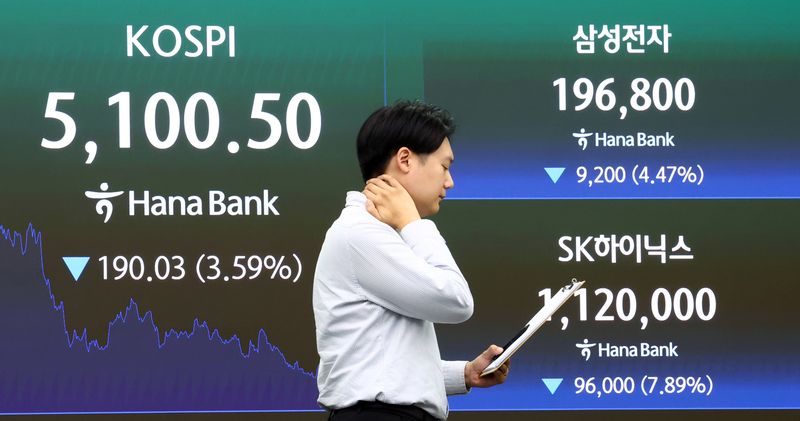
[Financial News] Global investment bank (IB) Morgan Stanley forecast that the era of a 10,000-point KOSPI would arrive within the next 3–5 years. It also added that the “Korea Renaissance,” in which the Korean economy and stock market are structurally revalued, could help the KOSPI settle at a sustainable level of 10,000 points.
According to Morgan Stanley on the 16th, its researchers Jun Seok, Kathleen Oh and Sean Kim, among others, presented this outlook in a report titled “Beyond the Miracle on the Han: The Korea Renaissance Is Coming” on the 11th (local time).
“KOSPI revaluation underway... 10,000 points to become a new benchmark within 3–5 years”
Morgan Stanley said, “The KOSPI is currently in the midst of a revaluation process,” adding, “As market fundamentals and technical conditions improve over the next 3–5 years, considerable further revaluation will be possible.”
In particular, it stressed that “a KOSPI level of 10,000 points or higher could become a sustainable new benchmark rather than a temporary peak,” adding that “there is also room for further gains if the three drivers of revaluation form a powerful virtuous cycle.”
Morgan Stanley’s assessment was based on its view that the Korean stock market has entered a structurally different phase of growth from previous ones. It said the KOSPI fluctuated between 1,800 and 2,200 from 2010 to 2018, moving around the 2,000 level, but has climbed to a higher level since last summer.
The researchers said that two previous attempts to revalue the stock market, in 2006–2011 and 2016–2022, failed to lead to sustainable gains, but that this time could be different. They forecast that a strategic reshaping of industries centered on AI, defense and energy, economic revitalization driven by a semiconductor boom, and reforms to capital markets and corporate governance would lead the Korean stock market’s long-term rise.

Based on this, Morgan Stanley expects the return on equity (ROE) of Korean companies to rise from about 8% historically to 13.5–14.5% by 2030, while the price-to-book ratio (PBR) expands to 1.5–1.6 times. It also said the “Korea discount,” a longstanding factor behind the Korean stock market’s undervaluation, could be eliminated as corporate earnings become less sensitive to economic cycles, shareholder returns increase and the cost of equity declines.
Combined capital expenditure by Samsung Electronics and SK hynix forecast to reach 3,482 trillion won by 2035
Morgan Stanley also forecast that annual combined capital expenditure by Samsung Electronics and SK hynix would rise from an average of 55 trillion won over the past 10 years to at least 167 trillion won this year, with cumulative investment reaching 3,482 trillion won by 2035. It expects up to 80% of that spending to go toward advanced semiconductor production facilities and equipment in Korea. The forecast is that this massive investment in the semiconductor industry will boost the Korean economy’s growth potential.
Beyond semiconductors, Morgan Stanley forecast that physical AI, including humanoid robots and autonomous vehicles, as well as nuclear power and electricity infrastructure, defense and shipbuilding, would become the next growth engines of the Korean economy. It said, “Korea is not simply a country participating in the AI industry but a key country enabling the AI revolution,” adding that it “will secure new growth opportunities by combining its strengths in memory semiconductors with its advanced manufacturing capabilities.”
Based on these factors, Morgan Stanley expects Korea’s economic growth to rebound to the upper 3% range in 2026 and continue growing at an annual average in the low 3% range through 2030. It also said the potential growth rate could rise over the long term from around 2% to about 3%.
Another factor cited as supporting a stock market revaluation was increased shareholder returns by companies. Morgan Stanley forecast that the total shareholder return ratio of Korean companies, currently around 35–40%, would rise to 50–60% within the next 3–5 years. In a bull-case scenario, it could expand to 60–70%, approaching levels in developed markets.
Delays in AI data center construction and slower memory chip demand among the risk factors
However, Morgan Stanley expected that reaching 10,000 points on the KOSPI would not be a smooth path. Key risks cited included delays in AI data center construction, deteriorating investment returns, slowing demand for memory semiconductors and inadequate implementation of corporate governance reforms. Geopolitical uncertainties, including the U.S.-China struggle for technological supremacy and restrictions on semiconductor exports, are also potential variables.
Morgan Stanley forecast that “temporary corrections and volatility will be inevitable during the stock market’s revaluation process,” but added that “the long-term uptrend will continue if companies steadily improve their ROE and total shareholder return ratio.”
[email protected] Kim Hee-sun Reporter