“The End Is in Sight for the AI Investment Frenzy”... Former U.S. Financial Regulator Chief Warns
- Input
- 2026-11-17 05:23:55
- Updated
- 2026-11-17 05:23:55
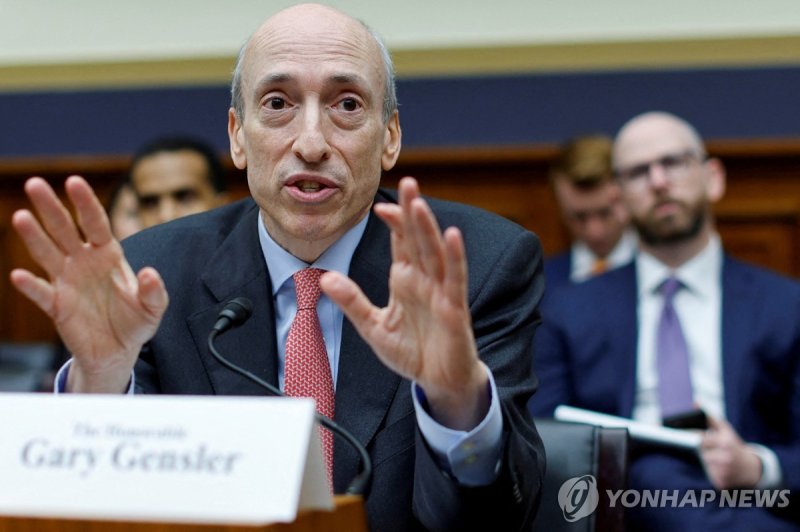
According to CNN on the 16th (local time), former U.S. Securities and Exchange Commission (SEC) Chair Gary Gensler said in an interview, “AI is already in a bubble,” adding, “I think we’ll see a repricing of asset prices and an economic slowdown before November 2028.”
Gensler, who led the SEC from 2021 to 2025 under the Joe Biden administration, is now a professor at the Massachusetts Institute of Technology (MIT).
He identified the astronomical scale of investment in AI infrastructure as the biggest risk factor. According to some estimates, as much as $800 billion a year is being invested in building AI infrastructure, including data centers and advanced semiconductors.
Former Chair Gensler pointed out, “Big Tech companies are spending five times as much in 2026 as they did just three years ago,” adding, “What is most surprising is the scale of the investment itself.”
He said, “History shows that when new technologies emerge and massive investments are made, growth eventually stagnates and investment contracts,” adding, “The only question is whether it will amount to a mild recession or lead to something much more dramatic.”
He was particularly concerned that investment in the AI industry is expanding far faster than revenue is being generated. Companies are racing to build data centers and secure advanced semiconductors, but if they cannot generate returns commensurate with their investments, large-scale restructuring will be unavoidable.
He also identified the way the sector is financing itself as a problem. Former Chair Gensler explained that circular financing, in which funds circulate among companies, and complex off-balance-sheet financing structures make it difficult to determine how much risk has actually built up in the financial markets.
He warned, “One can question why lenders are lending so much money,” adding, “History will show that they lent too much money too quickly.”
He named neocloud companies as the ones most likely to be hit first if the bubble bursts. Neoclouds are specialized cloud companies that rent high-performance computing resources to AI developers. Some are considered vulnerable to changes in market conditions because they are relying on massive debt to acquire data centers and graphics processing units (GPUs).
Former Chair Gensler predicted, “Large companies will survive,” but added, “There will be business collapses and bankruptcies among neocloud companies.”
Elon Musk recently also warned that more than 200 neocloud companies could face large-scale bankruptcies and industry consolidation.
Former Chair Gensler predicted that the impact of an AI bubble bursting could be as great as that of the dot-com bubble burst in the early 2000s. However, he expects it to have a smaller impact than the subprime mortgage crisis that triggered the 2008 Global Financial Crisis.
The warning comes amid growing uncertainty surrounding the AI industry. The possibility of tighter data center regulations has been raised following the U.S. Democratic Party’s victory in the midterm elections, and the sudden resignation of former NVIDIA CEO Jensen Huang is also sending shockwaves through the AI industry. Meanwhile, AI company Anthropic is pursuing a major initial public offering (IPO), drawing intense market interest.
[email protected] Correspondent Lee Byung-chul Reporter