One in 10 Domestic Electronic Financial Firms Fall Short of FSS Standards
- Input
- 2026-11-17 06:00:00
- Updated
- 2026-11-17 06:00:09

[Financial News] One in 10 companies in South Korea's electronic financial industry falls short of the Financial Supervisory Service's management guidance standards, including on capital impairment and insufficient capital. Major players in the industry include large electronic payment gateway (PG) operators, known as 'online payment wholesalers' and 'online clearinghouses,' and prepaid payment providers commonly known as 'Pay' services. The market as a whole is growing, but analysts say the performance gap between large and small and midsize firms is becoming even more pronounced.
According to the 'Electronic Financial Business Operating Results for the First Half of 2026' released by the Financial Supervisory Service on the 17th, total revenue for the electronic financial business of 228 South Korean companies (excluding 14 financial firms such as securities, insurance and specialized credit finance companies) was 6.3 trillion won, up 14.5% (800 billion won) from 5.5 trillion won in the first half of last year. Gross profit for the first half, calculated by subtracting cost of sales from revenue, was 2 trillion won, up 300 billion won (17.6%) from the same period a year earlier. Gross profit at payment gateway (PG) businesses rose 30%, while prepaid payment providers remained at roughly the same level.
By registration category (multiple registrations are allowed), electronic financial businesses included △ 192 payment gateway (PG) firms and △ 118 prepaid issuance and management firms△35 direct debit issuance and management firms, 48 payment escrow (escrow) firms, and 18 electronic bill presentment and payment (EBPP) firms, in that order.
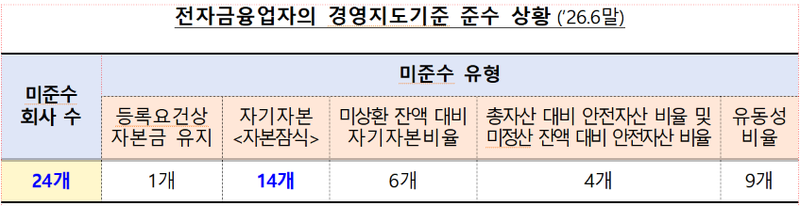
In contrast to the growth of large firms, 10.5% (24 companies) of electronic financial firms were found to be noncompliant with the Financial Supervisory Service's management guidance standards. As financial authorities strengthened prudential oversight, the number fell by five from 29 at the end of last year. Still, one in 10 of the 228 registered firms (242 including financial firms) fell short of the supervisory authorities' standards. The reasons included insufficient capital (1 firm), capital impairment (14), failure to meet the equity capital ratio relative to outstanding balances (6), an inadequate liquidity ratio (9), and an insufficient safe-asset ratio (4). An FSS official said, "Most of the noncompliant firms are small and midsize electronic financial companies with modest revenue from electronic financial business; the 24 firms averaged around 2.5 billion won in revenue from that business."
The Financial Supervisory Service said that, following the implementation of the revised Electronic Financial Transactions Act at the end of last year, it has so far required 12 companies to take measures such as increasing their capital.
[email protected] Jo Eun-hyo Reporter