[Editorial] SK Group's Shared-Growth Fab as a Springboard for Advancing the Semiconductor Materials, Parts and Equipment Ecosystem
- Input
- 2026-11-16 19:13:52
- Updated
- 2026-11-16 19:13:52
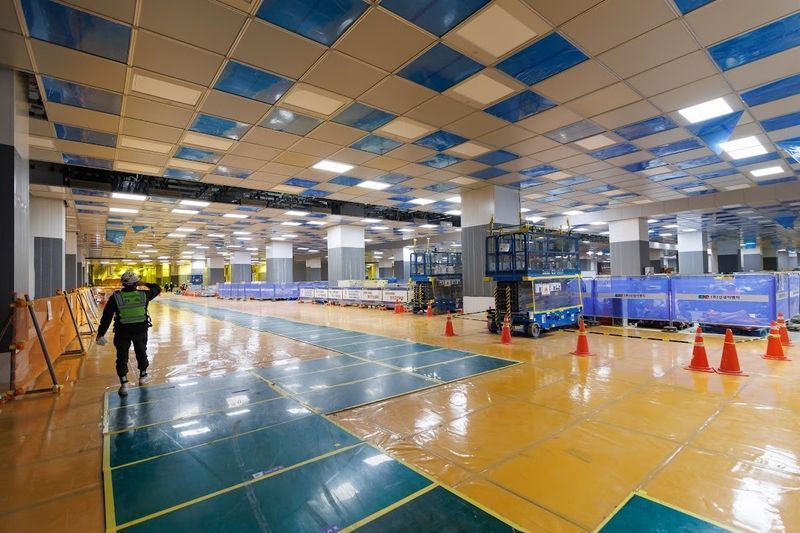
Once completed, the fab will allow small and midsize MPE companies to validate their products in an environment similar to an actual production line. The total project cost is 874.6 billion won, with SK hynix covering about half and the central and local governments contributing the rest. Construction has already begun. The fab is scheduled to open in May next year, with full-scale mass-production validation set to begin in the fourth quarter. It is said to be unprecedented worldwide, and is worth viewing as a meaningful experiment.
MPE companies in the semiconductor industry have often been frustrated by the high barriers to validation. Actual deliveries depend on more than technology development alone: companies must prove yield and stability on a real semiconductor production line before they can move forward. It is nearly impossible for a small company to build its own advanced semiconductor production line just to conduct validation. Making use of a large company's production facilities is the best option, but even securing that opportunity can take as long as two years. Trinity Fab in Yongin reportedly aims to shorten by at least a year the period from development to mass production, which typically takes three to four years. A nearby cooperative industrial complex is also being developed to accommodate around 50 MPE companies. We hope this can mark a turning point for our barren MPE ecosystem.
South Korea is a global powerhouse in memory semiconductors, but remains highly dependent on foreign suppliers in the MPE sector. Its localization rate stands at around 30%. As competition for technological dominance intensifies and global supply chains are reshaped, we cannot leave the competitiveness of core materials and equipment as it is.
The government has also consistently supported MPE research and development, but results on the ground have been limited. That is because many obstacles stand between technology development and actual deliveries. In this respect, the effort by a large company to open its own production infrastructure to partner firms and lower the final hurdle to commercializing technology is noteworthy.
The key is for the shared-growth fab to improve the competitiveness of the MPE ecosystem as a whole. Since nearly half of the total project cost comes from national and local government funds, the principle of openness—providing companies across the MPE sector with opportunities to test their products—must be upheld in practice. Institutional safeguards should also be put in place to protect participating companies' technology and trade secrets.
Rather than focusing narrowly on its record of R&D support, the government should assess policy effectiveness based on how much the time to commercialization has been shortened and how often that has led to actual adoption in mass production and overseas deliveries.
Public-private cooperation should also be expanded so that more companies can take part in this kind of shared-growth model. Above all, it is important to establish a virtuous cycle in which the competitiveness of domestic semiconductor manufacturers leads to growth for MPE companies. We hope that, following memory semiconductors, global leaders will also emerge in the MPE sector.