Painting the Invisible Movement [Moon Hye-ok's Art Talk]
- Input
- 2026-11-16 18:59:29
- Updated
- 2026-11-16 19:49:47
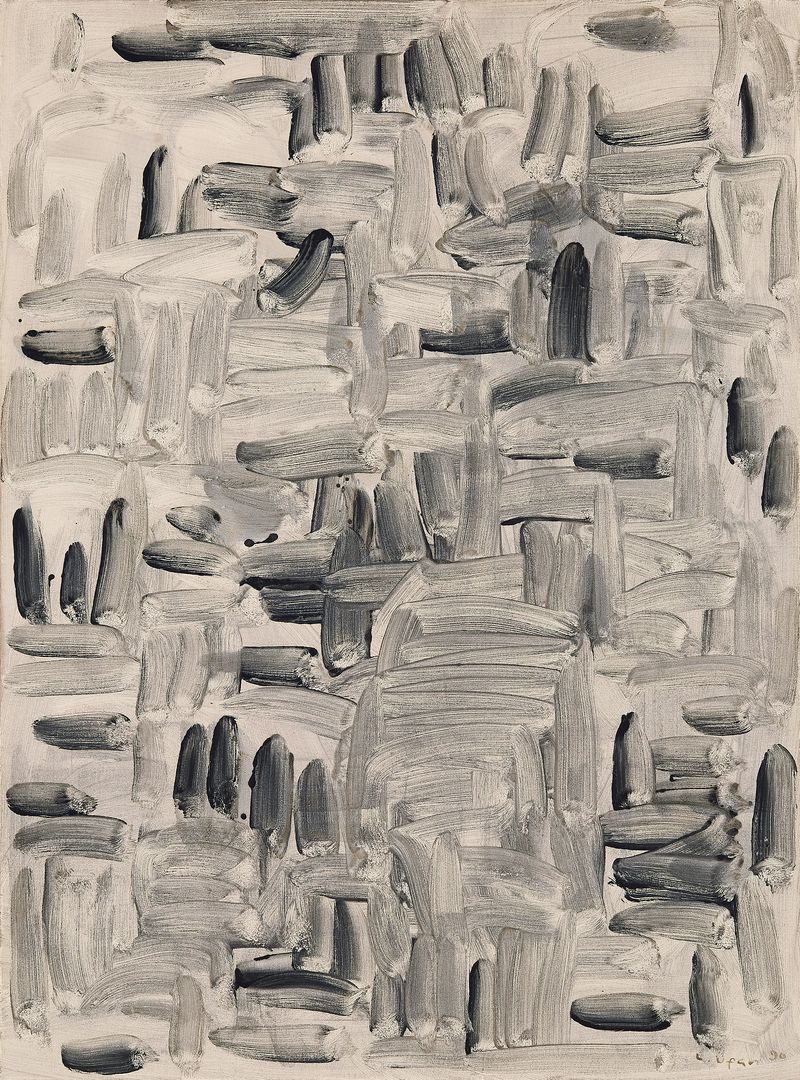
The Wind series evolves through From Winds, East Winds, and With Winds. While the early work From Winds expressed the movement of wind through free, dynamic brushstrokes, East Winds gives the direction and rhythm of the brushstrokes greater definition. By the time the series reached With Winds, which Lee began developing in 1987, the brushstrokes had become more restrained, and the empty space between them had taken its place as an important element of the composition.
The 60-ho painting With Winds, dated 1990, comes from a period when this painterly exploration had deepened. Gray-black brushstrokes intersect over a gray-white ground, creating tension and rhythm across the canvas. The gradation and speed of the paint, along with the pressure of the hand, remain fully visible where the brush has passed. The varying intensity of color from stroke to stroke and brushstrokes extending in different directions evoke winds blowing from multiple directions, meeting and dispersing.
For Lee Ufan, painting is not a one-way expression of the artist's thoughts or emotions. It is a process in which brush and paint, canvas and space meet and respond to one another. With minimal brushwork, he opens up broad expanses of empty space on the canvas and explores the relationship between what is painted and what is left unpainted. This connects to the artist's long-standing reflections on existence and absence, and on how things meet and form relationships.
Wind does not stay. It blows in and disappears, and another wind comes to take its place. Our lives are like that, too. In time marked by encounters and partings, coming into being and passing away, we pass through countless moments, leaving traces of our own. Some memories fade like the wind, while certain moments remain in our hearts for a long time.
Lee Ufan's wind prompts us to reflect on the time of life and the meaning of existence, reaching beyond the simple movement of nature. Between what is filled and what is empty, what remains and what disappears, we finally sense the presence of things we cannot see.
Perhaps life is not about trying to hold on to the passing wind, but about carrying in our hearts the traces left by winds that have brushed past us and living another day. Between what is painted and what is left unpainted. Though it does not stay, the wind remains by our side for a long time.Moon Hye-ok, director of the Partner Team at Seoul Auction
[email protected] Jang In-seo Reporter