Wi-Fi to Be Cut Off at CSAT Test Sites, but LTE and 5G Cannot Be Blocked... [AI Cheating Fallout]
- Input
- 2026-11-16 18:43:25
- Updated
- 2026-11-16 18:43:25
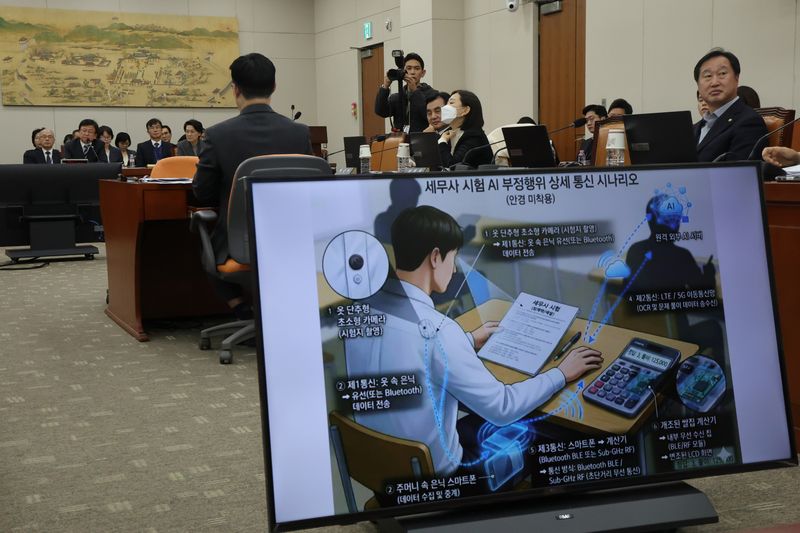
But the government is facing strong criticism for its belated response, having acted passively despite multiple cases of AI-assisted cheating being detected in various qualification exams, including the tax accountant exam, and widespread calls for countermeasures.
Some measures, such as blocking Wi-Fi, have been criticized as impractical. There are also concerns that responsibility for loopholes caused by gaps in the system is being shifted to on-site proctors who have to rely on visual inspections.
On the 16th, the government held an interagency meeting at Government Complex Seoul, chaired by Prime Minister Han Seong-sook, on preventing cheating on exams using smart devices. It decided to mount an all-out, pan-government response and swiftly draw up comprehensive measures. Prime Minister Han instructed officials, saying, “It must never happen that test takers who have worked hard suffer because of cheating by a few, or that trust in the exam system itself is undermined.” She added, “Each ministry should see this through to the end with a sense of responsibility, recognizing that safeguarding fairness in exams is directly tied to public trust.”
With the CSAT just three days away, it has become an urgent priority. The government plans to form an emergency pan-government response team for the CSAT and mount an all-out effort to prevent cheating that exploits AI. It will prohibit the use of all smart devices, including smartphones, smartwatches, earphones and tablet PCs, and require test takers to hand them in at test sites. It is also pursuing plans to block public Wi-Fi at all test sites during the exam.
In this connection, the Education Ministry will announce additional comprehensive measures on the 17th to prevent “AI cheating” on the CSAT, including plans to assign dedicated personnel to check whether smart glasses are being worn at all 1,312 test sites.
But with the CSAT fast approaching, new, stricter measures such as a blanket ban on bringing smart devices into test sites are likely to cause confusion on the ground. Critics say the measures may have limited effectiveness, since it would be difficult to block access through mobile data networks such as LTE and 5G even if Wi-Fi is cut off.
Some measures to prevent AI-assisted cheating, including extending the period during which cheaters are barred from taking exams from one year to three years, introducing radio-frequency detectors at test sites and installing thermal cameras, are expected to be implemented in part starting with next year’s CSAT.
The government also plans to draw up pan-government measures to prevent cheating on exams using AI. Key elements will include updating exam management standards so they can respond swiftly and broadly to increasingly varied and sophisticated methods, including AI smart glasses, miniature electronic devices and outside assistance, as well as strengthening sanctions and penalties for cheating, including filing complaints over suspected obstruction of official duties.
The government will also pursue amendments to the laws and systems needed for these measures. It plans to draw up a technology strategy to prevent and detect cheating, including developing and distributing AI detection technology for national qualification exams.
The system for post-exam reviews will also be strengthened. The government plans to put measures in place to identify suspected cheating even after an exam has ended and, if illegal or improper conduct is confirmed, hold those responsible accountable to the full extent of the law and rules through measures such as revoking exam passes, restricting eligibility to take exams and requesting investigations. As part of an exhaustive investigation into cheating on national qualification exams, the government plans to work with police to check the exam-day communications records of people suspected of cheating, including those with unusually high scores.
[email protected] Jung Sang-gyun, Kim Man-gi, Yoon Hong-jip, Seo Young-jun Reporter