As the 'AI Empire' Wobbles... Google, Amazon and MS Accelerate In-House Chip Development [Jensen Huang Risk Hits the AI Ecosystem]
- Input
- 2026-11-16 18:36:29
- Updated
- 2026-11-16 18:36:29
Industry sources said on the 16th that customers are accelerating efforts to make their own semiconductor chips, while competition for leadership in the AI industry is shifting from securing graphics processing units (GPUs) to building computing ecosystems. This is also speeding up the erosion of NVIDIA's dominant position.
■ The AI Industry Is Fragmenting and Becoming Multipolar
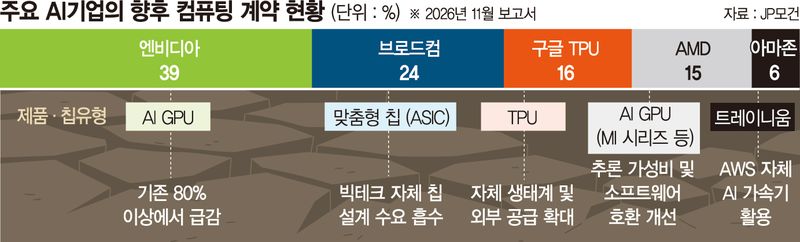
NVIDIA's dominant position is already being divided among multiple ecosystems, making the industry more multipolar. A report released by JPMorgan on the 14th (local time) put NVIDIA's share of future contracts at 39%, measured by power capacity in gigawatts (GW). Broadcom (24%), Google's Tensor Processing Units (TPUs, 16%) and AMD (15%) followed. The analysis suggests the market share of the dominant player, which controlled 85.2% of the AI accelerator market in the second quarter of 2025, will fall to half or less.
Huang's resignation has added to uncertainty by leaving a vacuum in leadership capable of making decisions on urgent challenges involving technology, management and redefining relationships with customers. There is a high risk that decisions and responses to the reshaping of the AI ecosystem will drift, and customer confidence is also wavering.
Customers that have been seeking alternative suppliers rather than risk relying on a single chipmaker, NVIDIA, are accelerating their efforts to diversify their supply chains. Contracts for custom semiconductors (ASICs) already account for nearly 46%. The trend has also been reflected in stock market movements. On the 13th, when the Nasdaq fell 0.4% and NVIDIA shares dropped 4.34%, NVIDIA rivals AMD and Broadcom rose 5.54% and 5.86%, respectively.
AMD's market capitalization was $736.5 billion as recently as the 6th, but surged to $960 billion (about 1,280 trillion won) in just four business days. Its market-cap ranking also jumped three places, from 19th to 16th.
■ Customers Making Their Own Chips
AMD and other rivals are not the only ones challenging NVIDIA's dominant position. The more fundamental threat comes from customers becoming competitors by making their own semiconductor chips and reshaping the ecosystem in the process. Google, Amazon, Microsoft (MS) and Meta, among others, have their own data centers and software and are accelerating the development of their own chips. Cloud providers are using their in-house semiconductors to manage costs and performance.
Google and these other companies are stepping up efforts to build integrated systems that can replace the platform ecosystem NVIDIA has developed over more than two decades. Model companies such as Anthropic and OpenAI are diversifying their supply chains by using different types of chips from multiple companies. This strategy is clear in the IPO prospectus Anthropic filed with the U.S. Securities and Exchange Commission (SEC) on the 15th. Anthropic said it would use four types of chips: Amazon's Trainium, Google's TPU, NVIDIA GPUs and AMD GPUs. TPUs and Trainium are among the most prominent ASICs.
■ Anthropic to Use Four Types of Chips
Anthropic will use Amazon's in-house AI chips, including AWS Trainium, to secure up to 5 GW of computing capacity under its agreement with Amazon. Its computing strategy is to choose chips offering favorable price and performance for each type of task. The approach targets both favorable pricing in negotiations with suppliers and customized performance.
Rather than assigning all computations to a single, expensive general-purpose GPU, companies now combine hardware suited to different types of work, such as training and inference, using their own chips or custom accelerators from individual companies. This has also expanded the ASIC sector. The global ASIC market is forecast to grow from $22.78 billion last year to $24.21 billion this year and $41.68 billion by 2034, with a compound annual growth rate (CAGR) in the 7% range.
Cloud providers are using their own chips to narrow the technology gap with NVIDIA and strengthen their bargaining power over NVIDIA GPUs. The more they expand their own semiconductors and AI ecosystems, the more NVIDIA's market position—and even its pricing power—will be eroded.
Anthropic CEO Dario Amodei's remark that “securing computing resources is the biggest business dilemma facing the company” shows the company's determination to diversify its computing supply chain. In remarks made public on the 15th, he said, “If we have too few computing resources, it is difficult to develop new technologies; if we have too many, the financial burden is heavy,” signaling a desire to manage resources economically. Experts say NVIDIA's ability to maintain its dominance will hinge on how it sustains medium- and long-term relationships with its customers.
[email protected] Lee Seok-woo, International Affairs Correspondent Reporter