Minister Hong Ji-seon Inspects Korea’s Largest Modular Rental Housing Site... “Orders for 20,000 Units by 2030”
- Input
- 2026-11-16 17:14:08
- Updated
- 2026-11-16 17:14:08
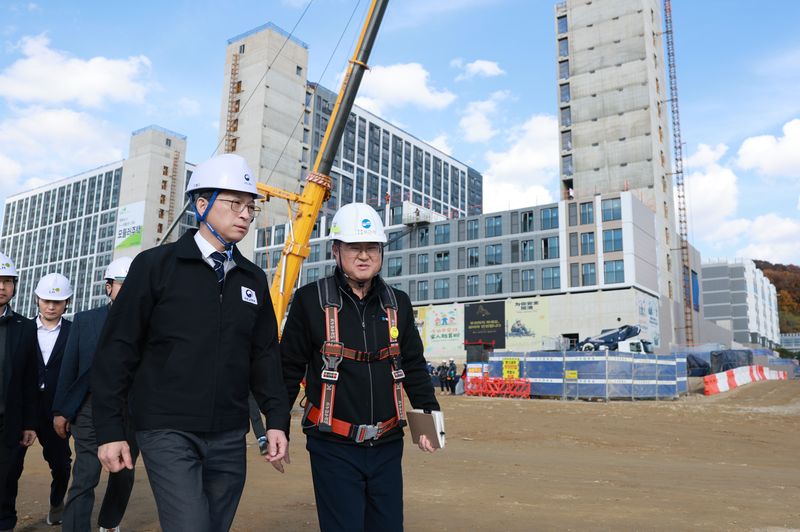
[Financial News] Hong Ji-seon, minister of MOLIT, visited the country’s largest modular public housing construction site, where factory-built housing units are stacked on-site.
According to MOLIT on the 16th, Minister Hong received briefings at the site from Korea Land and Housing Corporation (LH), the Korea Institute of Civil Engineering and Building Technology (KICT), the Korea Iron & Steel Association and site officials on trends in the modular industry, an overview of the complex and construction progress. He then watched as modular units were lifted by crane and joined together. The visit was intended to review the entire off-site construction (OSC) process, in which precisely manufactured units are transported from factories to a residential complex and assembled, and to encourage the industry. Modular construction is a method in which a building’s main structural components and some parts of its housing units are manufactured in a factory, then transported to the site for installation and assembly.
Since July this year, factory-made units have been brought to the site and stacked at the complex. As the site was developed as part of the National Smart City Pilot Program, a “smart turnkey” approach—in which a project is commissioned as a single package, incorporating advanced smart construction technologies from design through construction—was used for the first time in Korea for an apartment complex. Technologies such as robotic delivery, zero-energy systems and smart communities are also planned. LH commissioned a 12-story modular housing project above ground in this block in March 2024, and construction began in December of that year. Sejong 5-1 Living Area was designated a National Smart City Pilot City in 2018, together with Busan Eco Delta City.
Minister Hong said, “As construction sites face growing difficulties due to an aging population and a shrinking skilled workforce, modular construction is drawing attention as a key alternative that can shift the construction industry from labor-centered to technology-centered and significantly shorten construction periods.”
In its 8/13 measures, the government increased the planned orders for modular public housing for 2027–2030 from 12,000 to 20,000 units. The annual average volume of orders will rise from 3,000 to 5,000 units. The government will provide public funding through 2030 to cover 35 million won per unit—half of the roughly 70 million won in additional construction costs per unit compared with conventional methods. The government believes that carrying out factory production and on-site construction simultaneously can reduce a project that typically takes two years to around a year and a half. However, industry representatives cite high construction costs, the expense of transporting and hoisting large units, and a special law that has yet to pass the National Assembly as challenges. MOLIT is also working to enact a “Modular Special Act.”
Minister Hong said, “If you make recommendations on what is needed to build the modular housing market, we will review them promptly and reflect them in policy,” adding, “The government will also work through the challenges with you as one team.” He urged site officials to pay particular attention to their health and safety.
[email protected] Jeong Gyeong-su Reporter