“AI Innovation? ... Companies Could Be the Obstacle, Not Employees” [fn Insight]
- Input
- 2026-11-16 16:13:22
- Updated
- 2026-11-16 16:13:22
Many companies have made the use of artificial intelligence (AI) a key performance indicator (KPI). Yet in far more cases, operating profit—the figure that actually appears on the balance sheet—remains unchanged. Why? The answer from Rando Kim, Seoul National University emeritus professor and author of Trend Korea 2027, is a painful one: “The bottleneck is not the employees but the organization.”
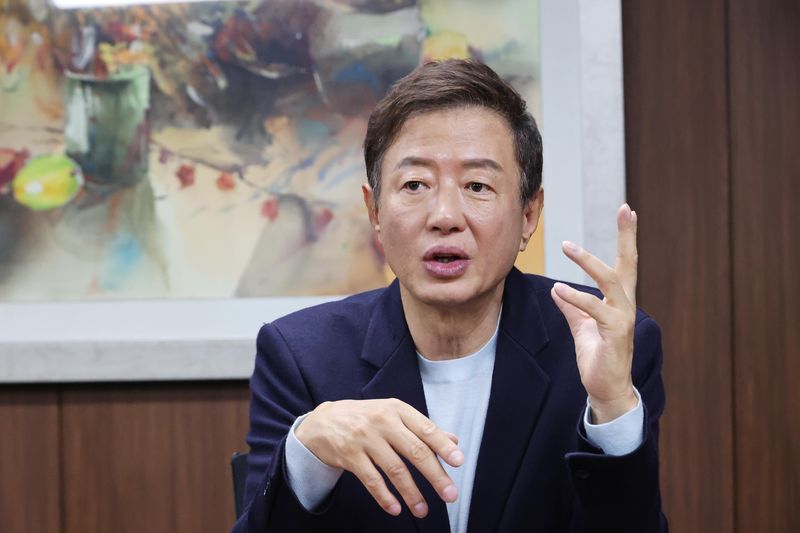
[Financial News] Emeritus professor Rando Kim met with Nodong-il, chief editorial writer at Financial News, on the 16th and stressed, “The keyword for artificial intelligence (AI) in 2027 is the widespread adoption of AI.” He added, “As we enter an era when using AI is no longer something to brag about, what ultimately sets us apart is where we reinvest the time and money saved with AI.”
Reports in 30 minutes, but approval times unchanged?
Professor Kim said the focus of the debate over AI productivity was misplaced. “Employees who use AI well can finish emails, meeting-minute summaries, and even PowerPoint presentations in 30 minutes,” he said. “But the time it takes to get approval from a department head is just as long as it used to be. That’s because the approval system is unchanged.” He continued, “Employees already have the necessary capabilities. To put it bluntly, the bottleneck now is the organization.”
He invoked Professor Erik Brynjolfsson’s “J-curve” theory, which holds that productivity does not rise at first when a new technology is introduced, but then surges once it passes a threshold. Professor Kim stressed, “If AI use remains at the individual level and does not feed into organizational decision-making, it won’t deliver results. We need to change how we work, our organizational culture, and the structure and speed of decision-making together.”
Professor Kim also offered a different framework for the trend of AI pushing people out. He argued that what is happening now is a “transformation” of the work people do.
He cited call centers as an example. Quite a few companies cut the number of customer service agents using chatbots, only to bring people back after customer complaints surged. By contrast, one telecom company cut the wait time for customer service from 47 seconds to 7 seconds by introducing AI. “What can an agent do with the 40 seconds saved? They can be kind and empathetic. They can provide real counseling,” Professor Kim said. “If you approach AI solely as a way to cut costs, costs will fall, but customer complaints will soar.”
From the ability to create well to the ability to choose well
He identified early-career workers as the group most affected by AI. “Research, basic preparation, and simple repetitive tasks used to be the work of juniors, but now AI does them, so junior jobs have declined,” he said, noting that “the work seniors do is actually harder for AI to replace.”
He then repeated a phrase he had used in his book for two consecutive years: “Seniors don’t fall from the sky. If there had been no junior years, who would become a senior?” Professor Kim said, “Deciding how to use AI requires ‘field knowledge’ about the essence of the business, and that can only be built by working together on the ground. Hiring juniors is an investment in the future.”
Where does an individual’s competitive edge lie? Professor Kim’s answer was “discernment.” He explained, “AI no longer produces just one result. If it gives you ten, you need an eye for picking the one that fits best.” He added, “The human edge ultimately comes down to how we refine what AI has produced.” He defined discernment as metacognition: “It means thinking not just, ‘This is good,’ but, ‘Why is it good? Will others like it too? How should I adapt it in this situation?’—the ability to take a step back and assess your own judgment.”
He also said expertise is a prerequisite for asking good questions. “Asking a question means you already have a grasp of the work,” he said. “You need mastery of your work to identify what’s missing and ask about it. Saying, ‘Do all of this for me,’ without expertise is not a good question.”

[email protected] Han Young-jun Reporter