Three Days Before the CSAT, a Drastic 'Wi-Fi Shutdown'... Can It Stop AI Cheating?
- Input
- 2026-11-16 15:55:41
- Updated
- 2026-11-16 15:55:41
[Financial News] With the 2027 College Scholastic Ability Test (CSAT) just three days away, the National Assembly and government have launched an urgent push for measures to block communications at CSAT test sites, following a recent case in which the top scorer on the tax accountant exam cheated using artificial intelligence (AI). The government is seriously considering temporarily suspending school and public Wi-Fi at test sites. However, a complete shutdown of mobile communications signals (5G/LTE), demanded by some in political circles, has effectively been ruled out due to the lack of a legal basis under current law and concerns that communications for nearby residents could be paralyzed.
Questions about 'signal blocking' pour in at National Assembly Education Committee; Minister Choi Kyo-jin says, "Measures to be announced on the 17th after consultations with the Ministry of Science and ICT"
According to the National Assembly and the government on the 16th, the Ministry of Education and the Ministry of Science and ICT have been in urgent contact with the country's three telecom carriers since this morning to discuss ways to control communications at test sites for the 2027 CSAT, which will be held on the 19th.
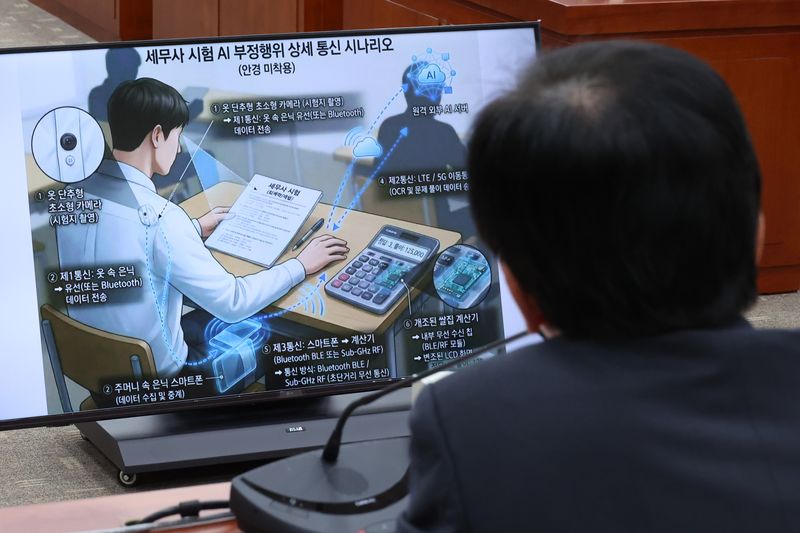
The discussion was prompted by the recent revelation that the top scorer on the tax accountant exam had cheated using a miniature camera, a smartphone and generative AI, evading the proctors' notice. As concerns grew that the fairness of the CSAT could be undermined, political circles also called for an immediate response.
At a plenary meeting of the National Assembly's Education Committee held that day, Education Minister Choi Kyo-jin responded to a question from Rep. Park Jeong-hun of the People Power Party, who asked, "Could measures be taken to block signals at CSAT test sites?" He said, "Today, I will consult with the Ministry of Science and ICT to find out whether this is possible, even for part of the exam period." He drew a line, however, at calls from some in political circles to postpone the CSAT, saying, "That could cause even greater confusion."
Deputy Education Minister Choi Eun-ok also said at the plenary meeting, "Without fundamentally blocking communications, it is difficult to detect 100% of cheating," adding, "We are consulting with the Ministry of Science and ICT on ways to prevent cheating using communications at the source, and the minister plans to announce final measures on the 17th, incorporating the results."
Disrupting 5G and LTE signals impossible due to legal and technical limits; plan settles on 'suspending Wi-Fi and collecting devices'
The government and telecom industry initially explored various options, including blocking Wi-Fi inside test sites, blocking 5G/LTE wireless data around test sites, and temporarily suspending mobile phone lines registered in test-takers' own names. However, during working-level discussions, they settled on excluding mobile network shutdowns.
First, there is no legal basis under current law. Article 29 of the Radio Waves Act allows the use of jamming devices only as an exception for highly limited public-safety purposes, such as military activities, counterterrorism, and responses to drones or explosives. Artificially disrupting signals to supervise an exam could therefore be illegal.
Technical and social side effects are also an obstacle. Telecom industry officials said it would be impossible to precisely cut off signals in only a specific area, given that test sites are located at schools near urban residential areas and commercial districts. Turning off nearby base stations or disrupting signals could simultaneously knock out phone and payment networks used by ordinary citizens within a radius of several hundred meters, as well as the 119 and 112 emergency call networks. Song Geun-hyeon, the Ministry of Education's director for university policy, also said that detection equipment such as radio-wave detectors, metal detectors and thermal cameras would be difficult to deploy in practice for this year's CSAT.
The government plans to announce on the 17th measures to temporarily suspend access to school and public Wi-Fi at test sites, collect all smart devices, including AI smart glasses, and substantially tighten checks of test-takers' belongings, including bag inspections.
"Can't stop workarounds using hotspots or phones registered to others"... Questions also raised about rushed measures just before the CSAT
Despite the government's preparations, people in the field and the telecom industry have raised doubts about the measures' effectiveness. Even if only school Wi-Fi is blocked, test-takers could secretly bring in smartphones and use their mobile network (5G/LTE) hotspot function to connect miniature cameras or AI smart glasses to external servers without any impediment. Some have also pointed out that it would be difficult to catch test-takers who secretly bring in a device registered in a parent's name or a separate SIM card, even if the line registered in the test-taker's own name is temporarily suspended.
A telecom industry official said, "With only three days to go before the CSAT, attempting untested controls on communications networks could cause even greater confusion due to unexpected network disruptions." The official added, "For now, we should focus on thoroughly collecting prohibited devices and carrying out supervision procedures. In the medium to long term, discussions are needed on improving the evaluation methods themselves to suit the AI era."
[email protected] Moon Young-jin Reporter