KOSPI Plunges 3.59% to 5,100; Foreign Investors and Institutions Net Sell 1.8 Trillion Won [fn Closing Market]
- Input
- 2026-11-16 15:55:54
- Updated
- 2026-11-16 16:12:22
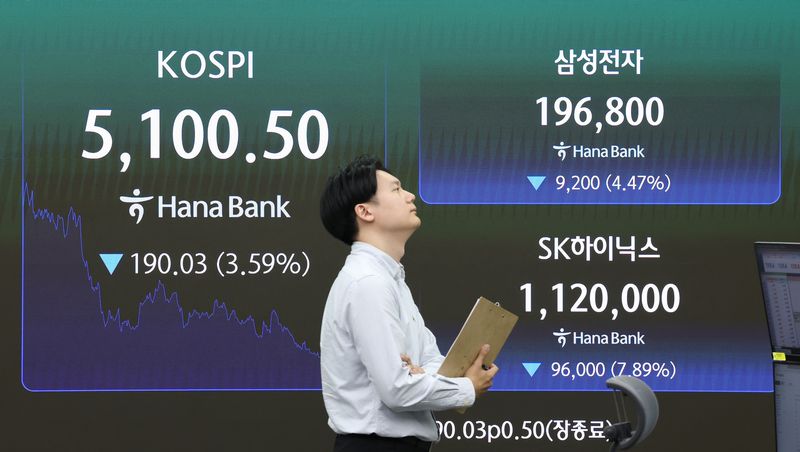
[Financial News] South Korea’s stock market plunged amid weakening investment sentiment toward artificial intelligence (AI) and joint selling by foreign investors and institutions. The KOSPI tried to rebound by reclaiming the 5,300 level early in the session, but failed to sustain its gains and turned lower.
The KOSDAQ also rose above the 700 level before quickly retreating, failing to rebound during the session. Individual investors made large net purchases in both markets but could not withstand the selling pressure from foreign investors and institutions.
According to the Korea Exchange (KRX), the KOSPI closed at 5,100.50 on the 16th, down 190.03 points (3.59%) from the previous trading day. The KOSDAQ fell 34.01 points (4.86%) to 665.65.
The KOSPI opened higher and reclaimed the 5,300 level early in the session, but soon turned lower. The KOSDAQ also traded above 700 briefly in the morning, but as selling intensified, it fell below 690 and then slid to the 660 level.
There were efforts to limit losses early in the session, but selling pressure grew as time passed, and neither of the two main indexes managed to break out of its weak trend.
Foreign investors’ selling stood out in terms of investor flows. Foreign investors’ selling stood out in terms of investor flows. In the KOSPI market, foreign investors were net sellers of 1.3842 trillion won, while institutions sold 462.6 billion won. Individuals, by contrast, were net buyers of 1.3515 trillion won, absorbing shares sold by foreign investors and institutions.
In the KOSDAQ market, foreign investors and institutions were net sellers of 211.3 billion won and 154.2 billion won, respectively, while individuals were net buyers of 377.1 billion won. Across both markets, individuals were net buyers of 1.7286 trillion won, while foreign investors were net sellers of 1.5955 trillion won and institutions of 616.8 billion won. Despite individuals’ large-scale buying, continued selling by foreign investors and institutions prevented them from stopping the indexes’ decline.
Most large-cap stocks with high market capitalizations also fell. Samsung Electronics Co., Ltd. closed at 196,700 won, down 9,300 won (4.51%) from the previous trading day, while SK hynix fell 39,000 won (3.36%) to 1,123,000 won.
SK Square plunged 9.84% and Samsung Electro-Mechanics fell 8.07%, as selling spread across the semiconductor value chain. Hanwha Aerospace also fell more than 4%, while major large-cap stocks including Doosan Enerbility and Samsung SDI were also weak. Samsung Biologics, by contrast, gained 0.35%, faring relatively well.
The market sees the deterioration in AI investment sentiment, which emerged mainly around U.S. technology stocks, as having affected domestic semiconductor stocks as well. In its global index futures report released today, Samsung Futures said AI investment sentiment had weakened following recent events related to technology stocks. It particularly noted the growing focus on the financing burden facing AI data center operators and uncertainty surrounding the so-called circular financing structure.
Analysts say concerns were heightened after CoreWeave said following its earnings announcement that it planned to raise $4 billion through investment-grade corporate bonds, and Nvidia-backed neocloud company Nebius mentioned the need for additional funding ahead of its initial public offering (IPO).
The explanation is that as investment in AI infrastructure continues to expand, questions about funding and profitability are mounting, once again bringing valuation concerns for related companies to the fore.
Jeong Hee-chan, a researcher at Samsung Futures, said concerns over uncertainty surrounding the circular financing structure spreading after Jensen Huang’s resignation also weighed on investor sentiment.
However, the researcher was cautious about interpreting this as a sharp increase in market-wide anxiety. Researcher Jeong said he judged that “market-wide anxiety had not increased significantly.”
NVIDIA’s earnings announcement scheduled for this week and developments related to Anthropic’s IPO are seen as factors that could determine the direction of AI investment sentiment. Researcher Jeong noted that it would be important to watch whether these events could lead to a recovery in AI investment sentiment.
The securities industry sees the domestic market’s sharp decline today as the result of renewed doubts about related companies’ financing and profitability, at a time when expectations for AI investment had risen.
An industry official said, “It is a concern that the indexes fell despite individuals absorbing a large volume of shares while foreign investors and institutions were selling,” adding, “Whether foreign selling, particularly in large-cap semiconductor stocks, eases and whether AI investment sentiment recovers on the back of NVIDIA’s earnings will determine the market’s direction going forward.”
[email protected] Kang Jung-mo Reporter