Korea-Japan Leaders to Meet in Manila on the 17th... Economic and Security Cooperation Expected to Be Discussed
- Input
- 2026-11-16 14:47:43
- Updated
- 2026-11-16 14:47:43
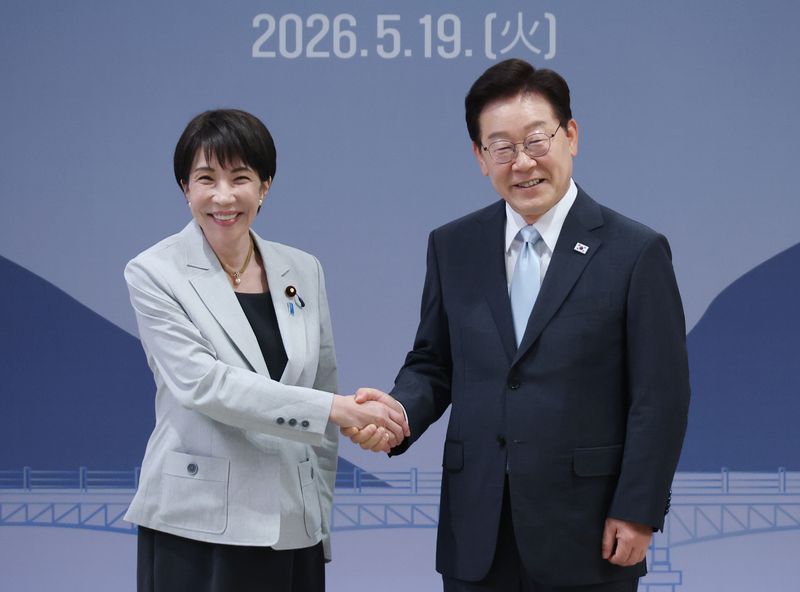
【Financial News, Tokyo = correspondent Seo Hye-jin】Japanese Prime Minister TAKAICHI Sanae and President Lee Jae Myung will hold bilateral talks in Manila, Philippines, on the afternoon of the 17th. The meeting comes about six months after they met in May in Andong, President Lee’s hometown, as part of shuttle diplomacy. The two leaders are expected to discuss economic, energy and security cooperation, as well as the rapidly changing international situation amid summits involving the United States, China and Russia.
Prime Minister Takaichi announced the schedule for her meeting with President Lee to reporters at the prime minister’s official residence before departing on the 16th to attend the ASEAN (Association of Southeast Asian Nations) summit and the Asia-Pacific Economic Cooperation (APEC) summit in Shenzhen, China.
The Mainichi Shimbun forecast that cooperation in the fields of economy, energy and security would be discussed at the Korea-Japan Summit. With U.S.-China and U.S.-China-Russia summits, among others, taking place on the occasion of the APEC summit, the two countries are also expected to share their views on them.
Prime Minister Takaichi said she also plans to hold separate talks with Philippine President Ferdinand Marcos Jr., Thai Prime Minister Anutin Charnvirakul and others, adding, “I will make sure to reaffirm our cooperative relationships” with those countries.
By contrast, the bilateral meeting schedule announced that day did not include a meeting with Chinese President Xi Jinping. With China-Japan relations strained since Prime Minister Takaichi’s remarks last year hinting at “intervention in the event of a Taiwan contingency,” a summit that Japan has been pursuing behind the scenes is unlikely to take place.
Kyodo News reported, “Although an official meeting between Prime Minister Takaichi, who will visit Shenzhen on the 18th, and President Xi is unlikely, the Japanese government plans to seek opportunities for dialogue with China.”
Whether meetings with U.S. President Donald Trump and Russian President Vladimir Putin will take place is also attracting attention. Japanese media reported that ahead of this multilateral summit, the Japanese government sounded out not only President Xi but also President Trump and President Putin about their willingness to meet.
The Japanese government is wary that its ally, the United States, could grow closer to China and Russia while relations with both countries remain strained. It has also been reported that, ahead of this multilateral diplomatic forum, Japan explained the Northeast Asian security situation to the United States and conveyed its concerns about closer ties among the United States, China and Russia.
There are also concerns in Japan that a U.S.-China-Russia summit could become a “second Yalta Conference,” where the reordering of the international order around the major powers is discussed. As at the Yalta Conference, where the leaders of the United States, Britain and the Soviet Union discussed the postwar international order in 1945, there is concern that issues affecting Japan’s security could be addressed without Japan’s participation.
Japan’s government spokesperson, Chief Cabinet Secretary Minoru Kihara, said at his regular press conference that day, “We are monitoring U.S.-China, U.S.-Russia, China-Russia and U.S.-China-Russia relations, taking into account their impact on the international situation.”
He went on to stress, “With the international situation changing rapidly and uncertainty growing further, a strong U.S.-Japan alliance is indispensable not only to maximize Japan’s national interests but also to ensure peace and stability in the international community.”
Meanwhile, Prime Minister Takaichi is also expected to emphasize Japan’s position on regional security and cooperation among allies and friendly countries at the Quad summit in Manila on the 17th, the first such meeting in two years. The Quad is a security consultation framework comprising the United States, Japan, Australia and India.
[email protected] Seo Hye-jin Reporter