Even After Demonstrating Smart Glasses, CSAT Measures Still Rely Only on 'Proctors' Eyes'
- Input
- 2026-11-16 15:04:52
- Updated
- 2026-11-16 15:04:52
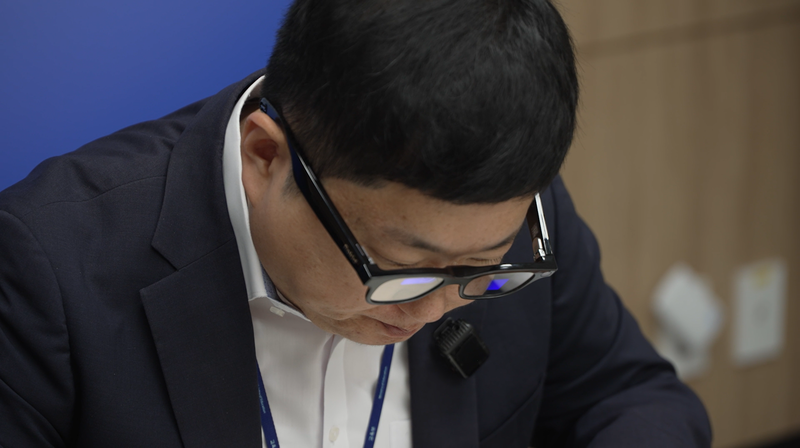
[Financial News] With three days to go before the 2027 College Scholastic Ability Test (CSAT), the Education Ministry unveiled actual smart glasses and announced measures to prevent cheating, but questions are being raised about their effectiveness. Although a new cheating method involving micro cameras and artificial intelligence (AI) was uncovered in a tax accountant exam, legal and practical constraints prevent signal jamming and body searches, leaving proctors with little choice but to rely on visual checks. The CSAT will go ahead as scheduled.
At a briefing on the 16th, the Education Ministry brought actual smart glasses to the venue and demonstrated the inspection procedures to be used at CSAT test sites on the 19th, emphasizing its determination to prevent cheating. The demonstration outlined how to check for distinguishing physical features, such as thick temples, a protruding camera on the lens, and a charging port, as well as behavioral signs that may appear when the device is operated.
After designating smart glasses as prohibited items in July, the Education Ministry will inspect every candidate’s glasses during every test session on the day of the CSAT. It will assign at least one dedicated staff member to each of the country’s 1,312 test sites; the staff will include supervisors, inspectors and teachers from provincial and metropolitan education offices. The ministry has also completed advance training to identify the devices using 54 actual pairs of smart glasses. All electronic devices will be switched off before the first session begins, placed in separate storage, and then secured at the test headquarters. Hallway proctors will carry handheld metal detectors and thoroughly screen people using the restrooms or displaying suspicious behavior.
The problem is that these measures alone may not be enough to ensure effective prevention. After it emerged that the top-scoring candidate in the tax accountant exam the previous day had used a micro camera and an earpiece hidden in clothing to send exam questions to an external AI system and write down the answers, criticism has mounted that checking glasses alone is insufficient to stop new methods. At the National Assembly’s Board of Education, lawmakers also continued to criticize the measures, warning that if candidates submit dummy phones and smuggle in the smartphones actually linked to the devices and micro cameras hidden on their bodies, visual checks alone cannot catch them.
Even so, it would be difficult to introduce more stringent physical measures to block cheating right away. Operating signal jammers at test sites is illegal under the current Radio Waves Act except for national security purposes, and could also disrupt emergency communications networks in nearby residential areas. Body searches of all candidates and inspections of all their belongings likewise lack a legal basis and could delay the entry of up to around 500 people per school and cause psychological distress, making them impractical.
The Education Ministry has now belatedly begun preparing additional measures. At a plenary meeting of the National Assembly’s Board of Education that day, Minister of Education Choi Kyo-jin said in a briefing on pending issues, “New methods are emerging in connection with cheating on the tax accountant exam that we had not thought of before.” He added, “I will consult with relevant ministries, including the Ministry of Science and ICT, prepare additional measures by tomorrow, and report back.”
He ruled out the possibility of postponing the exam, saying, “With the test papers being transported from the printing plant to the provincial and metropolitan education offices today, the 2027 College Scholastic Ability Test has effectively begun.” Earlier that day, Shin Jin-yong, director of the Education Ministry’s College Admissions Policy Division, also stated firmly at a briefing at the government complex in Sejong, “There will be no postponement of the CSAT.”
[email protected] Kim Man-gi Reporter